
Queensland has more rooftop solar than any other state, with more than 1.1 million small-scale systems installed. In 2026 there’s no state rebate for most households. What you can get is the federal solar discount, the federal battery discount of around 30%, and a free three-hour power window on Solar Sharer plans.
This guide covers what each incentive is worth, what solar costs in Queensland right now, feed-in tariffs in the south-east and the regions, and how to compare installers.
QLD at a glance (2026-27)
South East QLD (Energex) | Regional QLD (Ergon) | |
|---|---|---|
State solar rebate for homeowners | None | None |
Federal solar discount (STCs) | Yes, taken off your quote | Yes, taken off your quote |
Federal battery discount | Around 30%, up to $2,720 on a 10 kWh battery (installed May–Dec 2026) | Same |
Landlord solar rebate | Up to $3,500 (Supercharged Solar for Renters) | Same |
Feed-in tariff | Set by retailers, roughly 0–10c/kWh | Fixed at 6.006c/kWh |
Free midday power | Solar Sharer Offer, 11am–2pm | Solar Sharer tariff, 11am–2pm |
Typical 6.6 kW system cost | About $6,500–$6,700 (Brisbane) | Varies by town; ask local installers |
44c Solar Bonus Scheme | Ends 1 July 2028 (closed to new customers since 2012) | Same |
Not sure which network you’re on? If your poles and wires are run by Energex, you’re in South East Queensland. That network runs from the NSW border north to Gympie and west to the foot of the Great Dividing Range, taking in Brisbane, the Gold Coast and the Sunshine Coast. Toowoomba, Cairns, Townsville, Mackay and the rest of regional Queensland are on Ergon.
Is solar worth it in QLD?
For most Queensland homes, yes. A typical 6.6 kW system in Brisbane pays for itself in about five years, then keeps cutting your bills for another 15 or more.
How much power will solar panels make in QLD?
The Clean Energy Council’s guide figure for Brisbane is 4.2 kWh per day for every kW of panels, averaged over the year. A 6.6 kW system makes about 27.7 kWh a day. That’s more than double what an average household uses.
North Queensland gets similar or slightly higher yearly output. It’s sunnier through the dry season and drops during the wet. Panels face north for the best year-round result, and east-west layouts work well if you use most of your power in the morning and late afternoon.
How much does solar cost in QLD?
These are average installed prices in Brisbane, including the federal STC discount and GST.
System size | Standard system | Premium system |
|---|---|---|
3 kW | $4,120 | $4,910 |
4 kW | $4,850 | $5,710 |
5 kW | $5,540 | $6,520 |
6 kW | $6,200 | $7,320 |
7 kW | $7,080 | $8,330 |
10 kW | $9,350 | $11,000 |
Source: Solar Choice Price Index, 1 November 2026. Your price will depend on your roof, your installer and the products you choose. Use these figures as a guide only.
Premium systems use higher-efficiency panels and branded inverters, and usually come with longer warranties. Regional prices can sit above Brisbane’s because of travel and freight, so get quotes from installers who work in your area.
Worked example: a 6.6 kW system in Brisbane
Figure | |
|---|---|
System cost (standard, after STCs) | About $6,600 |
Solar generated per year | 10,118 kWh (27.7 kWh a day) |
Household use per year | 4,600 kWh (the AER’s benchmark home on the Energex network) |
Solar used in the home | 3,035 kWh (30% of generation) |
Solar exported | 7,083 kWh |
Saving on power bought at 30c/kWh | $911 a year |
Feed-in credits at 6c/kWh | $425 a year |
Total yearly benefit | About $1,336 |
Simple payback | About 4.9 years |
Assumptions: 30c/kWh usage rate and 6c/kWh feed-in tariff, both typical for Energex market offers in late 2026. No battery. If you work from home, run a pool pump or charge an EV during the day, you’ll use more of your own solar and pay it off faster.
To run the numbers for your own home, try the solar and battery calculator.
QLD solar and battery rebates in 2026
Queensland homeowners rely on two federal schemes: one for solar panels and one for batteries. Landlords can also claim a state rebate for putting solar on a rental.
Incentive | Who it’s for | What it’s worth | Status |
|---|---|---|---|
Federal solar discount (STCs) | Homes and small businesses | About $1,700 on a 6.6 kW system in Brisbane | Open; shrinks every year to 2030 |
Cheaper Home Batteries Program | Homes and businesses with solar | Around 30%, up to $2,720 on 10 kWh | Open; steps down every six months |
Supercharged Solar for Renters | Landlords | $2,500–$3,500 | Open until funds run out |
Battery Booster | Households | Was up to $4,000 |
Federal solar discount (STCs)
When you install solar, your system creates small-scale technology certificates (STCs). Nearly every installer takes these as a discount on your quote, so you don’t need to apply for anything.
The number of certificates depends on your system size, where you live and the year you install. Brisbane sits in STC zone 3. A 6.6 kW system installed there in 2026 creates about 45 certificates, worth roughly $1,700 at $38 each. The deeming period drops by a year every January, so the same system will earn fewer certificates in 2027.
Federal battery rebate (Cheaper Home Batteries Program)
The federal battery rebate takes around 30% off an eligible home battery. Like the solar discount, it comes off your quote at the point of sale.
- The battery must connect to new or existing solar panels.
- It must be on the approved list and installed by a Solar Accreditation Australia (SAA) accredited installer.
- It must be able to join a virtual power plant (VPP), though you don’t have to join one.
- Since 1 May 2026, the full rate applies to the first 14 kWh of usable capacity, 60% to 14–28 kWh, and 15% to 28–50 kWh.
The rate falls every six months until the program ends in 2030. The next drop is on 1 January 2027. See the battery section below for what that means in dollars.
Supercharged Solar for Renters
Queensland landlords can claim up to $3,500 from the state government for installing solar on a rental property. The program opened on 12 December 2025 and stacks with the federal STC discount.
System size | Rebate |
|---|---|
3 kW to under 4 kW | $2,500 |
4 kW to under 5 kW | $3,000 |
5 kW or more | $3,500 |
The property needs a current tenancy, no existing solar, and a rent of $1,000 a week or less. You must get conditional approval before installation. Read our Supercharged Solar for Renters guide for the full rules.
Rebates for businesses
Queensland businesses get the same federal solar and battery discounts. Systems up to 1 MW can now claim STCs. See commercial solar rebates and incentives for the details.
QLD solar feed-in tariffs in 2026-27
Queensland runs two feed-in tariff systems. In the south-east, retailers set their own rates. In the regions, the Queensland Competition Authority (QCA) sets one flat rate that everyone gets.
Regional Queensland (Ergon)
The regional feed-in tariff is 6.006c/kWh from 1 July 2026. That’s 31% lower than last year, and less than half the rate of two years ago.
Year | Regional QLD feed-in tariff |
|---|---|
2024-25 | 12.377c/kWh |
2025-26 | 8.660c/kWh |
2026-27 | 6.006c/kWh |
Source: QCA final determination, June 2026.
South East Queensland (Energex)
There’s no minimum feed-in tariff in the south-east. Market rates mostly sit between 0c and 10c/kWh, and the highest rates usually come with higher usage charges. Check the whole plan, not just the export rate.
Is a high feed-in tariff the best plan?
Not always. Every kWh you use yourself saves you around 30c, while every kWh you export earns you 6–10c. Running the dishwasher, washing machine or pool pump in the middle of the day is usually worth more than chasing a higher tariff. Use our energy comparison tool to compare plans in your postcode.
See the full breakdown on our QLD feed-in tariff page.
The 44c Solar Bonus Scheme ends in 2028
Households who joined the Solar Bonus Scheme before 10 July 2012 still get 44c/kWh for exports. The scheme is legislated to end on 1 July 2028. After that, those homes will drop to a standard feed-in tariff, so many are now planning a battery or a system upgrade. Read what happens when the 44c tariff ends.
Electricity in QLD: networks, prices and free midday power
Who supplies your power?
Energex runs the network in South East Queensland, where you can choose from dozens of retailers. Ergon runs the network everywhere else. In most of regional Queensland, Ergon Energy Retail is your only retailer, and the QCA sets the prices it can charge.
Under the state’s uniform tariff policy, regional households pay roughly the same rates as the south-east, even though it costs more to supply them.
QLD electricity prices in 2026-27
The Default Market Offer (DMO) caps what retailers can charge on standing offers in the south-east. From 1 July 2026, the benchmark annual bill on the Energex network fell:
Energex plan type | 2025-26 | 2026-27 | Change |
|---|---|---|---|
Flat rate | $2,143 | $1,988 | -7.2% |
Time of use | $2,143 | $1,914 | -10.7% |
Based on 4,600 kWh a year. Source: AER Default Market Offer 2026-27.
The DMO is a ceiling, not a good deal. Most market offers are cheaper, so it pays to compare.
The Solar Sharer Offer: free power from 11am to 2pm
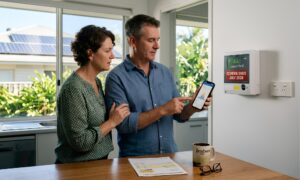
Since 1 July 2026, Queensland households with a smart meter can choose a plan with three hours of free electricity every day, from 11am to 2pm (up to 24 kWh).
- South East QLD: every retailer with more than 1,000 customers must offer it.
- Regional QLD: the QCA approved a matching Solar Sharer tariff for Ergon customers on standard contracts.
You don’t need solar panels to sign up. The catch is that power outside the free window usually costs more than on a standard plan. It suits homes that can run appliances, charge an EV or top up a battery in the middle of the day. If you already have solar, your panels are covering that window anyway, so compare carefully.
Rules for new solar inverters
New and upgraded solar systems in Queensland must allow the network to reduce or switch off exports remotely in a grid emergency, under the state’s emergency backstop rules. It rarely happens, and your installer handles the setup and network approval.
Solar batteries in QLD
With feed-in tariffs at 6–10c and grid power around 30c, storing your solar is now worth three to five times more than exporting it.
A home battery stores the solar you don’t use during the day and runs your home in the evening. Most Queensland homes choose 10–13.5 kWh, which typically costs $8,000–$15,000 installed before the federal discount.
What the federal discount is worth by battery size
Usable capacity | Discount if installed May–Dec 2026 | Discount if installed Jan–Jun 2027 |
|---|---|---|
5 kWh | Up to $1,360 | Up to $1,120 |
10 kWh | Up to $2,720 | Up to $2,280 |
13.5 kWh | Up to $3,640 | Up to $3,040 |
20 kWh | Up to $4,760 | Up to $4,000 |
Maximum values at $40 per certificate. Actual discounts are usually a little lower because certificates trade at market prices.
The discount drops every six months
A 10 kWh battery’s discount falls from $2,720 now to $840 by late 2030.
The discount you get depends on the day your battery is installed, not the day you sign the contract. Waiting from December to January costs $440 on a 10 kWh battery.
Should you join a virtual power plant?
A virtual power plant (VPP) lets your retailer draw on your battery when the grid is under pressure, and pays you for it in credits or bill discounts. Every battery claiming the federal rebate must be VPP-ready, but joining is optional. Find out how a VPP works before you sign up, and check how much of your battery the retailer can use.
Off-grid solar in regional QLD
Off-grid solar runs a home or farm with no connection to the electricity network. It’s common on rural Queensland properties where a new grid connection would cost more than the system itself.
An off-grid system has four main parts:
- Solar panels to generate power during the day
- A battery bank sized to carry you through the night and a few cloudy days
- An off-grid inverter to turn stored DC power into AC for your appliances
- A backup generator for long stretches of wet-season cloud
Sizing matters more off-grid than on-grid, because there’s no network to fall back on. A good installer will work through your daily load, your worst-case winter or wet-season output, and how many days of storage you need.
Off-grid batteries can claim the federal battery discount too, and they don’t need to be VPP-ready. The property generally needs to be at least 1 km from the grid, or face a grid connection cost above $30,000. Your installer can confirm whether you qualify.
Learn more about off-grid solar systems, see what an off-grid system costs, or read our guide to designing an off-grid system for Australian conditions.
Finding a solar and battery installer in QLD
Queensland has hundreds of solar installers, and quotes for the same home can differ by thousands of dollars. Getting three quotes is the simplest way to see what a fair price looks like.
Energy Matters connects you with up to three pre-vetted installers in your area. They’ll contact you by phone or email with a system design and price, and you choose whether to go ahead.
Work out what you need first
- Your energy use. Check your last few bills for your average daily usage.
- Your roof. North-facing with little shade is ideal. East and west roofs still work well.
- Future plans. An EV, pool, heat pump or home extension will all push your usage up, so size for where you’ll be in five years.
- A battery now or later. If you want one later, ask for a battery-ready (hybrid) inverter.
What to check before you sign
- The installer is accredited by Solar Accreditation Australia (SAA)
- The retailer is a New Energy Tech Approved Seller
- The quote names the panel, inverter and battery brands and models
- The quote shows the number of STCs and the price per certificate
- Panel, inverter, battery and workmanship warranties are written down
- Someone came to see your roof, or used detailed aerial imagery, before quoting
- Network approval and any export limit are explained
- You know who to call for service in five years’ time
Read our guides to Australian standards for solar installations and what Tier 1 solar panels really means, or download the free solar consumer guide.
Solar in QLD cities and regions
Find local prices, output and installers for your area:
South East QLD (Energex) | Regional QLD (Ergon) |
|---|---|
|
Live somewhere else in Queensland? Whether you’re in Bundaberg, Hervey Bay, Rockhampton or out west, the same rebates and tariffs above apply. Request quotes and we’ll match you with installers who service your postcode.
QLD solar and battery FAQs
Is there a QLD solar rebate in 2026?
Not for owner-occupiers. Queensland homeowners get the federal STC discount, which comes off your installer’s quote. Landlords can also claim up to $3,500 through the state’s Supercharged Solar for Renters program.
Is there a QLD battery rebate in 2026?
There’s no state battery rebate. The Battery Booster program closed in May 2024. Queensland households can use the federal Cheaper Home Batteries Program instead, which takes around 30% off an eligible battery.
How much is the battery rebate in QLD?
For a battery installed between May and December 2026, the federal discount is up to $2,720 on a 10 kWh battery and up to $3,640 on a 13.5 kWh battery. It drops on 1 January 2027 and every six months after that until 2030.
Do I need solar panels to get the battery rebate?
Yes. The battery has to connect to a new or existing solar system. A battery that only charges from the grid doesn’t qualify.
What is the feed-in tariff in QLD?
In regional Queensland it’s a flat 6.006c/kWh for 2026-27. In South East Queensland there’s no set rate; retailers set their own, mostly between 0c and 10c/kWh.
What happens when the 44c Solar Bonus Scheme ends?
The scheme ends on 1 July 2028. Households still on it will move to their retailer’s standard feed-in tariff. Many are adding a battery before then so they can use their solar at night instead of exporting it for much less.
What is the Solar Sharer Offer?
It’s an electricity plan with free power from 11am to 2pm every day, up to 24 kWh. It’s available across South East Queensland and, through a matching QCA tariff, to Ergon customers on standard contracts in regional Queensland. You need a smart meter.
How much does a 6.6 kW solar system cost in QLD?
In Brisbane, a standard 6.6 kW system costs about $6,500–$6,700 installed after the STC discount. Premium systems cost 20–30% more.
How long does solar take to pay for itself in QLD?
About five years for a typical Brisbane home with a 6.6 kW system. Homes that use more power during the day pay theirs off faster.
Can renters get solar in QLD?
Renters can’t claim the Supercharged Solar for Renters rebate themselves, but their landlord can. Renters with a smart meter can also sign up for a Solar Sharer plan and get free power in the middle of the day.
Is off-grid solar worth it in Queensland?
It can be on rural properties where a grid connection is expensive or unavailable. Off-grid batteries can claim the federal battery discount if the property meets the distance or connection-cost rules.
How do I find a good solar installer in QLD?
Check they’re SAA accredited, that the retailer is a New Energy Tech Approved Seller, and that the quote lists brands, warranties and STC details. Compare at least three quotes. Energy Matters can connect you with up to three pre-vetted local installers.
QLD news and updates
Keep up to date with the latest renewable news and updates from Queensland.