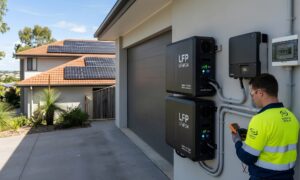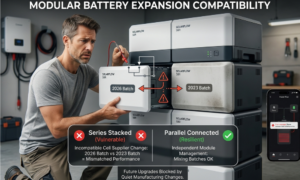






In April 2026, Australia’s home battery subsidy was on track to blow through its budget years ahead of schedule. Households were piling into oversized systems, installers were happy to sell them, and the numbers showed it: registered storage volume hit a peak of 2.43 gigawatt-hours in a single month. Something had to give.
By July, the picture looked completely different. Average system sizes had roughly halved. The most popular battery size band had shifted down a full tier. And yet, the overall market didn’t slow down. Installations were still running at close to three times the rate seen when the scheme first launched a year earlier.
That combination is rare enough to be worth a closer look: a subsidy that got reined in without losing its audience. Here’s how it happened, and why it matters beyond batteries.
Quick summary
- Australia’s home battery rebate shifted from a flat ~30% discount to a tiered taper in May 2026: full discount up to 14kWh, 60% of that rate for 14–28kWh, and just 15% for 28–50kWh.
- Average battery system size has roughly halved since the change, with the 20–30kWh band overtaking 40–50kWh as the most-installed size.
- Despite the correction, demand hasn’t dropped. Installs are still running at ~3x the rate seen when the scheme launched, with ~2,000 new systems going in every week.
- It’s a rare example of a subsidy taper reshaping what people buy without reducing how many people buy; a template other flat-rate subsidy schemes (EVs, solar, heat pumps) could learn from.
The problem: a flat discount rewards going big
When federal Labor’s Cheaper Home Batteries scheme launched in mid-2025, the discount was simple: roughly 30% off the up-front cost of a home battery system, regardless of size. That simplicity was probably good for uptake in the early months, but it created an obvious distortion: the bigger the system, the bigger the absolute discount. For households (and the installers pitching to them), there was little financial reason to size a battery to actual household need rather than to the ceiling of what the rebate would subsidise.
The result was a wave of super-sized installations (systems of 50kWh and beyond) that chewed through the scheme’s four-year, $2.3 billion budget at a pace that wasn’t going to last. April’s 2.43 GWh of registered capacity was the high-water mark, and also the last month the scheme ran on its original settings.
The fix: a taper, not a cliff
Rather than capping system size outright or scrapping the discount structure, the government reshaped the incentive by tier. From May, the settings became:
- Up to 14kWh — the full ~30% discount
- 14–28kWh — 60% of that discount rate
- 28–50kWh — 15% of that discount rate
This is a meaningfully different policy instrument than either of the two blunter options available. A hard size cap would have simply excluded larger systems from support altogether; politically risky, and arguably unfair to households with genuinely higher energy needs. Scrapping or slashing the whole rebate would have hit demand across the board, including the “right-sized” installs the scheme was supposed to encourage in the first place. The taper did neither. It let the discount curve do the work: still meaningful support at every size, but a shrinking financial case for going oversized.
Did it work? The data says yes… so far
Three months in, the evidence is fairly clear. According to SunWiz’s July market update, average battery system size has fallen by roughly half from its April peak. The 20–30kWh band, comfortably inside the “60% discount” tier, grew 18% month-on-month and overtook the 40–50kWh band as the largest size segment by volume. The 40–50kWh segment, by contrast, fell 23% over the same period.
Crucially, none of this came at the cost of overall demand. Installation volumes are still running at roughly three times the rate recorded in the scheme’s first months, with new systems going in at a pace of around 2,000 a week nationally. More than 490,000 systems had been installed under the rebate by the end of July, on track to cross the half-million mark within weeks.
That’s the part that makes this a genuine policy success rather than just a cooling-off: the taper changed what people bought, not whether they bought.
Why this matters beyond batteries
Subsidy design usually gets discussed in binary terms, either the incentive is “too generous” (and gets cut) or “not generous enough” (and gets expanded). What the battery rebate shows is a third option: shaping the distribution of spend rather than the total level of it. A tiered taper can push consumer behaviour toward a policy-preferred outcome. In this case, appropriately sized systems relative to typical household consumption while still preserving broad-based demand.
That’s a template worth watching for other subsidy schemes prone to the same distortion: electric vehicles (where flat rebates can favour larger, pricier models), rooftop solar (oversized arrays), and heat pumps (oversized units chasing maximum rebate capture). Anywhere a subsidy is priced as a flat percentage of cost, there’s a structural incentive to buy bigger than you need. A taper breaks that link without breaking the incentive altogether.
Expert tip: If you’re weighing up a home battery purchase under the current settings, the 14kWh and 28kWh thresholds are the numbers that matter most, not the sticker price. A system just over 28kWh drops into the lowest discount tier (15%), so the effective cost-per-kWh can jump sharply right at that line. Before sizing up, run the math on your actual daily household consumption (check 12 months of bills, not just peak summer usage) rather than sizing to the top of a discount band. Installers are incentivised to sell bigger; the rebate tiers are specifically designed to make that a worse deal for you than it used to be.
Caveats worth flagging
It’s early. Three months of post-change data is encouraging, not conclusive, and a few open questions are worth watching:
- Budget runway. Even with smaller average systems, it’s not yet clear whether current spend is sustainable across the scheme’s remaining life, or whether this is simply a slower burn toward the same ceiling.
- Threshold gaming. Tiered incentives create obvious edges; the 14kWh and 28kWh cutoffs and it’s worth watching whether installs start clustering suspiciously close to those lines rather than reflecting genuine household sizing.
- Installer economics. A market built around smaller average system sizes may mean thinner per-job margins for installers, even as total install volume holds up. That could shape how aggressively the industry pushes back on the tiered structure over time.





The takeaway
Good subsidy design isn’t just a dial between “more” and “less.” It’s also about where the money flows once it’s spent. Australia’s home battery rebate is a live example of a government using tier design to correct a market distortion mid-scheme, without triggering the demand collapse that cruder interventions usually cause. For policymakers watching subsidy-driven distortions in other sectors, this is worth a much closer look than it’s currently getting.