
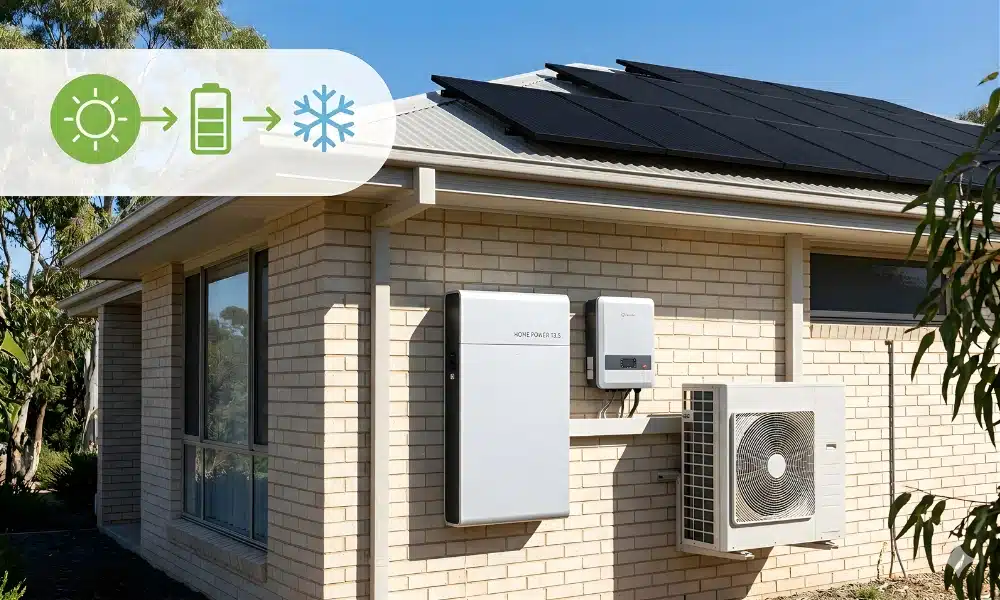
Can solar batteries and air conditioning systems in Australia really work together? Many homeowners want to know if a solar battery can run their AC and cut their energy bills.
With rising electricity costs, combining solar power with battery storage and air conditioning is becoming more popular. This guide explains what works, what doesn’t, and how to choose the right system.
The reality of running AC on solar power with battery storage
It is a common myth that solar panels alone are enough to keep you cool around the clock. While panels work great during the day, solar power with a battery storage system is what changes the game for evening use. Without a battery, your AC switches back to the expensive grid the moment the sun goes down.
Most modern inverter air conditioners are quite efficient, but they still require a steady power supply. A standard split-system unit might draw between 600W and 2.5kW, depending on its size and the temperature outside. To keep this running after dark, your solar battery storage system must be robust enough to handle the “surge” when the compressor starts.
Why sizing matters for your cooling needs
The biggest hurdle for most homeowners is choosing the correct solar battery size. If your battery is too small, your AC might drain it in just two or three hours. If it is too large, you might never fully charge it during the day, leading to a poor return on investment.
Ideally, you want a system that balances your daytime generation with your evening consumption. This ensures that you aren’t just “buying a gadget,” but rather building a functional power plant for your home.
Don’t let another heatwave drain your bank account! Use the Energy Matters Solar & Battery Calculator to find the perfect system for your home and start saving immediately.


What size battery do I need for my house and AC?
If you are asking, “What size battery do I need for my house?” you must first look at your AC’s label. Air conditioners are rated by their cooling capacity, but you need to find the “input power” in kilowatts (kW). This tells you exactly how much electricity the unit pulls from your system every hour.
For a typical Australian three-bedroom home, here is how the sizing usually breaks down:
- Small homes (1-2 bedrooms): A 5kWh to 7kWh battery may support a small split-system for a few hours of evening cooling.
- Average family homes: A 10kWh to 14kWh battery is often the “sweet spot.”
- Large homes with ducted AC: You will likely need 20kWh or more, often requiring multiple batteries stacked together.
Use Energy Matters’ easy-to-use solar power and battery storage calculator to determine the size of your solar system with storage! Our solar calculator will generate performance information and potential savings.
We can send this information to 3 of our pre-vetted, trusted local installers in your area to receive obligation-free solar quotes and take the first step toward true energy independence!

Calculating your runtime
To get a rough estimate, divide your battery’s usable capacity by the AC’s hourly draw. If you have a 13.5kWh battery and a 1.5kW air conditioner, it could theoretically run for about 9 hours. However, remember that other appliances, like your fridge and lights, will also be “sipping” from the same energy pool.
Maximising efficiency: Tips for solar-powered cooling
To make solar batteries & air-conditioning work effectively, you need a strategy. You cannot simply set the thermostat to 18°C and hope for the best. Smart energy management is the key to making your stored power last through the night.
1. Pre-cool your home
Run your air conditioner during the day while the sun is shining. This uses direct solar power rather than draining your battery later. By cooling your walls and furniture during the day, the AC won’t have to work as hard at night.
2. Set realistic temperatures
Every degree lower increases your energy consumption by about 10%. Setting your AC to 24°C in summer is usually the most efficient balance between comfort and battery life. It keeps the humidity down without killing your storage capacity.
3. Maintain your hardware
Dirty filters make your AC work harder and draw more power. Clean your filters every month during peak season to ensure you aren’t wasting precious battery energy on a struggling motor.
The tech behind the power: LFP vs. NMC batteries
When considering a solar battery’s size, the chemistry inside the box matters just as much as the capacity. Most modern batteries in Australia use either Lithium Iron Phosphate (LFP) or Nickel Manganese Cobalt (NMC).
LFP batteries are becoming the standard for Australian homes because they handle heat exceptionally well. Since our summers can reach 40°C+, having a battery that won’t degrade in the heat is vital for running heavy loads like air conditioning.
Advantages of modern battery systems
- High cycle life: Many 2026 models offer 6,000 to 10,000 cycles, lasting over 10 years.
- Modular design: You can start with one battery and add another later if your AC needs grow.
- Smart apps: Real-time monitoring allows you to see exactly how much power your AC is using.

So, can solar batteries and air conditioning systems work together?
Yes—but only with the right setup. Choosing the correct solar battery size, understanding your usage, and managing expectations are key.
Is it worth the investment? The short answer is yes—if you plan to stay in your home for at least 5-7 years. The combination of solar power with battery storage provides a “buffer” against rising utility rates. As electricity prices fluctuate, your “free” stored energy stays at the same price.
Furthermore, having a battery provides peace of mind during blackouts. While your neighbours sit in the dark during a summer storm, your battery can keep your bedroom AC and fridge running.
Take control of your energy today. Talk to Energy Matters and get expert advice on the best solar battery system for your home. Start saving on your cooling costs now!