






A new palm-sized radar scanning unit capable of detecting minute defects in the composition of wind turbine blades could save the global wind power sector millions in production and maintenance costs, according to its German developers.
Scientists from the Fraunhofer Institute for Applied Solid State Physics say their radar-based technology provides manufacturers with a far more accurate solution to identifying weak points in turbine blades than current methods such as ultrasound.
Designed to withstand the enormous force of extreme winds or impacts from debris, wind turbine blades are made from glass fibre and carbon fibre reinforced plastics, which allows them to flex and torque without breaking. A single blade is usually composed of up to 100 sheets of glass fibre webbing that are layered on top of each other, shaped and then glued together with epoxy resin.
A defect at this stage of manufacture can lead to hundreds of thousands of dollars in unplanned maintenance over the life of a wind turbine, explains Dr Axel Hülsmann, coordinator of the radar project and group manager of sensor systems at Fraunhofer IAF.
“The difficulty lies in layering the glass fibre sheets flat before they are glued, without creating undulations and folds, and avoiding the formation of lumps of resin or sections of laminate which don’t set when applying the epoxy,” he says.
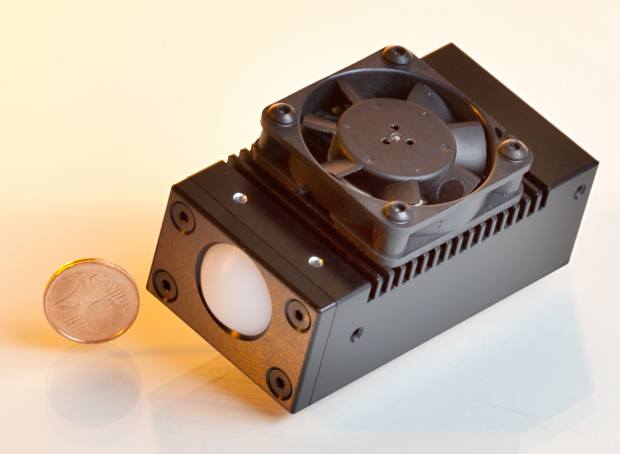
The Fraunhofer module uses high frequency radar to generate a cross-sectional image of each blade and identifies defects down to the millimetre range, which “makes our material scanner significantly more accurate than conventional methods,” says Dr Hülsmann.
Measuring 42 x 28 x 79 mm, and weighing just 160 grams, the diminutive scanner could also be used adapted for use in maintenance work on wind farm or offshore platforms where conducting delicate ultrasound testing on a rotating turbine is unfeasible.
“Currently, the routine testing of rotor blades is mainly performed by hand: an expert knocks on the blade with a hammer and can tell from the tone whether there are any defects in that section,” Hülsmann says.
“An automated solution, supplemented by our radar technology, could vastly reduce the downtime of wind turbines and thus save costs.”
Trivia : the world’s largest wind turbine blade (as at June last year), is 88.4 metres long.