





Australian households installed more than 284,000 home batteries in the ten months to May 2026, up over 200 per cent from what was installed before the federal rebate arrived. If you are shopping for home battery systems, the chemistry inside the cabinet deserves as much attention as the price on the quote.
The LFP vs NMC battery Australia question comes down to one thing: how each chemistry behaves when something goes wrong. Heat, physical damage or a single faulty cell can trigger very different outcomes.
This guide covers thermal behaviour, lifespan, real 2026 pricing, rebates and the installation rules that apply in your state. Compare your options with Energy Matters and get free quotes from SAA-accredited installers today.
Key takeaways
- LFP is the safer chemistry for home storage, with a thermal runaway threshold roughly 60 to 120 degrees Celsius higher than NMC and minimal oxygen release during failure.
- NMC still wins on energy density, making it the right choice for electric vehicles and genuinely space-constrained installations.
- LFP delivers 3,000 to 6,000 cycles against 1,000 to 2,500 for NMC, so it usually costs less per stored kilowatt-hour over its life.
- Installation standards like AS/NZS 5139 matter as much as chemistry. Location, clearances, and accredited installation keep any battery safe.
- The federal rebate is chemistry-neutral and steps down again on 1 January 2027, so timing your install has real dollar value.



What is LFP vs NMC battery chemistry and why does it matter for Australian homes?
Every lithium battery has a cathode, and the metals in that cathode define the cell’s personality. LFP and NMC are the two cathode recipes you will see on almost every Australian residential quote.
LFP uses iron and phosphate. NMC uses nickel, manganese and cobalt. That single difference drives safety, lifespan, size and price.
Key terminology
- LFP (LiFePO4): Lithium iron phosphate. A cobalt-free chemistry known for thermal stability and long cycle life. Sometimes written as a LiFePO4 battery on product sheets.
- NMC: Nickel-manganese-cobalt. A high-energy-density chemistry that stores more kilowatt-hours per kilogram.
- Thermal runaway: A self-feeding chain reaction in which a cell heats, vents, and ignites neighbouring cells.
- Cycle life: How many full charge and discharge cycles the battery delivers before capacity drops to around 60 to 70 per cent.
- Usable capacity: The kilowatt-hours you can actually draw, which the federal rebate is calculated on.
Why it matters in 2026
Battery uptake has outrun public understanding of battery safety. Fire and Rescue NSW recorded 332 lithium-ion incidents in 2025, up from 323 in 2024 and 272 in 2023.
Almost all involved e-bikes, e-scooters, power tools, and cheap chargers, not professionally installed storage. Residential battery energy storage systems remain one of the lowest-risk lithium products in the home, with NSW recording only three such fires in 2023 across more than 57,000 installed units.
Chemistry still matters because it sets the margin for error. A safer chemistry gives your battery management system more room to intervene before anything becomes dangerous.
Expert tip
If an installer cannot tell you the cell chemistry, cycle rating and warranty throughput of the battery they are quoting, treat that as a red flag. Every Clean Energy Council-approved product publishes these figures.
How LFP vs NMC battery chemistry works in Australia
Step-by-step: What happens inside the cell
- Charging: Lithium ions move from the cathode to the graphite anode and sit there until you need them.
- Discharging: The ions travel back, releasing electrons that power your home through the inverter.
- Under stress: Heat, overcharging, or damage can break down the cathode structure and release energy as heat.
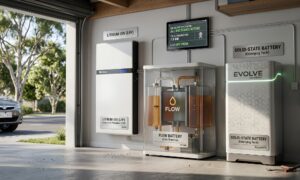
- The divergence: An LFP cathode holds its olivine structure to around 270 degrees Celsius and releases very little oxygen. An NMC cathode starts decomposing between roughly 150 and 210 degrees and releases oxygen, which feeds the fire.
- The result: Independent 2026 testing found thermal runaway roughly 80 per cent less likely in LFP cells under equivalent abuse conditions.
Real-world examples
Tesla moved its Powerwall home storage range to LFP precisely because the product sits on a garage wall inside a family home. BYD, Sungrow, Sigenergy and most mainstream Australian storage brands have done the same.
NMC still dominates in electric vehicles (EVs), where every kilogram of pack weight costs driving range. In a stationary home battery, weight doesn’t matter the way it does in a car.
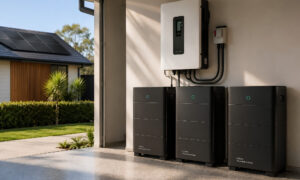
The practical upshot for LFP battery safety is that a garage-mounted LFP unit in a Queensland summer has a much larger thermal buffer than an NMC battery home installation in the same spot. Check our page for our recommended solar battery products.
Expert tip
Australian rooftop cavities and west-facing brick walls routinely exceed 50°C in summer. Ask your installer to model the ambient temperature at the exact mounting location, not the garage average.
Costs and savings
Upfront costs
LFP now costs less per kilowatt-hour than NMC in the Australian market, reversing the position from five years ago. Higher production volumes and the absence of cobalt have driven the price down.
The figures below reflect average installed pricing in Australia as at mid-2026, including the federal rebate.
| Usable capacity | Installed price before rebate | Federal rebate applied | Typical price after rebate |
| 5 kWh | $7,400 | $1,260 | $6,140 |
| 10 kWh | $11,400 | $2,520 | $8,880 |
| 13.5 kWh | $13,900 | $3,402 | $10,498 |
| 20 kWh | $18,500 | $4,427 | $14,073 |
| 27 kWh | $25,850 | $6,804 | $19,046 |
Figures are indicative national averages as at mid-2026 and vary by brand, site complexity and Small-scale Technology Certificates (STCs) price.
Savings calculation
Grid electricity costs most Australian households between 27 and 45 cents per kilowatt-hour, while solar feed-in tariffs have fallen to roughly 3 to 8 cents in 2026. A battery closes that gap.
A household shifting 8 kWh of solar into the evening every day avoids roughly $1,000 to $1,500 of grid purchases a year, before any VPP payments.
Payback period
Most Australian homes with a well-sized battery are seeing a payback of six to eight years post-rebate. LFP typically pays back faster because it delivers 3,000 to 6,000 cycles, compared with 1,000 to 2,500 for NMC.
Run your own numbers with the Energy Matters solar battery calculator before you commit to a system size.
Expert tip
Cycle life, not upfront price, decides your true cost per stored kilowatt-hour. A battery costing 10 per cent more but delivering twice the cycles is the cheaper battery over its life.
State-by-state considerations
The federal solar battery rebate applies in every postcode and is worth about $252 per usable kilowatt-hour on the first 14 kWh from May to December 2026. State schemes sit on top.
• Victoria (VIC): Federal rebate only. The Solar Homes battery rebate and interest-free loan have both closed, so Victorian quotes should show the federal discount as the sole incentive line.
• New South Wales (NSW): The Peak Demand Reduction Scheme pays up to around $1,500 for connecting an eligible battery to an approved Virtual Power Plant, and it stacks with the federal rebate. Eligible households can also access the Home Energy Saver loan of up to $15,000.
• Queensland (QLD): Federal rebate only since Battery Booster closed. Queensland sits in a higher STC zone, so solar paired with the battery generates more certificates than in southern states.
• South Australia (SA): The Home Battery Scheme closed in 2022. A VPP cashback under the Retailer Energy Productivity Scheme is available through participating retailers.
• Western Australia (WA): The Residential Battery Scheme offers up to around $1,300 for Synergy customers and up to $3,800 in Horizon Power areas, plus an interest-free loan of up to $10,000. VPP connection is mandatory.
If a VPP payment is available in your state, check the cycling terms carefully. High-cycling VPP programs favour LFP, and you can review current offers before you join a Virtual Power Plant.
Expert tip
Rebate value steps down again on 1 January 2027 and then every six months to 2030. Installing earlier in a rate window captures a materially larger discount for identical hardware.
Comparison table: LFP vs NMC vs alternatives
This is the core of the LFP vs NMC battery Australia decision, with lead-acid and emerging sodium-ion included for context.
| Feature | LFP (LiFePO4) | NMC | Lead-acid | Sodium-ion |
| Thermal runaway onset | Approx. 270 C | Approx. 150 to 210 C | Not applicable | Approx. 250 C |
| Oxygen release in failure | Minimal | Significant | None | Minimal |
| Cycle life (80% DoD) | 3,000 to 6,000+ | 1,000 to 2,500 | 500 to 1,200 | 2,000 to 4,000 |
| Expected lifespan | 10 to 15+ years | 7 to 10 years | 3 to 7 years | Early market data |
| Energy density | 90 to 160 Wh/kg | 150 to 250 Wh/kg | 30 to 50 Wh/kg | 75 to 160 Wh/kg |
| Cobalt content | None | Yes | None | None |
| Cold weather output | Needs heating below 0 C | Slightly better | Poor | Strong |
| Best suited to | Home storage | EVs, tight spaces | Off-grid legacy | Emerging home storage |
| Typical AU availability | Widely available | Limited residential range | Niche | Early stage |

How to get started: Step-by-step guide
- Check your evening usage. Pull twelve months of interval data from your retailer and identify how many kilowatt-hours you draw between 4 pm and 10 pm.
- Set a target size. Most Australian households land between 10 and 16 kWh usable, which also captures the full federal rebate tier.
- Shortlist by chemistry. Ask for LFP unless space is genuinely constrained, and confirm the product sits on the Clean Energy Council approved list.
- Confirm the install location. AS/NZS 5139 governs where the battery can legally go, so ask your installer to nominate the exact wall before quoting.
- Compare three quotes line by line. Each should name the exact battery model, usable capacity, warranty throughput and rebate value.
- Decide on VPP participation before installation, because some incentives require enrolment at the point of installation.
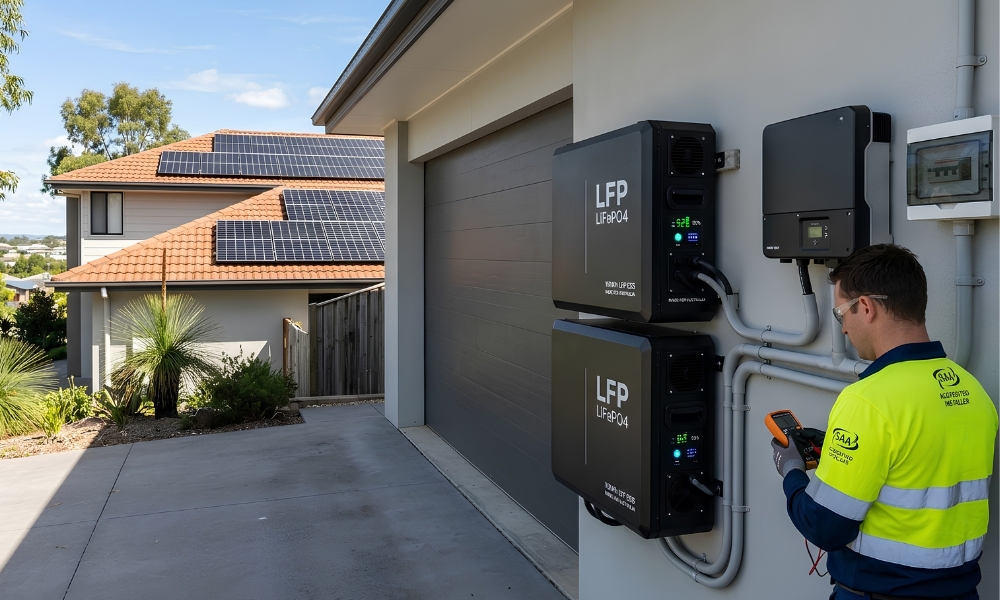
Energy Matters can arrange up to three obligation-free solar battery quotes from accredited local installers who work to AS/NZS 5139.
Use Energy Matters’ easy-to-use solar power and solar battery storage system calculator to determine the right size for your solar system with storage. Our solar calculator will generate performance information and potential savings.
We can send this information to 3 pre-vetted, trusted local installers in your area so they can provide obligation-free solar quotes and help you take the first step toward true energy independence!

Common mistakes to avoid
- Buying on energy density alone. Unless you are fitting a battery into a narrow side passage, the compactness advantage of NMC rarely justifies the shorter cycle life.
- Ignoring the installation location. Even the safest chemistry in the world fails compliance if it is mounted on a bedroom wall without fire separation.
- Comparing nominal capacity instead of usable capacity. The rebate and your evening coverage both depend on usable kilowatt-hours.
- Overlooking warranty throughput. A ten-year warranty capped at a low megawatt-hour figure can expire on throughput long before the calendar date.
- Treating the battery as a standalone fix. Pairing storage with energy efficiency upgrades or a solar hot water system usually delivers a faster payback than simply buying a bigger battery.
- Skipping accreditation checks. Only SAA-accredited installers can claim the federal rebate for you.
Expert tip
Request the manufacturer datasheet, not the sales brochure. The datasheet lists chemistry, operating temperature range, throughput warranty and the ingress protection rating that determines whether outdoor mounting is permitted.

Frequently asked questions
Is LFP or NMC the safest home battery chemistry?
LFP is the safest home battery chemistry for residential storage. Its cells enter thermal runaway at around 270 degrees Celsius compared with roughly 150 to 210 degrees for NMC, and LFP releases far less oxygen during failure, which dramatically slows fire spread between cells.
What is the difference between lithium iron phosphate vs lithium ion?
Lithium iron phosphate is a type of lithium-ion battery, not a separate technology. The lithium iron phosphate vs lithium ion comparison usually means LFP versus other lithium cathodes such as NMC, which trade thermal stability for higher energy density.
Are home batteries a fire risk in Australia?
Professionally installed home batteries are among the lowest-risk lithium products in an Australian home. Fire and Rescue NSW recorded only three residential battery energy storage fires in 2023 across more than 57,000 installed units, with most lithium incidents involving e-bikes and e-scooters.
Can I install an NMC battery in my home in Australia?
Yes. An NMC battery home installation is legal if the product appears on the Clean Energy Council approved list and the install meets AS/NZS 5139, AS/NZS 4777.2 and the wiring rules. Location restrictions and clearances are stricter for higher-risk chemistries.
How long does a LiFePO4 battery last?
A quality LiFePO4 battery typically delivers 3,000 to 6,000 full cycles, which translates to roughly 10 to 15 years of daily cycling in an Australian home. Most manufacturers warrant 60 to 70 per cent retained capacity at the end of a ten-year term.
Does the federal rebate treat LFP and NMC differently?
No. The Cheaper Home Batteries Program pays the same per usable kilowatt-hour regardless of chemistry, currently around $252 per kWh on the first 14 kWh. Eligibility depends on Clean Energy Council product approval and accredited installation, not on the cathode material.
Making the safer choice for your home
The evidence points one way for Australian homes. LFP offers a higher thermal threshold, longer cycle life, no cobalt, and a lower cost per stored kilowatt-hour, which is why it now dominates residential storage here.
NMC isn’t unsafe, and a certified NMC system installed to AS/NZS 5139 by an accredited professional is a legitimate choice when space is tight. Chemistry is one input, and installation quality is the other.
Get it right from the start. Compare home battery systems, check your rebate eligibility and talk to installers who put the chemistry in writing.
Ready to compare batteries the right way?
Energy Matters has helped Australian households compare solar and storage since 2005. Tell us about your home, and we will match you with up to three SAA-accredited installers who quote chemistry, capacity and rebate value in full.
Sources and References
- Fire and Rescue NSW: Residential Battery Energy Storage Systems
- NSW Government: Battery reform and lithium-ion fire data
- Clean Energy Council: Approved battery products and accredited installers
- Clean Energy Regulator: Small-scale Renewable Energy Scheme
- Australian Energy Market Operator: Distributed energy resources data