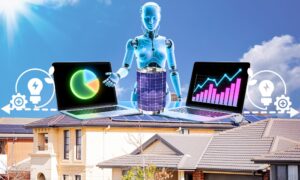








As artificial intelligence (AI) reshapes industry and Bitcoin gains traction as a decentralised currency, a pressing question looms: how will these technologies impact our future energy needs? AI and cryptocurrency are energy-hungry, decentralised by nature, and accelerating faster than policy can keep up. That means rethinking energy production, distribution, and storage. And yes, renewables will need to do some heavy lifting.
Let’s explore how AI and Bitcoin are driving the next energy revolution and what that means for Australia and the world.
AI is smart, but it’s power-hungry
AI models like ChatGPT, Midjourney, and autonomous driving systems rely on high-performance computing. This isn’t your average laptop kind of workload. Training a large language model can consume as much electricity as 100 Aussie homes use in a year. And once deployed, inference (real-time processing) demands constant server activity, often run from energy-intensive data centres.
According to the International Energy Agency (IEA), global data centre electricity consumption could double by 20261, driven largely by AI and cloud services. Already, these centres account for roughly 1–1.5% of global electricity use. That figure could climb above 3% in the next five years2.
For Australia, the implications are clear. As AI becomes embedded in health care, mining, agriculture, and logistics, the need for consistent, clean, and scalable energy will spike. We’ll need smart grids, energy storage, and localised renewables to keep up, especially as AI also supports the development of those same solutions.




Bitcoin and the global energy footprint
Bitcoin’s decentralised ledger system (blockchain) depends on a process called proof of work. This involves miners solving complex mathematical problems to validate transactions. It’s secure, but wildly inefficient in energy terms.
The Bitcoin network consumes more electricity annually than some entire countries, including Argentina and the Netherlands. While Bitcoin mining has increasingly shifted to regions with cheap or stranded energy (like hydro in Canada or gas flaring in Texas), it’s still a contentious issue.
Critics argue that Bitcoin is a climate disaster. Proponents claim it incentivises renewable energy by creating a constant buyer for excess power. In reality, both are partly true. Mining operations will go where energy is cheap. And with the right settings, that could be solar, wind, hydro, or geothermal.
In 2023, the Bitcoin Mining Council reported that 59.9% of Bitcoin’s global mining energy mix was from sustainable sources3. But we’re still a long way from a clean crypto economy.
The AI and crypto convergence
Here’s where things get interesting: AI is now being used to optimise Bitcoin mining. Algorithms can dynamically shift workloads to times and places with the lowest energy costs or highest renewable output. In some cases, they’re even scheduling mining around solar or wind peaks, effectively becoming a flexible demand-side solution.
In return, Bitcoin miners are helping AI operations by investing in shared infrastructure, like modular data centres and off-grid power systems. This symbiosis could reshape the traditional grid model.
We’re entering a world where flexible loads follow renewable generation, not the other way around. AI and crypto aren’t just energy users; they could help balance the grid, too.


The renewable energy opportunity
The future of energy will hinge on whether renewables can scale fast enough to support these growing digital demands. The good news? We’re getting there.
Australia leads the world in rooftop solar uptake, and utility-scale renewables are growing fast. But the grid wasn’t built for two-way energy flows or unpredictable demand spikes from data centres and mining rigs.
Here’s what we’ll need:
- Batteries: To store excess renewable generation and smooth out AI and crypto-driven peaks.
- Virtual power plants (VPPs): To coordinate distributed energy resources like home solar, batteries, and EVs.
- Flexible loads: Including data centres that ramp up or down based on renewable supply.
- Hydrogen and long-duration storage: For when the sun’s not shining or the wind’s not blowing.
Governments are starting to catch on. The NSW Electricity Infrastructure Roadmap and the Federal Capacity Investment Scheme are examples of how Australia is incentivising dispatchable renewables – a key pillar of this next phase.
Will Bitcoin become a universal currency?
While Bitcoin isn’t replacing the Aussie dollar any time soon, it is being adopted globally in surprising ways. El Salvador made it legal tender in 2021, and countries with unstable currencies are exploring Bitcoin as a hedge against inflation.
But for it to be truly universal, scalability and energy use must improve. That’s where ‘proof of stake’ blockchains like Ethereum have a leg up, using more than 99% less energy than Bitcoin’s proof of work.
There’s talk of Bitcoin eventually adopting similar systems or relying more on layer-2 solutions like the Lightning Network. Either way, if Bitcoin goes mainstream, the energy discussion will be front and centre.
Where does Australia fit in?
Australia is uniquely positioned to lead in this AI-crypto-energy nexus. We have:
- Abundant renewable resources (especially solar and wind)
- A decentralised energy market already embracing batteries and VPPs
- Mining infrastructure and tech expertise
- A growing AI sector, from agriculture to medicine
Rather than viewing AI and Bitcoin as threats to the energy system, we should see them as catalysts. With the right policy and investment, they could accelerate the transition to a smarter, more flexible, and more renewable grid.
What’s next?
The rise of AI and Bitcoin is reshaping energy economics. These technologies won’t just consume power, they’ll dictate how and where energy is produced, stored, and traded.
If we get it right, AI could help design net-zero cities, while Bitcoin mining could underwrite the business case for remote solar farms. If we get it wrong, we risk straining grids, increasing emissions, and deepening digital inequality.
Australia has a chance to lead this conversation. But it will take courage, clarity, and a rethink of what we mean by ‘energy efficiency’ in the digital age.
- https://www.iea.org/reports/energy-and-ai/energy-demand-from-ai ↩︎
- https://www.scientificamerican.com/article/ai-will-drive-doubling-of-data-center-energy-demand-by-2030/ ↩︎
- https://bitcoinminingcouncil.com/bitcoin-mining-council-survey-confirms-year-on-year-improvements-in-sustainable-power-and-technological-efficiency-in-h1-%202023/ ↩︎