Choosing between N-type vs P-type solar panels is one of the most important decisions for Australian homeowners going solar. The Australian sun is intense, and not all solar panels handle heat and UV exposure equally well. Understanding the difference between N-type and P-type solar panels can help you get more energy, a longer lifespan, and a better return on your investment.
Understanding the basics: What is P-type and N-type?
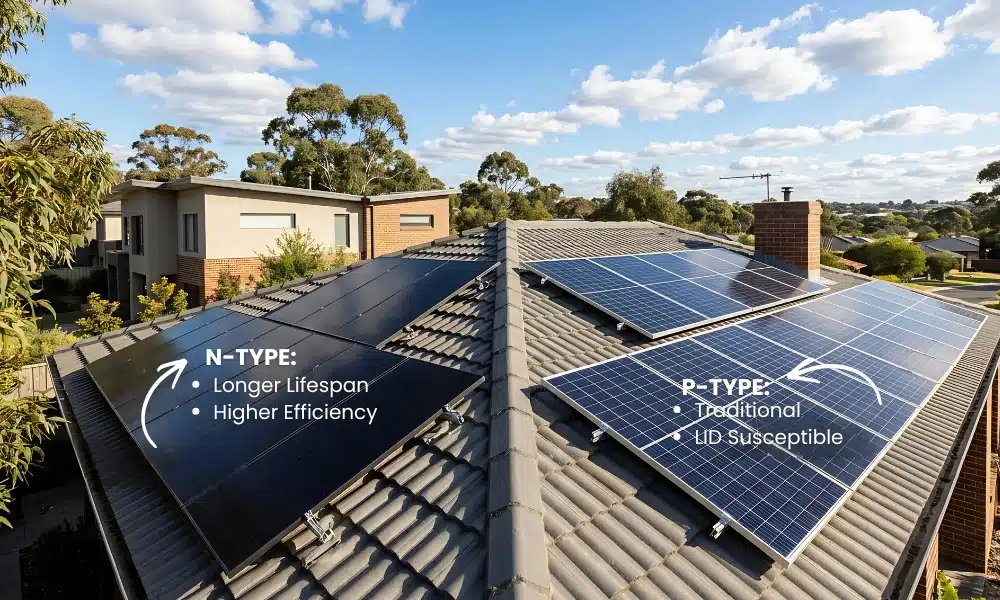
To understand N-Type vs. P-Type solar panels, we must look at how silicon wafers are “doped” with chemicals. P-type cells are traditional, using boron to create a positive charge. N-type cells use phosphorus, creating a negative charge that offers unique advantages in efficiency.
[metaslider id=”138351″]
P-type technology has dominated the market for decades because it is cheaper to manufacture. However, N-type technology is rapidly becoming the new industry standard. This shift is driven by the need for improved performance in high-heat environments, such as those in Australia.
P-type solar panels
P-type solar panels use silicon doped with boron. This has been the standard in the solar industry for decades. Most traditional PERC (Passivated Emitter and Rear Cell) panels are P-type. They are widely available and generally more affordable than N-type panels.
However, in the N-Type vs P-Type solar panels debate, lifespan is where P-Type starts to fall behind.
Key features of P-type panels
- Lower upfront cost
- Proven and widely used
- Slightly lower efficiency
- Higher degradation over time
N-type solar panels
N-type solar panels use silicon doped with phosphorus. This produces a wafer with a negative charge. N-type technology includes advanced cell designs such as TOPCon (Tunnel Oxide Passivated Contact), HJT (Heterojunction Technology), and IBC (Interdigitated Back Contact). These are considered next-generation solar panel options and are becoming increasingly popular in Australia.
When comparing N-Type vs P-Type solar panels, N-Type clearly stands out for durability.
Key features of N-type panels
- Higher efficiency rates
- Better performance in heat
- Lower degradation over time
- Longer lifespan
Why does cell type matter for longevity?
The Australian sun is relentless, subjecting panels to intense heat and high UV radiation. The “longevity” of a panel isn’t just about it staying in one piece. It is about how slowly the power output degrades over 25 to 30 years.
In the N-Type vs. P-Type solar panels debate, N-type consistently wins on degradation rates. Because N-type cells lack boron, they do not suffer from specific chemical reactions that plague P-type cells. This means your system stays more powerful for much longer.
Key differences: N-type vs. P-type solar panels
1. Light-Induced Degradation (LID)
The biggest weakness of P-type panels is Light-Induced Degradation (LID). When boron-doped cells are first exposed to sunlight, a boron-oxygen reaction occurs. This can cause an immediate 2% to 3% drop in efficiency within the first few days.
N-type panels are virtually immune to LID because they use phosphorus instead of boron. When comparing N-Type vs. P-Type solar panels, N-type provides more “day one” power. You get exactly what you paid for without an instant performance hit.
2. Temperature coefficient
Australia’s heat can cause solar panels to lose efficiency as they get hotter. This is measured by the temperature coefficient. N-type panels generally have a superior coefficient, meaning they lose less power on 40°C days.
If you live in Queensland or Western Australia, this thermal stability is a game-changer. N-Type vs. P-Type solar panels comparisons show that N-type generates more electricity during the hottest parts of the day. This higher yield adds up to thousands of dollars in savings over time.
3. LeTID (Light and Elevated Temperature Induced Degradation)
Another silent killer of solar performance is LeTID. This occurs when high temperatures and sunlight combine to degrade the silicon structure. P-type panels are historically more susceptible to this phenomenon.
N-type architecture is inherently more resistant to LeTID. For an Australian system, this resistance ensures the panel doesn’t “age” prematurely. Choosing N-type means your roof continues to produce high voltage even after a decade of heatwaves.
[metaslider id=”150087″]
Cost vs. Long-term value of N-type solar panels in Australia
P-type solar panels are still more affordable upfront. For budget-conscious buyers, P-type PERC panels offer solid performance and a well-established track record. However, the price gap between N-type and P-type panels has been narrowing steadily as N-type manufacturing scales up.
When you factor in the lower degradation rate and better heat performance of N-type panels, the total energy yield over 25 years is often higher. This makes N-type solar panels a better value proposition for many Australian homeowners, even if the initial cost is slightly higher.
Which panel is right for your home?
The best choice depends on several factors. Here is a simple guide:
- Hot climate (Queensland, WA, NT, SA): N-type panels are strongly recommended due to their superior heat tolerance
- Shaded roof: N-type HJT or IBC panels handle shade better than P-type panels
- Budget-conscious buyers: P-type PERC panels offer good value at a lower upfront cost
- Maximising energy output: N-type panels consistently outperform P-type in efficiency and long-term yield
- Longer warranties: N-type panels often come with 25–30-year product warranties
Not sure which solar panel is right for your home? Let Energy Matters match you with the best system for your needs and budget. Compare solar quotes for free.
Frequently Asked Questions (FAQs)
Can I mix N-type and P-type panels on one roof?
It is generally not recommended to mix different cell types on the same string. They have different electrical characteristics, which can cause mismatch losses. Always consult a professional before expanding an existing system.
How do I know if a panel is N-Type?
Check the manufacturer’s datasheet. Look for terms like “TOPCon,” “HJT,” or “N-Type Monocrystalline.” Most high-end panels released in 2025 and 2026 will be N-type.
Is the price difference for N-Type worth it?
Yes, especially in Australia. The extra energy produced over 25 years usually covers the price gap within the first 5 to 7 years. After that, the extra electricity is pure profit.
Final verdict: Which lasts longer?
The evidence is clear: N-type panels last longer and perform better in the Australian sun. By eliminating Light-Induced Degradation and offering better heat tolerance, N-type technology provides the durability needed for our climate. When comparing N-Type vs. P-Type solar panels, N-type is the undisputed champion of longevity.
Why Energy Matters recommends N-type for 2026
At Energy Matters, we have seen the evolution of the Australian solar market. We consistently see fewer warranty claims and higher customer satisfaction with N-type systems. The durability of N-Type vs. P-Type solar panels in salty coastal air and dusty inland plains is proven.
- Higher yield: More kilowatt-hours produced per square meter.
- Better warranties: Manufacturers trust the chemistry to last 30 years.
- Future proof: Most new inverter technologies are optimised for high-efficiency N-type modules.
Check our page for our recommended solar panel products.
[metaslider id=”138379″]
Investing in a P-type system today might save you a few hundred dollars now. However, you risk higher degradation and lower savings in the long run. The smart money in Australia is firmly on N-type technology.
Don’t settle for outdated technology that fades under the sun. Ensure your home is powered by the most resilient cells available. Contact Energy Matters today for expert advice on the latest N-type solar solutions!