


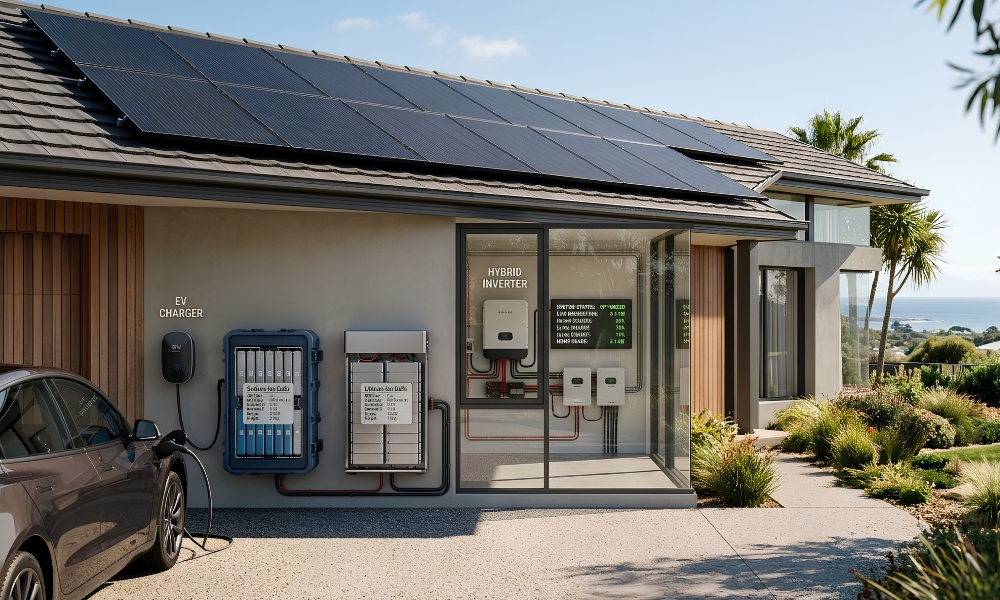
Australians have installed more than 400,000 home batteries in a single year under the federal Cheaper Home Batteries Program, adding roughly 11.2 GWh of storage. So the sodium-ion vs. lithium-ion home battery question now lands in front of homeowners already halfway through a quote. Before you decide, it helps to understand how home battery systems are actually approved and paid for in this country.
Sodium-ion batteries promise lower-cost materials, improved fire safety and impressive cold-weather performance. Lithium-ion, meanwhile, dominates every approved product list and every battery rebate scheme in Australia.
This guide compares both chemistries honestly, using current Australian rules, prices and incentives. Ready to act on it? Energy Matters connects you with up to three obligation-free quotes from SAA-accredited installers, so you can compare real numbers instead of marketing claims.
Key takeaways
- Lithium-ion LFP remains the only rebate-eligible home battery chemistry in Australia in 2026.
- Sodium-ion wins on thermal safety, cold-weather range and cycle life, but loses on energy density and market access.
- The federal Cheaper Home Batteries Program is worth roughly $252 per usable kWh on the first 14 kWh, tapering above that.
- NSW and WA add state-level incentives on top, while Victoria, Queensland and South Australia rely on the federal discount alone.
Waiting for sodium-ion costs to be real money, because the rebate steps down again on 1 January 2027.
What is sodium-ion battery technology and why does it matter for Australian homes?
A sodium-ion battery stores and releases energy by shuttling sodium ions between two electrodes, much like a lithium-ion battery shuttles lithium ions. The engineering is familiar, but the raw material is not.
Sodium is abundant, cheap and available almost everywhere, including in Australian salt and soda ash supply chains. Australia also mines lithium heavily, but the refined battery-grade supply chain sits largely offshore.


Key terminology
- Na-ion vs Li-ion: Shorthand for sodium-ion versus lithium-ion. “Na” is the chemical symbol for sodium and “Li” for lithium.
- LFP (lithium iron phosphate): The safest and most common lithium chemistry in Australian home batteries.
- Energy density: How much energy fits into a given weight or volume. It decides how big the box on your wall is.
- Cycle life: How many full charge-and-discharge cycles a battery delivers before capacity drops meaningfully.
- Usable capacity: The kilowatt-hours you can actually draw, which is what rebates are calculated against.
Why it matters in 2026
Battery ownership is no longer niche. SunWiz recorded around 221,000 residential battery installations across Australia during 2025, roughly triple the previous year, lifting battery ownership to about 4.6 per cent of homes.
Average system sizes also grew, from about 11.8 kWh in 2024 to 21.6 kWh in 2025. Bigger systems mean chemistry choice matters more, because cost per kilowatt-hour compounds quickly.
Expert tip: Chemistry is not the first question
Our installer network consistently reports the same thing: sizing a battery to your actual evening load saves more money than switching chemistry. Get the kilowatt-hours right first, then compare brands.
How sodium-ion battery home storage works in Australia
The physics works anywhere. The market access does not, and that is where Australian homeowners get caught out.
Step-by-step: How a battery reaches an Australian wall
- The manufacturer tests the product against the relevant Australian and IEC safety standards through an accredited certifying body.
- The product is submitted to the Clean Energy Council approved products list, assessed under the Battery Best Practice Guide or the newer SA TS 5398 technical specification.
- Once listed, an SAA-accredited installer can install it and create Small-scale Technology Certificates.
- Those certificates become the point-of-sale discount you see on your quote, with no separate application required.
- State schemes and Virtual Power Plant incentives then stack on top, where they are available in your state.
Sodium-ion currently stalls at step two. Checked against the CEC register in August 2026, none of the 3,400-plus listed battery products used sodium-ion chemistry.
Real-world examples
Australia is not standing still on the research side. ARENA has funded the Smart Sodium Storage System project, which developed and validated sodium-ion packs including a 5 kWh unit at the award-winning Illawarra Flame House and a 30 kWh system at Sydney Water’s Bondi Sewage Pumping Station.
On the commercial side, Brisbane-based manufacturer PowerCap sells sodium-ion systems ranging from roughly 10.3 kWh to 27.5 kWh, priced at around $900 per kWh installed and TUV-certified. These sales target commercial battery, industrial, and off-grid customers, not rebate-eligible residential installations.
Expert tip: Check the register, not the brochure
If a supplier offers you a sodium-ion home battery with the federal rebate attached, search the exact model number on the Clean Energy Council approved products list before paying a deposit. If the model is not listed, the rebate cannot be claimed.
Costs and savings: sodium-ion vs lithium-ion battery home economics
Upfront costs
Sodium-ion cells are cheaper to make in theory, because sodium costs a fraction of lithium and the current collectors can use aluminium instead of copper. Production volumes, however, are still small.
In 2026, sodium-ion is still not cheaper on an installed basis in Australia. It also arrives without the automatic discount that lithium systems receive.
Indicative installed cost and rebate comparison, 13.5 kWh usable system (September 2026)
| Cost component | LFP lithium-ion | Sodium-ion (current AU reality) |
| Typical installed price | Approx. $800 to $1,200 per kWh | Approx. $900 per kWh (commercial supply) |
| Gross cost, 13.5 kWh | Approx. $13,500 | Approx. $12,150 |
| Federal rebate eligibility | Yes, CEC-listed products | No, not on CEC register |
| Federal discount applied | Approx. $3,400 (at $252 per kWh) | $0 |
| State or VPP incentive | Available in NSW and WA | Not accessible without listing |
| Net cost after federal rebate | Approx. $10,100 | Approx. $12,150 |
| Installer and warranty support | Extensive national network | Very limited residential support |
Figures are indicative national averages for comparison only. Rebate values vary by STC zone, STC market price and installation date.
Savings calculation
A 13.5 kWh battery in a typical solar home shifts roughly 3,500 to 4,500 kWh of self-consumed solar per year, depending on load profile and weather. At a blended import rate of around 35 cents per kWh, net of a modest feed-in tariff, that is roughly $1,000 to $1,400 in annual bill reduction.
Joining a Virtual Power Plant can add a few hundred dollars more each year. Either chemistry delivers those savings identically, because the savings come from stored kilowatt-hours, not from the ions moving inside the cell.
Payback period
- LFP lithium at approximately $10,100 net, saving $1,200 per year: around 8.4 years.
- Sodium-ion at approximately $12,150 with no rebate, saving $1,200 per year: around 10.1 years.
- Add a Virtual Power Plant (VPP) payment of $300 per year to the lithium case, and payback drops closer to 6.7 years.
The gap is entirely driven by incentive access, not performance. That is the single most important point in the whole sodium-ion vs. lithium-ion battery home debate.
Expert tip: The rebate clock is the real cost
The STC factor fell from 8.4 to 6.8 on 1 May 2026 and drops again to 5.7 on 1 January 2027. Every six months you wait for a chemistry that is not yet approved, the discount on the approved chemistry gets smaller.
Use Energy Matters’ easy-to-use solar power and solar battery storage system calculator to determine the right size for your solar system with storage. Our solar calculator will generate performance information and potential savings.
We can send this information to 3 pre-vetted, trusted local installers in your area so they can provide obligation-free solar quotes and help you take the first step toward true energy independence!

State-by-state considerations for home battery storage
The federal discount applies in every postcode, but the top-ups do not. Here is where each mainland state stands in late 2026 for home battery systems.
- Victoria (VIC): federal rebate only. The Solar Victoria battery loan closed in May 2025, so the Cheaper Home Batteries Program discount is the main lever for Victorian households.
- New South Wales (NSW): the strongest stack in the country. The Peak Demand Reduction Scheme now pays upfront battery incentives through the BESS1 and BESS2 activities that commenced on 1 July 2026, typically worth several hundred to around $1,500 for VPP-connected systems, and the Home Energy Saver interest-free loan of up to $15,000 sits alongside it.
- Queensland (QLD): federal rebate only after Battery Booster closed in 2024, though sunnier STC zones mean the per-kWh rebate value is higher than in southern states.
- South Australia (SA): federal rebate only, with the Home Battery Scheme long closed. High solar penetration and volatile evening pricing still make storage attractive.
- Western Australia (WA): the Residential Battery Scheme adds up to around $1,300 for Synergy customers and up to around $3,800 for Horizon Power customers, plus interest-free loans, but WA also applies a second approval gate through Synergy’s supported solutions list.
Expert tip: WA has two gates, not one
Western Australian homeowners need the battery on the CEC list and the system on Synergy’s supported solutions list. Ask your installer to confirm both before signing, especially for newer brands.
Comparison table: Na-ion vs. Li-ion at a glance
This table covers the sodium-ion battery pros and cons that matter most for a home installation.
| Factor | Sodium-ion (Na-ion) | LFP lithium-ion (Li-ion) |
| Energy density | Approx. 75 to 175 Wh/kg | Approx. 175 to 200 Wh/kg |
| Wall space needed | Larger for the same kWh | More compact |
| Cycle life | Approx. 8,000 to 10,000 cycles | Approx. 6,000 or more cycles |
| Operating temperature | Approx. -40 to +70 degrees C | Approx. -20 to +60 degrees C |
| Thermal safety | Excellent, very low fire risk | Very good, no thermal runaway in LFP |
| Raw materials | Sodium, iron, manganese, abundant | Lithium, iron, phosphate |
| CEC approved in Australia | No (as at August 2026) | Yes, thousands of listed models |
| Federal rebate eligible | No | Yes |
| VPP compatibility | Not available residentially | Widely supported |
| Installer availability | Commercial and off-grid only | Nationwide |
| Best suited to | Cold climates, off-grid, future use | Australian grid-connected homes now |
Expert tip: Density matters more than it sounds
Sodium-ion needs roughly 20 to 30 per cent more wall or floor space for the same usable capacity. On narrow side passages and compact garages, that alone can rule out a system before price enters the conversation.
How to get started: step-by-step guide
- Check your bill. Identify how many kilowatt-hours you use after sunset, because that number determines battery size.
- Confirm your solar output. A battery only pays back if there is surplus generation to store, so review your inverter data across a full year.
- Verify approval status. Search the exact model number on the Clean Energy Council approved products list before you commit.
- Confirm your state incentives and whether VPP participation is required to unlock them.
- Compare at least three quotes from SAA-accredited installers, checking usable capacity rather than nameplate capacity.
- Read the warranty carefully, including throughput limits, retained capacity guarantees and the local support arrangement.
Not sure where to start? Request your free solar quotes and let Energy Matters match you with accredited installers who work in your postcode. You can also see whether it makes sense to join a Virtual Power Plant once your system is running.
Common mistakes to avoid
- Waiting indefinitely for sodium-ion. No published date exists for residential approval in Australia, while the federal discount shrinks every six months.
- Confusing overseas launches with local availability. A product sold in China or Europe cannot be installed here until it is certified and listed.
- Paying a deposit on a pre-order. If the model is not on the CEC list on the installation date, you cannot claim the rebate retrospectively.
- Oversizing the system. Since 1 May 2026, the rebate tapers to 60 per cent between 14 and 28 kWh and 15 per cent above that, so oversized batteries earn far less per kilowatt-hour.
- Comparing nameplate capacity instead of usable capacity. Rebates and real-world savings are both calculated on usable kilowatt-hours.
- Ignoring VPP requirements. Federal eligibility has required VPP capability since May 2026, and some state incentives require active participation.

Frequently asked questions
Can I buy a sodium-ion home battery in Australia right now?
Not for a standard grid-connected home installation. As of August 2026, no sodium-ion product appears on the Clean Energy Council-approved battery register of more than 3,400 listed products, so accredited installers cannot fit one under the rebate schemes. Sodium-ion is available for some commercial and off-grid applications.
Are sodium-ion batteries safer than lithium-ion?
Sodium-ion has an excellent thermal safety profile and can typically be discharged to zero volts for transport without damage. That said, LFP lithium batteries used in Australian homes are also very safe and do not suffer the thermal runaway risk associated with older NMC chemistries.
Are sodium-ion batteries cheaper than lithium-ion?
Not yet in Australia. Sodium-ion cells promise lower material costs at scale, but current installed pricing sits around $900 per kWh and attracts no federal rebate. A comparable LFP system usually lands cheaper after the roughly $252 per kWh discount is applied.
How long do sodium-ion batteries last compared with lithium?
Sodium-ion cells are commonly rated between 8,000 and 10,000 cycles, compared with 6,000 or more for quality LFP lithium. In practice, both chemistries comfortably exceed the 10-year warranty periods offered on Australian home batteries under normal daily cycling.
Should I wait for sodium-ion before installing a battery?
For most households, no. There is no confirmed approval date for residential sodium-ion in Australia, while the federal STC factor drops from 6.8 to 5.7 on 1 January 2027. The savings lost while waiting generally exceed any future price advantage.
Will sodium-ion batteries ever get an Australian rebate?
Possibly. The Clean Energy Council has been working with Standards Australia on certification pathways for non-lithium chemistries, and SA TS 5398 was released in October 2025 as a broader energy storage safety specification. No timeline for sodium-ion listing has been published.
Choose the battery you can actually install
Sodium-ion is a genuinely exciting technology, and Australian research through ARENA has helped prove it works. But a battery you cannot buy, cannot have installed by an accredited installer, and cannot claim a rebate against isn’t a real option in 2026.
For almost every Australian household, the smart move is a quality LFP lithium system sized to your evening load, claimed against the federal solar battery rebate while it is still at its current value.
Don’t leave thousands of dollars on the table waiting for a chemistry with no approval date. Compare your options today and lock in the discount before the next step-down.
Ready to compare real numbers? Energy Matters connects you with up to three obligation-free quotes from SAA-accredited installers in your area. No pressure, no cost, just clear comparisons on approved, rebate-eligible systems.
Sources and Further Reading
- Clean Energy Regulator: Quarterly Carbon Market Report, June quarter 2026
- DCCEEW: Cheaper Home Batteries Program (STC factors and 1 May 2026 changes)
- Clean Energy Council: Approved products program and battery programs, Apply to join the approved products list (SA TS 5398)
- ARENA: Smart Sodium Storage System for renewable energy storage