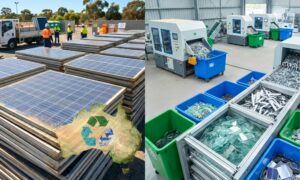







Australia is expected to generate around one million tonnes of solar panel waste by 2035, according to the Department of Climate Change, Energy, the Environment and Water (DCCEEW). Yet some households are pulling perfectly good panels off their roofs after just two years. That’s why governments are now designing a mandatory solar panel recycling scheme, and why a solar panel recycling fee could soon affect every Australian solar owner.
The big question is when you’d pay. One option builds the cost into the price of new panels. The other charges a small fee when panels come off the roof. Both have backers, and both have trade-offs.
In this guide, we explain what’s being proposed in NSW and federally, how each fee model works, and what it could mean for you, whether you already have solar, are buying a system or are adding a home battery.
Quick summary
- Australia has no mandatory solar panel recycling scheme yet, but NSW has proposed the first one, expected to start in early 2028.
- Policymakers are debating whether solar owners pay through slightly higher upfront prices or a small fee when panels are removed.
- Nothing changes for households yet. NSW submissions close at 5pm on 16 November 2026.
Why solar panel recycling is on the agenda in 2026
Australia has more than 4.5 million solar systems on homes and businesses, according to the Clean Energy Regulator, but still no mandatory national scheme for reusing or recycling panels. Several developments are now pushing the issue forward.
At the federal level, a House of Representatives committee has been examining solar panel reuse and recycling since February 2026. It held its final public hearing in Sydney on 24 September, and its report is still to come.
Meanwhile, the $24.7 million National Solar Panel Recycling Pilot, announced in January 2026, has stalled. It was meant to set up around 100 collection sites and recycle up to 250,000 panels, but it has been suspended since May while a complaint about the administrator tender is investigated.
With federal action on hold, NSW is moving first. The state government has proposed Australia’s first mandatory solar panel recycling scheme and is taking public feedback until 16 November 2026.
The timing matters, because more panels are about to come down. The federal home battery rebate is prompting many households to replace older panels with bigger systems, and the Smart Energy Council expects this to add millions of removed panels each year.
Expert tip
Adding a battery doesn’t automatically mean replacing your panels. Ask your installer for a quote that keeps your existing array, then compare it with a full replacement before deciding.
Why are working solar panels being thrown away?
Many panels being removed still work. A Smart Energy Council pilot in Queensland found that removed panels were, on average, only about eight years old, and most could have kept generating for another 10 to 15 years.
Part of the problem is that reuse is harder than it sounds. Giving old panels a second life means removing and transporting them without damage, then having them electrically tested and signed off as safe. Even then, finding buyers is difficult.
As a result, dumping is often the cheaper option when there’s no scheme in place. The NSW Environment Protection Authority says most end-of-life panels are still landfilled, stockpiled or illegally dumped, wasting valuable materials such as silicon, silver, copper and aluminium.
Learn more in our guide to what happens to old solar panels in Australia.
Expert tip
Before replacing panels, check whether the real problem is your inverter. Inverters usually fail well before panels and cost far less to replace.
Option 1: a recycling fee built into the price of new panels
Under this model, the companies that put panels on the market pay to recycle them. In practice, the cost is likely to appear as a slightly higher price when you buy a system.
How the NSW scheme would work
NSW’s draft regulation would require panel brand owners, meaning the manufacturers and importers that supply panels into NSW, to join a product stewardship organisation. That organisation would fund collection, recycling and public education. The scheme would cover rooftop and solar farm panels, but not inverters, batteries, cables or mounting gear.
Who supports this approach?
The Smart Energy Council favours a fee collected upfront and passed through to customers. At the federal inquiry, the Australian Academy of Technological Sciences and Engineering suggested a fee of roughly $10 to $20 per panel at installation.
Pros and cons
- Pros: Funding is collected long before panels need recycling. It’s relatively simple to run, and it makes the businesses selling panels responsible for them at end of life.
- Cons: It adds slightly to the upfront cost of going solar and does nothing to discourage households from removing panels that still work. Critics also argue that passing costs down the supply chain adds overheads customers ultimately pay.
Expert tip
When comparing quotes, ask each installer whether recycling or take-back is included. Once a scheme starts, a slightly higher price may simply reflect a stewardship cost rather than a worse deal.





Option 2: a fee when solar panels are removed
Under this model, a small, clearly stated charge applies when a household decides to retire its panels.
Who supports this approach?
Dr Rong Deng of UNSW made this case to the federal inquiry in September. She told the committee she has seen panels removed after only two years, and plans to put the same argument to the NSW consultation.
Pros and cons
- Pros: Removing panels currently costs nothing, which makes early replacement easy. A modest fee would encourage households to keep working panels on the roof for longer. Deng also argues customers pay either way, so charging them directly avoids supply-chain overheads. By end of life, households have usually had decades of savings from their system.
- Cons: A fee at removal could tempt some people to dump panels to avoid paying. Funding may be less predictable because it depends on when households upgrade. It may also feel unfair to people who bought systems before any fee existed.
Expert tip
If you’re planning an upgrade in the next few years, keep an eye on the final scheme design. Under a removal fee, the timing of your upgrade could affect what you pay.
What a solar panel recycling fee means for homeowners
Under both models, solar owners end up paying; the difference is when. Law academic Penelope Crossley told the inquiry that a user-pays approach matters so that lower-income households who can’t afford solar aren’t left subsidising the cost.
| Your situation | Option 1: fee built into the price | Option 2: fee at removal |
| Buying a system now | Possibly a slightly higher price once a scheme starts (from 2028 in NSW) | No change upfront, but a cost when the panels come off |
| Already have panels | Likely no direct cost unless you install new panels | You may pay when you remove your current system |
| Upgrading to add a battery | New panels may cost a little more | Removing old panels would carry a fee |
If you’re buying a solar system now
Ask your installer what happens to your panels at end of life, and whether they offer take-back or recycling.
If you already have solar panels
Nothing changes yet. If a removal fee were adopted, factor it into the timing of any future upgrade.
If you’re adding a home battery
Check whether you really need to replace your existing panels. Often you can keep them and add a battery, or add extra panels alongside them. NSW’s draft scheme covers panels only, not batteries or inverters.
Expert tip
If your old panels do need to come off, ask whether they can be tested for reuse first. Energy Matters’ Second Life Solar program removes panels during an upgrade and tests them for redeployment before recycling.
Thinking about upgrading your solar?
Compare residential solar options and find a system that suits your home, energy needs and budget. Get started by requesting a free solar quote below.
What happens next for solar panel recycling in Australia
Nothing has been decided yet, and the final design could combine elements of both models.
- NSW: Public submissions on the draft scheme close at 5pm on Monday 16 November 2026 via the NSW EPA Have Your Say page. Once finalised, the scheme is expected to start in early 2028.
- Nationally: Federal, state and territory environment ministers have endorsed principles for a nationally aligned scheme, so other states may follow NSW’s lead.
- Federal inquiry: The committee’s report and recommendations are still to come.
- Federal pilot: Still suspended, with no restart date announced.
Expert tip
If you live in NSW, you can make a submission even as a homeowner. Short, practical feedback about how a fee would affect your upgrade decisions is useful to regulators.
Solar panel recycling fee FAQs
Will I have to pay a fee to recycle my solar panels in Australia?
Not yet. Australia has no mandatory solar panel recycling scheme, so there’s currently no national fee. NSW has proposed the first mandatory scheme, expected to start in early 2028, and federal policymakers are working on a national approach. Depending on the final design, households may pay through higher system prices or a charge at removal.
Who would pay for solar panel recycling under the NSW scheme?
Under NSW’s draft regulation, solar panel brand owners, meaning the manufacturers and importers supplying panels into NSW, would fund collection and recycling through a product stewardship organisation. That cost is likely to be passed on to buyers through slightly higher system prices, rather than charged when panels are removed.
How much could a solar panel recycling fee cost?
No fee has been set. At the federal inquiry, the Australian Academy of Technological Sciences and Engineering suggested $10 to $20 per panel at installation. For a typical 6.6 kW system using fifteen 440 W panels, that would add roughly $150 to $300 to the upfront price.
Why are solar panels being thrown away so early?
Many households replace working panels when they upgrade to a bigger system, often alongside a new home battery. A Smart Energy Council pilot in Queensland found removed panels averaged about eight years old, and most could run another 10 to 15 years. Removal currently costs nothing, so there’s little incentive to keep them.
What should I do with my old solar panels now?
First, check whether they need replacing at all, because working panels can often stay in place alongside a new battery or extra panels. If they must come off, ask your installer about reuse and recycling, check for manufacturer take-back programs, and avoid sending panels to landfill.
Key takeaways
- Australia doesn’t have a mandatory solar panel recycling scheme yet, but NSW has proposed one, expected to start in early 2028.
- The main debate is whether solar owners pay through higher upfront prices or a small fee when panels are removed.
- NSW’s draft model makes manufacturers and importers responsible, with costs likely passed on in system prices.
- Many removed panels still work, so keeping them on your roof is often the cheapest and greenest choice.
- Nothing changes for households yet. NSW residents can have their say before 16 November 2026.
Upgrading your solar? Give your old panels a second life.
Energy Matters’ Second Life Solar program removes old panels as part of your upgrade, tests them, and redeploys them into community solar projects or sends them for responsible recycling.
Sources
- DCCEEW: National Solar Panel Recycling Pilot
- DCCEEW: Putting wind and solar on repeat
- Parliament of Australia: Inquiry into solar panel reuse and recycling in Australia
- NSW EPA: Draft Solar Panels Regulation
- Energy Matters: What happens to old solar panels in Australia?
- Energy Matters: Solar recycling in Australia
- Renew Economy: Some households are discarding solar panels after just 2 years
- ABC News: Recycling fee put forward as solution to solar panel waste