


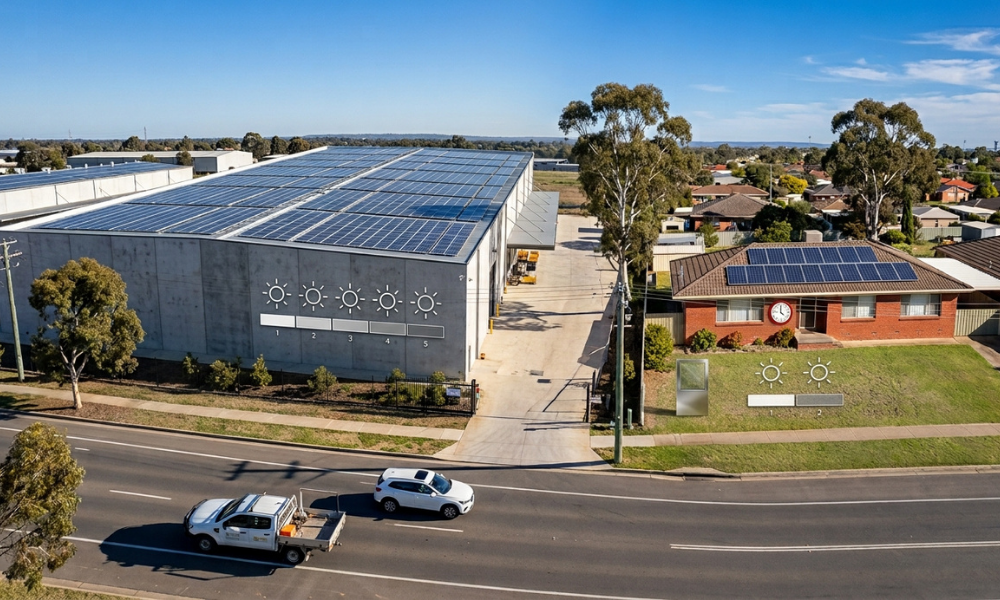
Install a 10 kW solar system on your home in 2029, and the federal solar rebate will count two years of deemed generation. Install a 500 kW system on a warehouse that same year and the business gets five. That’s the quiet paradox inside Australia’s Small-scale Renewable Energy Scheme (SRES) since it expanded to commercial solar up to 1 MW on 1 October 2026.
The government’s reasoning is clear enough. Citing Institute for Energy Economics and Financial Analysis data, Energy Minister Chris Bowen said Australian homes host about 22 GW of rooftop solar, while businesses have installed only about 5.6 GW. Households are well served. Businesses are the “missing middle”.
The result, though, is a scheme where a business installing near the end gets up to five times the support per kilowatt that a household does. Here’s how that happened, why, and what it means for you.
Quick summary
- Household solar rebates (systems up to 100 kW) shrink every year until the scheme ends in 2030.
- New mid-scale systems (100 kW to 1 MW) get a fixed five-year entitlement whenever they’re installed before 2031.
- The difference is deliberate: the government wants to close a gap in business solar, not reward businesses over households.
How the household solar rebate shrinks to 2030
The household solar rebate loses one year of value every 1 January until it reaches zero for systems installed from 2031. Systems up to 100 kW earn small-scale technology certificates (STCs) using a simple formula:
STCs = system size (kW) × zone rating × deeming period (years)
The zone rating reflects how much sun your postcode gets. The deeming period is the number of years of generation you’re paid for upfront, and it’s tied to the scheme’s end date. A system installed in 2026 is deemed for five years, 2027 for four, 2028 for three, 2029 for two and 2030 for one.
For a 10 kW system in zone 3, which covers Sydney, Brisbane, Adelaide and Perth (rating 1.382), that works out to:
| Install year | Deeming period | STCs (approx.) |
| 2026 | 5 years | 69 |
| 2027 | 4 years | 55 |
| 2028 | 3 years | 41 |
| 2029 | 2 years | 27 |
| 2030 | 1 year | 13 |
The dollar value depends on the STC market price at the time, but the trend is fixed: each year the same system earns about 20% less than its 2026 entitlement.
Expert tip
If you’re going to install solar anyway, waiting past 1 January costs you one full year of deemed generation. Check your postcode’s zone rating and run the numbers with the Clean Energy Regulator’s STC calculator before deciding to delay.
What changed for commercial solar on 1 October 2026
Solar systems between 100 kW and 1 MW installed from 1 October 2026 can now earn STCs, and their deeming period is fixed at five years rather than shrinking each year. The Clean Energy Regulator describes this fixed period as a key feature of the expansion. The change was made through amendments to the Renewable Energy (Electricity) Regulations 2001.
Before this change, systems over 100 kW couldn’t access the upfront rebate at all. They had to register as power stations and earn certificates gradually as they generated electricity. The government estimates the new upfront discount cuts installation costs for mid-scale systems by about 20%, or roughly $68,000 off a 250 kW system.
A few details matter for businesses weighing it up:
- Applications open later. The CER expects STC applications for mid-scale systems to open in mid to late November 2026, so there’s a lag between installing and receiving the benefit.
- There’s a trade-off. Owners must choose between upfront STCs and Renewable Electricity Guarantee of Origin (REGO) certificates. Choosing STCs rules out creating REGO certificates for the deeming period.
- Standard rules still apply. Panels, inverters and batteries must be on the Clean Energy Council’s approved list, and installations must meet Solar Accreditation Australia guidelines.
Expert tip
If you own a business with a large roof, the fixed five-year period removes the deadline pressure households face. Use the time to get grid connection approval sorted first, because network approval is often the slowest part of a mid-scale project.
Household vs commercial rebates at a glance
The two schedules start level in 2026 and pull apart every year after.
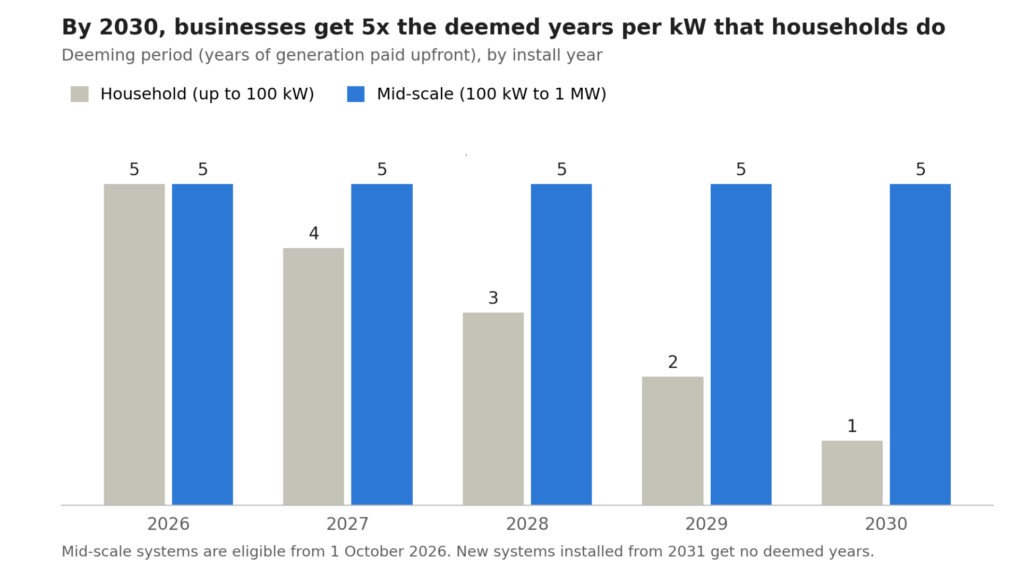
Because STCs are calculated per kilowatt, the deeming period is the whole story. A business installing in 2029 earns 2.5 times the certificates per kW of a household installing the same year, and by 2030 that rises to five times.
Why businesses get a fixed five years
The fixed period exists because mid-scale solar is starting from almost nothing, and because big projects take longer to build. Three reasons stand out.
The gap is large. Australia has about four times as much rooftop solar on homes as on business premises. In Europe, the ratio runs the other way, with roughly 1.5 times more solar on businesses than on houses. A shrinking rebate would give businesses a smaller incentive with each year they took to catch up.
Commercial projects are slow. A 500 kW system needs engineering, finance approval and, often, months of negotiation with the local network for a grid connection. According to the CER, the fixed period was designed to give industry enough time to prepare applications without losing entitlement. A falling deeming period would reward rushed projects and penalise careful ones.
Households already had their turn. Rooftop solar has had access to STCs since the scheme began in 2001. Early household installers received far longer deeming periods than any business will get now.
In the minister’s words
Announcing the expansion at the National Press Club in August 2026, Energy Minister Chris Bowen summed up the policy goal in one line: “The missing middle is mid-scale solar.”


Is it unfair to households?
The per-kilowatt gap is real, but the bigger fairness question is who pays. The government described the expansion as budget neutral because the SRES runs through a market mechanism: electricity retailers must buy STCs, and that cost flows through to electricity bills. More STCs from commercial systems means a higher cost spread across all customers, including households and renters who can’t install solar at all.
On the other side, if mid-scale solar grows as hoped, more daytime generation from factories, warehouses and farms could ease pressure on the grid and wholesale prices that every customer pays. Whether that offsets the cost on bills is something only the data from the next few years will show.
Expert tip
If you run a small business with a large roof, don’t size your system to 99 kW just because that was the old cap. Ask your installer to model a system sized to your actual daytime use, and compare the STC pathway with REGO certificates before you commit.
What this means if you’re a homeowner
For most households, the commercial rules change nothing: your rebate still shrinks each year, and there’s no sign of a fixed household period on the way. A few practical points follow from that.
- Don’t wait for a better deal. No change to the household deeming schedule has been announced. If solar makes sense for your home, delaying only reduces your entitlement.
- Farms and home businesses may be different. The mid-scale rules apply to systems over 100 kW, whoever owns them. A farm shed or rural property that can genuinely use that much solar may qualify for the fixed five-year period.
- Upgrades are still being worked out. The CER says it will publish further guidance on extensions and upgrades to existing systems. If you’re thinking of expanding a large system past 100 kW, wait for that guidance or get advice first.
- Batteries follow their own schedule. Home batteries are covered by the Cheaper Home Batteries Program, which steps down every six months and isn’t affected by the commercial changes.
Expert tip
If you own a farm or run a business from a large rural property, ask an installer to assess whether your site could use more than 100 kW. Crossing that threshold could move you from a shrinking rebate to a fixed five-year one.
Frequently asked questions
Why do commercial solar systems get a fixed five-year deeming period?
The government wants to close the gap between household and business solar, and mid-scale projects take months to plan, finance and connect to the grid. A fixed five-year period lets businesses prepare properly without losing entitlement each year. It applies to eligible systems between 100 kW and 1 MW installed from 1 October 2026.
Does the household solar rebate end in 2030?
Yes. Systems installed up to 31 December 2030 can still earn STCs, but the deeming period falls by one year every 1 January, from five years in 2026 to one year in 2030. New systems installed from 1 January 2031 receive no support under the Small-scale Renewable Energy Scheme.
Can a household get the fixed five-year period?
Only if the system is over 100 kW and meets the mid-scale eligibility rules, which is far larger than any typical home needs. Farms and large rural properties with genuine demand for that much solar may qualify. Standard home systems up to 100 kW stay on the shrinking schedule.
How much is the commercial solar rebate worth?
The government estimates the upfront discount cuts the cost of a mid-scale system by about 20%, or roughly $68,000 off a 250 kW system. The exact value depends on system size, postcode zone and the STC market price. The Clean Energy Regulator’s mid-scale STC calculator gives an estimate.
Who pays for solar rebates?
Solar rebates aren’t paid from the federal budget. Electricity retailers must buy STCs under the Renewable Energy Target, and that cost is passed on through electricity bills. More certificates from commercial systems means a higher total cost shared across all electricity customers, including households.
Key takeaways
- Household solar rebates lose one year of deemed generation every 1 January until they end for systems installed from 2031.
- Commercial systems from 100 kW to 1 MW installed from 1 October 2026 get a fixed five-year deeming period.
- By 2030, a business can earn up to five times the STCs per kilowatt that a household does.
- The government’s goal is to close the gap between household and business solar, not to favour businesses.
- If solar suits your home, waiting won’t get you a better deal.
Ready to compare solar quotes?
Whether it’s a home system or a large commercial roof, get up to three quotes from accredited local installers.
Sources
- Clean Energy Regulator, Mid-scale solar (updated 7 October 2026)
- Clean Energy Regulator, Transitional guidance for mid-scale solar (PV) systems
- Renewable Energy (Electricity) Amendment (Mid-scale Solar) Regulations 2026
- Minister for Climate Change and Energy, Putting more roofs to work, media release, 5 August 2026 (add link)
- RenewEconomy, Supersized rooftop solar rebates go live (CER spokesperson comments)