






University of Alberta scientists have used nanotechnology to design a solar cell incorporating abundant-earth elements, which they say could lead to cheaper and more prolific solar power in off-grid areas.
The team’s work revolves around finding ways to lower the cost of print and spray-on solar technology using nanoparticle-based photovoltaic cells.
Jillian Buriak, senior research officer of the UA’s National Institute for Nanotechnology and fellow researchers used two commonly occurring elements, zinc and phosphorous, to form zinc phosphide, a highly conductive and photosensitive nanoparticle. The team then invented a method for dissolving the nanocrystals into a red-coloured ink capable of absorbing light and transforming it to energy.
Buriak believes this photovoltaic ink is an important step towards mass production of solar power through roll-to-roll printing and spray-on techniques.
“Nanoparticle-based ‘inks’ could be used to literally paint or print solar cells or precise compositions,” she said.
“Half the world already lives off the grid, and with demand for electrical power expected to double by the year 2050, it is important that renewable energy sources like solar power are made more affordable by lowering the costs of manufacturing.”
According to the University, the advantage of using such abundant-earth elements in the solar research is that both materials are more plentiful than scarce materials such as cadmium and are free from manufacturing restrictions imposed on lead-based nanoparticles.
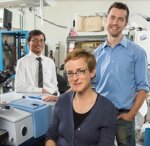
Team member Hosnay Mobarok of UA’s Faculty of Science discovered the method of turning the zinc phosphide nanoparticles into a photovoltaic liquid. Erik Luber, from the Faculty of Engineering then worked on making the film responsive to sunlight.
The team have built a prototype solar panel and are currently working on spray-coating larger solar cells to test their efficiencies.
The work, funded in part by the Natural Sciences and Engineering Research Council of Canada, has been published in the journal ACS Nano.