





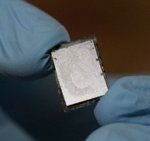
Vanderbilt University researchers have developed a proof-of-concept load bearing supercapacitor that could potentially turn energy storage on its head.
Energy storage can be an unwieldy and bulky affair, but the new material could see applications such as a laptop’s casing becoming a power source or even house construction materials doubling as batteries.
The supercapacitor material is created with silicon electrodes chemically treated to have nanoscale pores on their inner surfaces. The electrodes are coated with an ultrathin graphene-like layer of carbon. Between the electrodes is a polymer film that fulfils the role of electrolyte paste in a battery. When pressure is applied, the polymer is forced into the tiny pores. Once cooled and solidified, an extremely strong mechanical bond is created – “tighter than superglue”.
The strength of the bond overcomes the issue of delaminating in load-bearing supercapacitors.
Supercapacitors are larger than equivalent rated lithium-ion batteries; but when used as part of a structure housing a device; this no longer becomes such an issue.
“Supercapacitors store ten times less energy than current lithium-ion batteries, but they can last a thousand times longer. That means they are better suited for structural applications,” says Assistant Professor of Mechanical Engineering Cary Pint.
The material displays a coulombic efficiency of 98% under exposure to over 300 kPa tensile stresses and 80 g vibratory accelerations. Coulombic efficiency describes the efficiency with which charge is transferred in a system facilitating an electrochemical reaction.
While the use of silicon in structural supercapacitors is best suited to consumer electronics and solar panels, the team believe their design will have applications in other materials including carbon nanotubes and metals such as aluminium.
The Vanderbilt University team’s work has been published in Nano Letters and was supported by grants from the USA’s National Science Foundation.