






U.S. scientists have created a high efficiency solar cell after incorporating combining graphene with common glass. It’s a breakthrough that could also pave the way for a new class of optic/electronic devices.
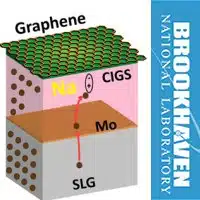
Researchers from New York’s Brookhaven National Laboratory set out to optimize a solar cell containing graphene by stacking it on a copper indium gallium diselenide (CIGS) semiconductor, which was then was placed on an industrial soda-lime glass substrate; a substance commonly used for windows and bottles.
They found the sodium atoms contained in the glass boosted the electron density, electronic properties and performance of the graphene layer in the solar device.
The work, a collaboration between scientist from Brookhaven National Laboratory, Stony Brook University (SBU), and the Colleges of Nanoscale Science and Engineering at SUNY Polytechnic Institute, was published in the journal Scientific Reports.
“We actually discovered this efficient and robust solution during the pursuit of something a bit more complex. Such surprises are part of the beauty of science,” said co-author Nanditha Dissanayake.
Naturally conductive, atoms-thick and wholly transparent, graphene is ideal for use in optico-electronic devices such as solar panels and touch screens. But graphene must first be tailored to suit the device through a chemical process called doping, whereby electrons are added or electron holes are created to optimise efficiency.
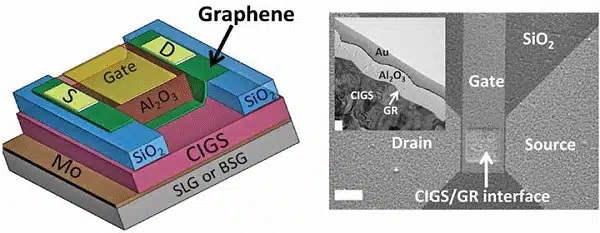
“The graphene doping process typically involves the introduction of external chemicals, which not only increases complexity, but it can also make the material more vulnerable to degradation,” said study co-author Matthew Eisaman, a physicist at Brookhaven Lab and professor at SBU.
The sodium contained in the glass automatically acted as a dopant within the graphene, removing the need to chemically alter its natural characteristics and, most importantly, the effects remained long after the device was exposed to the open air – which the researchers say is a big improvement over current techniques.
“To our surprise, the graphene and CIGS layers already formed a good solar cell junction!” Dissanayake said. “After much investigation, and the later isolation of graphene on the glass, we discovered that the sodium in the substrate automatically created high electron density within our multi-layered graphene.”
The team believe their discovery of a new highly conductive, transparent electrode could go on to replace fragile and costly indium tin oxide (ITO) electrodes used in solar panels, organic light emitting diodes (OLEDs), flat panel displays, and touch screens.
“The potential applications for graphene touch many parts of everyone’s daily life, from consumer electronics to energy technologies,” Eisaman said. “It’s too early to tell exactly what impact our results will have, but this is an important step toward possibly making some of these applications truly affordable and scalable.”