






Australia’s electricity sector could consist of 100% renewable energy by 2030, according to new analysis from the Australian National University.
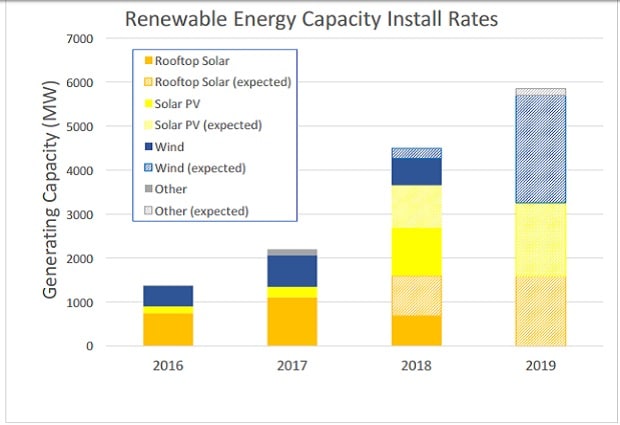
Data contained in an ANU report shows that during 2018/19 Australia will install around 10,400 MW of renewable energy generation.
This new capacity is split between 7,200 MW of large-scale solar and wind power, together with 3,200 MW of small-scale rooftop PV systems.
Combined, this represents 30 per cent of the nation’s peak electricity demand.
Nation on track to eclipse current renewable energy target
Report co-author ANU Professor Ken Baldwin says if the growth in renewables continues, Australia will smash its current Renewable Energy Target of 26 per cent by 2030.
“We estimate electricity emissions would thereby be reduced by 26 per cent in 2021,” Baldwin says.
“The electricity sector on its own would meet Australia’s entire Paris emissions reductions target of 26 per cent by 2025.”
The researchers say Australia is deploying solar PV systems and wind energy at one of the world’s highest rates per capita.
100% renewable energy possible by early 2030s
If industry can keep deploying new renewable capacity “at current rates” into the 2020s, then the report predicts Australia will:
- comfortably exceed the 2020 large scale Renewable Energy Target (LRET) of 33,000 GWh;
- be capable of supplying up to 29% renewable electricity in 2020, 50% in 2025 and 100% in the early 2030s;
- achieve 26% emissions reductions in the electricity sector by 2020/21; and
- meet its entire 26% Paris emission reduction target for the whole economy in 2024/25.
Energy policy vacuum blocks cheap, renewable renergy
Solar PV and wind power now comprise 60 per cent of new capacity additions globally. In Australia, renewables also make up nearly 100 per cent of new capacity entering the network.
PV and wind electricity prices in Australia are currently $50-65/MWh and falling, the report states. By comparison the average wholesale price in NSW is $82/MWh. Thus, increasing the amount of renewables into the network puts downward pressure on electricity prices.
In addition, Australian policy-makers must focus on storage and transmission capacity to deliver reliable energy to homes and businesses.
The report states the remaining piece of the puzzle is more storage, like home battery systems, for thousands of solar users. Governments should also work together on transmitting renewable energy across state lines.
“Our message is that the renewables train has developed great momentum, so policy makers need to get on board,” the researchers conclude.