





Researchers from the University of Houston and Massachusetts Institute of Technology have demonstrated a substantial increase in power from a new kind of device that combines concentrating solar technology and thermoelectric materials to generate electricity.
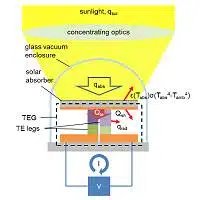
Known as concentrating STEGs (solar thermoelectric generators), the device uses a solar thermal absorber to convert light into heat energy.
The absorber is placed on segmented legs composed of two different types of thermoelectric materials: bismuth telluride – commonly used in thermoelectric devices – and skutterudite. By using two materials with thermoelectric properties, the researchers said were able to exploit the way heat current flows between warmer and cooler areas.
Bismuth telluride works best at temperatures below 200 degrees Celsius, so by pairing it with skutterudite, which can handle temperatures upwards of 600 degrees Celsius, on the top half of the legs, the team was able significantly boost generating efficiency.
“The performance improvement is achieved by the use of segmented thermoelectric legs, a high-temperature spectrally selective solar absorber enabling stable vacuum operation with absorber temperatures up to 600 (degrees) C, and combining optical and thermal concentration,” the researchers wrote in findings published in the journal Nature Energy.
“Our work suggests that concentrating STEGs (solar thermoelectric generators) have the potential to become a promising alternative energy technology.”
The scientists built on previous findings out of UH, which proved such a device was possible, albeit with an efficiency of just 4.6 percent. But that was using thermoelectric legs made from bismuth telluride alone. Once the team actually constructed the device from segmented materials, they demonstrated an advanced efficiency of 7.4 percent, which they calculate could reach 9.6 percent.
While this may not revolutionise the global solar energy landscape, Zhifeng Ren, MD Anderson Professor of physics at the University of Houston and an author of findings, said the work illustrates a new low-cost, nontoxic way to generate power. The technology isn’t intended for use in large-scale solar plants, but could become a useful addition in off-grid communities, powering homes and small businesses, along with providing instant solar hot water.
The STEGs project was supported by the U.S. Department of Energy.
In addition to Ren, other authors of the paper included MIT’s Gang Chen, Daniel Kraemer, Kenneth McEnaney, Lee A. Weinstein and James Loomis, and UH researchers Qing Jie, Feng Cao and Weishu Liu.