

New solar collection devices for use in creating green fuels may be based on existing designs in nature provided by butterflies.
Sunlight could play an important part in producing clean-burning hydrogen fuel as it increases the activity of catalysts that separate water into hydrogen and oxygen. Harnessing sunlight for this application has presented a number of challenges.
At the American Chemical Society’s (ACS’) 243rd National Meeting & Exposition, Tongxiang Fan from Shanghai Jiao Tong University presented research originally based on swallowtail butterflies – these seemingly simple creatures are masters of harvesting solar energy.
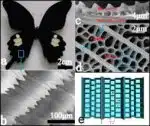
All butterfly wings contain tiny scales that act as natural solar collectors to enable butterflies to continue being active in the cold. The swallowtail butterflies have evolved to build on this attribute by having incredibly black wings that absorb a great deal of sunlight and reflect very little.
Their ability to reap so much energy isn’t just due to pigment – scale structure is a vital component. Ridges running the length of each scale have tiny holes on either side that open up onto an underlying layer. The walls of the ridges absorb longer wavelengths of light while allowing shorter wavelengths to reach a membrane below the scales.
Fan’s team then used actual butterfly-wing structures of the Asian butterfly, Papilio helenus Linnaeus, and transformed them to titanium dioxide; a catalyst used to split water molecules into hydrogen and oxygen by a process known as dip-calcining. Platinum nanoparticles were also added to increase water-splitting power.
The results: the butterfly-wing compound catalyst produced hydrogen gas from water at more than double the rate of the unstructured compound catalyst on its own.
Commenting on the challenges of extracting hydrogen from water and his team’s findings, Fan said: “We realized that the solution to this problem may have been in existence for millions of years, fluttering right in front of our eyes.”
Nature’s lessons for improving solar energy related technology isn’t confined to butterflies. For example, bacteria have been shown to have potential to make solar cells, a tobacco virus is being studied for its potential to create a new generation of highly efficient batteries, a film that mimics the anti-reflective qualities of moth eyes for use with solar cells to improve their efficiency has been developed and sunflowers are inspiring better designs for solar farms.
Trivia: Copying or taking inspiration from nature in order to solve human problems is called ‘biomimicry’ (from the Greek words bios, meaning life, and mimesis, meaning to imitate.)
Source/Image source: American Chemical Society