



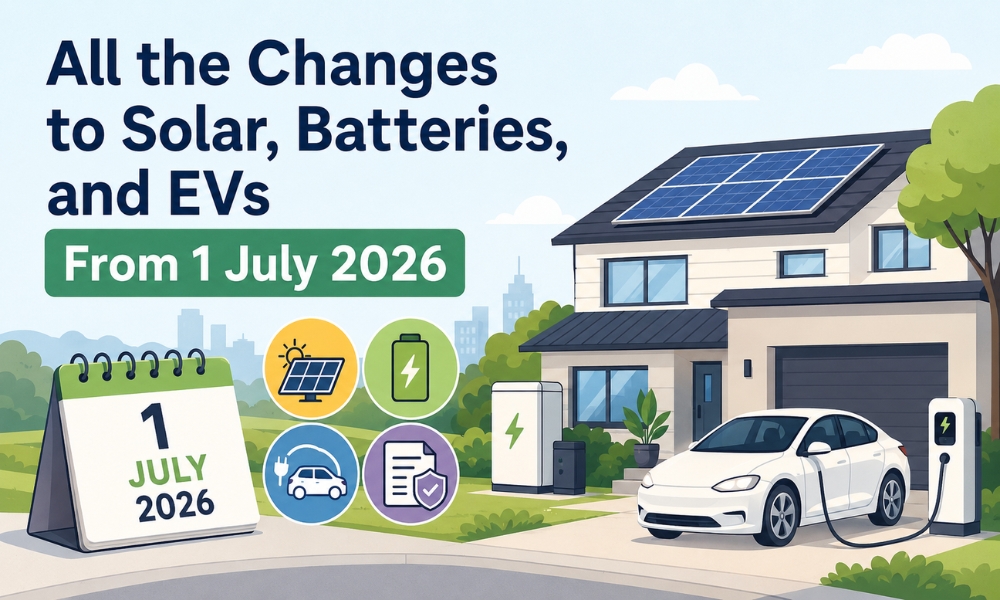
Australian households are entering the new financial year with several important changes affecting solar, batteries, electric vehicles (EVs), electrification, and energy bills. Some incentives remain available. Others have become more targeted. Several states have introduced new programs, while eligibility changes may mean some households no longer qualify for support they could have accessed just weeks ago. Whether you’re considering rooftop solar, battery storage, an EV charger, a heat pump hot water system, or a broader home electrification project, here’s what you need to know from 1 July 2026.
Key takeaways (TL;DR)
- Victoria’s Solar Homes income cap is the clearest 1 July 2026 change: it dropped from $210,000 to $150,000 combined taxable income, while rebate values stayed the same (up to $1,400 for solar PV).
- The federal Cheaper Home Batteries Program still delivers roughly a 30% upfront discount, but the major reform actually took effect on 1 May 2026 — with support now tapered by battery size.
- The EV FBT exemption does NOT end on 1 July 2026 — the full discount continues until the end of March 2027, with the first phase-down starting 1 April 2027.
- NSW launches the Home Energy Saver Program with zero-interest loans of up to $15,000, and WA’s battery rebate is live and stackable with federal support.
- The AER’s Solar Sharer Offer brings three free daytime electricity hours to NSW, SA and SE QLD — but it isn’t automatically the cheapest plan.
- New Default Market Offer prices apply, and the federal Energy Bill Relief Fund has ended with no universal replacement announced.
Key changes at a glance
The single biggest confirmed change on 1 July 2026 is in Victoria, where the Solar Homes income cap tightened to $150,000. The most significant federal battery reform happened earlier, on 1 May 2026, and the EV FBT exemption remains unchanged on 1 July 2026. The table below summarises what changes, what continues, and who is affected across every jurisdiction.
| Area | Change from 1 July 2026 | Impact |
| Federal | Solar Sharer Offer begins | Free daytime electricity plans available in NSW, SA, and SE QLD |
| Federal | New Default Market Offer pricing | Electricity prices change across DMO regions |
| Federal | Energy Bill Relief Fund ends | No new universal household bill credits announced |
| Federal | Battery rebate continues | Upfront discounts remain available through the Cheaper Home Batteries Program |
| VIC | Solar Homes income cap reduced to $150,000 | Fewer households qualify for rebates |
| VIC | Battery loans remain closed | Federal rebate now the primary battery incentive |
| NSW | Home Energy Saver Program launches | Interest-free loans for solar, batteries, and electrification |
| NSW | VPP incentives continue | Additional support available for battery owners |
| QLD | Solar for Renters remains available | Landlords can access solar rebates |
| WA | Battery rebate and loan scheme continues | Significant battery support remains available |
| NT | Battery and apartment solar programs continue | Ongoing grants for households and multi-dwelling buildings |
| Australia-wide | EV FBT exemption remains | Significant tax savings continue for eligible EVs |
| NT | EV registration & stamp duty concessions continue | Free rego and up to $1,500 stamp duty relief until 30 June 2027 |
| NSW | EV Fleets Incentive Kick-start continues | Business grants from $5,000 to $1.2 million until 30 November 2026 |
Context matters: battery uptake has surged since the federal program began. As of 8 June 2026, over 460,000 solar batteries had been installed across Australia since 1 July 2025, equating to 12.8 GWh of installed storage capacity (Clean Energy Regulator). Q1 2026 set a national small-scale solar record: 791 MW installed across 77,000 installations, with an average system size of 10.3 kW and 71% of systems installed alongside a battery (Clean Energy Regulator quarterly report).
Federal changes from 1 July
At the federal level, three things change on 1 July 2026: the Solar Sharer Offer begins, new Default Market Offer prices apply, and the Energy Bill Relief Fund has already ended. The Cheaper Home Batteries Program continues, though its most important reform took effect on 1 May 2026, not 1 July.
Solar Sharer Offer launches
One of the biggest energy retail changes in years arrives on 1 July 2026.
The Solar Sharer Offer requires retailers in Default Market Offer regions to make plans available that include three free hours of daytime electricity each day, starting 1 July 2026.
The Australian Energy Regulator has introduced the Solar Sharer Offer, requiring retailers in Default Market Offer regions to make plans available that include three free hours of daytime electricity.1
The free period varies by region:
- NSW and South East Queensland: 11 am to 2 pm
- South Australia: 12 pm to 3 pm
For households with EVs, batteries, pool pumps, heat pump hot water systems, or flexible daytime usage, these plans could deliver meaningful savings.
However, homeowners should compare plans carefully. Free electricity periods may be offset by higher rates at other times of the day. The Solar Sharer Offer is not automatically the cheapest option for every household. Because outcomes depend heavily on when you use power, it’s worth reading our guide on what your battery software doesn’t know about your energy plan before switching.
Electricity prices change
The Australian Energy Regulator’s 2026-27 Default Market Offer takes effect on 1 July 20262, adjusting standing offer prices across NSW, South East Queensland and South Australia.
Residential standing offer customers will generally see:
- NSW decreases of 3.4% to 7.7%
- South East Queensland decreases of 7.2% to 10.7%
- South Australia changes ranging from a 1.1% decrease to a 1.4% increase
While most Australians are on market offers rather than standing offers, the DMO acts as an important benchmark for electricity pricing.
Energy bill relief ends
The Federal Government’s Energy Bill Relief Fund concluded on 31 December 2025, and no replacement universal household bill relief has been announced for FY2026-27.3
No replacement universal household bill relief has been announced for FY2026-27. This means households should not expect automatic energy bill credits unless new support measures are introduced.
Federal battery rebate continues
The Cheaper Home Batteries Program still provides roughly a 30% upfront discount on eligible batteries, but the big reform took effect on 1 May 2026 — not 1 July — introducing size-based tapering of support.
The Cheaper Home Batteries Program remains one of Australia’s most significant renewable energy incentives.4
Available through the Small-scale Renewable Energy Scheme (SRES), the program provides an upfront discount on eligible battery systems installed alongside new or existing solar.
For most households, the discount is approximately 30% of the battery cost, although actual savings vary depending on battery size and system design.
To be precise about how the reform works: after changes that took effect on 1 May 2026, the STC factor is 6.8 for batteries installed from May to December 2026, and support is now tapered by size — 100% of the factor for the first 14 kWh, 60% for capacity above 14 kWh up to 28 kWh, and 15% for capacity above 28 kWh up to 50 kWh (DCCEEW). Eligible systems must be 5 kWh to 100 kWh nominal capacity, STCs are only available for the first 50 kWh of new or added usable capacity, and on-grid batteries must be virtual-power-plant capable (DCCEEW eligibility).
Battery support remains available nationwide from 1 July 2026. The rebate available will reduce from 1 January 2027. For a fuller breakdown, see our explainers on how the changes to the federal battery rebate will impact you and the Cheaper Home Batteries changes from 1 May 2026.
The scale of the program is substantial: the federal battery scheme was expanded from an original estimate of $2.3 billion to an estimated $7.2 billion over four years, with the government expecting more than 2 million Australians to install a battery by 2030, delivering around 40 GWh of additional storage capacity (DCCEEW).
Solar rebates will reduce again in 2027
Solar rebates under the Small-scale Renewable Energy Scheme phase down annually, so the value available for rooftop solar will reduce again from 1 January 2027 — bringing an install forward can secure a larger rebate.
While not a July change, households considering solar should keep an eye on the calendar.
The Small-scale Renewable Energy Scheme continues to phase down annually, meaning the value of solar rebates will reduce again from 1 January 2027.5
For homeowners planning solar within the next year, bringing forward an installation could result in a larger rebate.
Victoria: Changes from 1 July
Victoria’s headline 1 July 2026 change is a tighter Solar Homes income cap — down to $150,000 combined taxable income. Rebate values did not change, battery loans remain closed, and apartment solar support continues.
Solar Homes income eligibility reduced
Victoria’s biggest renewable energy change takes effect on 1 July 2026.
The Solar Homes household income threshold has been reduced from $210,000 to $150,000 combined taxable income.6 Solar Victoria confirms the combined household income eligibility cap for Solar Homes solar PV and hot water rebates fell from $210,000 to $150,000 per year from 1 July 2026 (Solar Victoria).
The change affects eligibility for:
- Solar panel rebates
- Solar hot water rebates
- Heat pump hot water rebates
- Rental property solar rebates
Households earning between $150,000 and $210,000 that previously qualified for assistance are no longer eligible from 1 July 2026.
Importantly, the rebate amounts themselves held steady. Rebate values did not change on 1 July 2026: households can still access up to $1,400 for solar PV plus the option of an equivalent interest-free loan, and up to $1,400 for a locally made hot water product or up to $1,000 for other eligible hot water products; Victoria says an additional 27,000 hot water rebates will be available in 2026-27 (Solar Victoria). Applying correctly matters — see our guide to 4 mistakes that will kill your Solar Victoria application before July 1.
Battery loans remain unavailable
Victoria’s interest-free solar battery loan program remains closed and is no longer accepting applications, leaving the federal rebate as the primary battery incentive for Victorians.
Victoria’s interest-free battery loan program remains closed following the exhaustion of available funding.7 Solar Victoria confirms it is no longer taking applications for interest-free loans for the installation of a solar battery system (Solar Victoria).
Victorian households can still access the Federal Government’s battery rebate, but state battery loans are no longer available.
For perspective on the program’s overall impact: Victoria says the Solar Homes Program has helped lift rooftop solar from around 14% to about 30% of suitable homes, contributed to over 850,000 small-scale solar PV systems statewide, and more than 45,000 Victorians now have a battery installed.
Solar for Apartments continues
Victoria continues to lead the nation in apartment solar support.
The Solar for Apartments Program provides rebates of up to $2,800 per apartment, capped at $140,000 per building.8
The program helps apartment residents access shared rooftop solar systems that would otherwise be difficult to install.
New South Wales: Changes from 1 July
NSW launches its Home Energy Saver Program with zero-interest loans of up to $15,000 for solar, batteries and electrification, keeps its Virtual Power Plant incentive available to stack with the federal battery rebate, and plans additional discounts of up to $4,000 for lower-income households later in 2026.
Home Energy Saver Program launches
The NSW Government has introduced the Home Energy Saver Program, one of the country’s most substantial home electrification initiatives.9
Eligible owner-occupiers and landlords with a combined household income of up to $210,000 can access:
- Zero-interest loans of up to $15,000
- Repayment periods of up to 10 years
Eligible upgrades include:
- Solar systems
- Home batteries
- Heat pump hot water systems
- Reverse-cycle air conditioning
- Insulation
- Draught proofing
- Ceiling fans
- Switchboard upgrades
Additional discounts coming later in 2026
Alongside the loan program, NSW plans to introduce discounts of up to $4,000 for eligible lower-income households and concession card holders.
These discounts are expected later in 2026.
VPP incentives remain available
NSW households can continue to access incentives for connecting eligible battery systems to Virtual Power Plants (VPPs).10
These incentives can be combined with the Federal Government’s battery rebate, further reducing the cost of battery ownership. The former NSW battery installation discount remains suspended, but the NSW Virtual Power Plant incentive can still be combined with the federal Cheaper Home Batteries Program, and the VPP incentive is open to batteries above 2 kWh and up to 50 kWh (NSW Climate and Energy Action).
Businesses should also note NSW’s fleet support. The FY26 EV Fleets Incentive Kick-start funding is open until 30 November 2026, with grants ranging from $5,000 to $1.2 million supporting up to 15 BEVs plus optional smart chargers; rates include $5,000 for eligible passenger BEVs/SUVs and light commercial vehicles under 2.5t, scaling up to $50,000 for heavy commercial vehicles above 15t and up to 23t, with charger support reaching up to $60,000 per DC port for eligible heavy-vehicle applications (NSW Government).
Queensland: Changes from 1 July
Queensland’s Supercharged Solar for Renters program continues with rebates of up to $3,500 for landlords, and the legacy 44c Solar Bonus Scheme remains available to eligible participants until 2028 — with caution advised before any system changes.
Solar for Renters continues
Queensland’s Supercharged Solar for Renters Program remains available.11
Eligible landlords can access rebates of up to $3,500 to install solar systems on rental properties, helping renters benefit from lower electricity costs while improving property efficiency.
A reminder for 44c feed-in tariff households
Queensland’s legacy 44c Solar Bonus Scheme remains available to eligible participants until 2028.12
However, homeowners should exercise caution before modifying their solar systems, changing account details, or making battery upgrades, as certain changes can affect eligibility.
South Australia: Changes from 1 July
South Australian households with smart meters can access Solar Sharer plans offering free electricity between 12 pm and 3 pm, while new compliance requirements apply to certain advanced EV charging equipment (particularly V2G and DC chargers) from 1 July 2026.
Solar Sharer Offer available
South Australian households with smart meters can access Solar Sharer plans from 1 July 2026, providing free electricity between 12 pm and 3 pm.
The plans may suit households with EV charging, battery charging, or significant daytime consumption. If you’re weighing whether your existing setup is affected by evolving state rules, our explainer on SA smart inverter rules and whether your solar is grandfathered is a useful companion read.
New EV charger compliance requirements
From 1 July 2026, new compliance requirements apply to certain EV charging equipment installed in South Australia.13
The changes primarily affect advanced vehicle-to-grid (V2G) chargers and DC charging equipment.
Homeowners considering V2G technology should ensure any proposed equipment meets current South Australian requirements.
Western Australia: Changes from 1 July
WA’s Residential Battery Scheme is live and offers some of the country’s strongest battery support — rebates of up to $1,300 for Synergy customers and up to $3,800 for Horizon Power customers, plus no-interest loans of up to $10,000, and it can stack with the federal battery program.
Battery rebates and loans remain available
Western Australia’s Residential Battery Scheme continues to provide some of the strongest battery support in the country.14
Eligible households can access:
- Battery rebates
- Interest-free loans
- Additional support when combined with the Federal Government’s battery rebate
For some households, combined state and federal support can significantly reduce battery installation costs. The scheme offers rebates of up to $1,300 for Synergy customers and up to $3,800 for Horizon Power customers, plus no-interest loans of up to $10,000 for households with combined annual income below $210,000, with participation in a VPP required (Government of Western Australia). WA says its rebate can stack with the federal program — its official example shows a 10 kWh battery could receive the maximum $1,300 WA rebate and around $5,000 combined total support with the federal rebate (WA Government applicant information).
Australian Capital Territory
The ACT Sustainable Household Scheme continues in 2026 with no major 1 July changes announced, offering eligible households low-interest loans for solar, batteries, EV chargers, insulation, heating and cooling, and hot water systems.
Sustainable Household Scheme continues
The ACT Sustainable Household Scheme remains available in 2026.15
Eligible households can access low-interest loans for:
- Solar systems
- Batteries
- EV chargers
- Insulation
- Heating and cooling
- Hot water systems
No major changes to the scheme have been announced from 1 July 2026.
Northern Territory: Changes from 1 July
The NT’s Home and Business Battery Scheme continues with grants of up to $12,000, apartment solar support remains, and EV consumer concessions — free registration plus stamp duty relief of up to $1,500 — remain current through 30 June 2027.
Battery grants continue
The Northern Territory Home and Business Battery Scheme remains one of Australia’s most generous battery incentive programs.16
Eligible households can access grants of up to $12,000 towards battery storage installations.
Solar support for apartment buildings continues
The Solar for Multi Dwellings Grant Scheme remains available, helping apartment buildings and unit complexes install shared solar systems and battery storage.17
EV concessions continue
The NT also maintains direct EV incentives for drivers. The Northern Territory’s EV consumer concessions remain current through 30 June 2027: free registration for new and existing plug-in electric vehicles, plus stamp duty concessions of up to $1,500 for eligible vehicles valued up to $50,000 (NT Government).
Electric vehicles: Changes from 1 July
There is no new federal cut to the EV FBT exemption on 1 July 2026. The full discount continues until the end of March 2027, with the first phase-down starting 1 April 2027. Plug-in hybrids generally no longer qualify unless transitional arrangements apply.
FBT exemption remains a major incentive
The Federal Government’s Fringe Benefits Tax exemption continues to be one of Australia’s most valuable EV incentives.18
Eligible EVs purchased through salary packaging or employer arrangements can deliver substantial tax savings.
Crucially, the exemption is not reduced on 1 July 2026. Treasury confirms the full discount continues until the end of March 2027, with phase-down starting on 1 April 2027 (Treasury Ministers). Treasury also reported that electric or plug-in hybrid vehicles made up 22.9% of new car sales in March 2026, up from 1.8% in May 2022.
However, plug-in hybrid electric vehicles generally no longer qualify under the exemption rules introduced in 2025, unless transitional arrangements apply.19
What should households do now?
The best move is to check which incentives apply to your state and situation before signing any contract. Victorians should confirm Solar Homes eligibility, NSW residents should explore the Home Energy Saver Program, and battery buyers should combine federal and state support where possible.
If you’re considering solar, batteries, EV charging, or electrification upgrades, now is a good time to review available incentives.
In particular:
- Victorian households should confirm Solar Homes eligibility before proceeding.
- NSW households should investigate the new Home Energy Saver Program.
- Battery buyers should ensure they understand both federal and state incentives.
- EV owners should compare Solar Sharer plans against traditional electricity plans.
- Apartment residents should investigate shared solar opportunities available in their state.
For a wider view of everything shifting this year, our roundup of renewable energy updates for 2026 ties these changes together, and our look at 12 record-breaking months that reshaped Australia’s battery future shows just how fast adoption is accelerating.
The ever-changing incentive landscape
The biggest winners from 1 July 2026 are households using the federal battery rebate, NSW’s new Home Energy Saver Program, and daytime-solar electricity plans — while tighter Victorian eligibility means some households miss out. Understanding which incentives apply before signing a contract is the key to maximising savings.
The renewable energy landscape continues to evolve rapidly.
The biggest winners from 1 July 2026 are likely to be households taking advantage of the Federal Government’s battery rebate, NSW’s new Home Energy Saver Program, and emerging electricity plans designed around abundant daytime solar generation.
At the same time, tighter eligibility requirements in Victoria mean some households will miss out on support they could have accessed previously.
As always, the best outcome comes from understanding which incentives apply before signing a contract. A little research today could save thousands tomorrow. And as home energy gets smarter, it’s worth considering whether AI managing your home energy is right for you.
Frequently Asked Questions (FAQs)
Are solar and battery incentives ending on 1 July 2026?
No. Most incentives continue on 1 July 2026 — the federal Cheaper Home Batteries Program remains available nationwide, and several state schemes carry on. The clearest change is in Victoria, where the Solar Homes income cap tightened, not the rebate value itself. The federal solar rebate does reduce again from 1 January 2027, so bringing an install forward can secure more support.
Does the EV FBT exemption end on 1 July 2026?
No. There is no new federal cut to the electric car FBT exemption on 1 July 2026. Treasury confirms the full discount continues until the end of March 2027, with the phase-down starting on 1 April 2027 (Treasury). Plug-in hybrids generally no longer qualify unless transitional arrangements apply.
What actually changed with the federal battery rebate — and when?
The major reform to the Cheaper Home Batteries Program took effect on 1 May 2026, not 1 July. The program still offers roughly a 30% discount, with an STC factor of 6.8 for batteries installed from May to December 2026, and support tapered by size — 100% of the factor for the first 14 kWh, 60% for 14–28 kWh, and 15% for 28–50 kWh (DCCEEW).
Who no longer qualifies for Victoria’s Solar Homes rebates from 1 July 2026?
Households with a combined taxable income between $150,000 and $210,000 are no longer eligible. Solar Victoria cut the combined household income cap for Solar Homes solar PV and hot water rebates from $210,000 to $150,000 per year from 1 July 2026, while keeping rebate values unchanged at up to $1,400 for solar PV (Solar Victoria).
Can I combine state and federal battery incentives?
Yes, in several states. WA’s Residential Battery Scheme and NSW’s Virtual Power Plant incentive can both stack with the federal Cheaper Home Batteries Program. WA’s official example shows a 10 kWh battery could receive the maximum $1,300 WA rebate and around $5,000 combined total support with the federal rebate (WA Government).
What is the Solar Sharer Offer and is it the cheapest plan?
The Solar Sharer Offer requires retailers in Default Market Offer regions to make plans available with three free hours of daytime electricity — 11 am to 2 pm in NSW and SE QLD, and 12 pm to 3 pm in SA. It is not automatically the cheapest option, because free daytime periods may be offset by higher rates at other times. It suits households that can shift usage to the middle of the day.
Is there still household energy bill relief in FY2026-27?
No universal replacement has been announced. The Federal Government’s Energy Bill Relief Fund concluded on 31 December 2025, so households should not expect automatic bill credits unless new measures are introduced. The new Default Market Offer prices do apply from 1 July 2026, with decreases in NSW and SE QLD and mixed changes in SA.
How many Australians are installing batteries under the current scheme?
Uptake has surged. As of 8 June 2026, over 460,000 solar batteries had been installed across Australia since 1 July 2025 (12.8 GWh of storage), and 71% of solar systems in Q1 2026 were installed with a battery (Clean Energy Regulator).
- Australian Energy Regulator, Solar Sharer Offer Fact Sheet ↩︎
- Australian Energy Regulator, Default Market Offer 2026-27 Final Determination ↩︎
- Australian Government, Energy Bill Relief Fund ↩︎
- Australian Government Department of Climate Change, Energy, the Environment and Water, Cheaper Home Batteries Program ↩︎
- Clean Energy Regulator, Small-scale Renewable Energy Scheme ↩︎
- Solar Victoria, Solar Homes Program Continuing to Provide Targeted Assistance ↩︎
- Solar Victoria, Solar Battery Loan Program ↩︎
- Solar Victoria, Solar for Apartments Program ↩︎
- NSW Government, Home Energy Saver Program ↩︎
- NSW Government, Virtual Power Plants Program ↩︎
- Queensland Government, Supercharged Solar for Renters ↩︎
- Queensland Government, Solar Bonus Scheme ↩︎
- South Australian Government, Electric Vehicle Supply Equipment Standards ↩︎
- WA Government, Residential Battery Scheme ↩︎
- ACT Government, Sustainable Household Scheme ↩︎
- Northern Territory Government, Home and Business Battery Scheme ↩︎
- Northern Territory Government, Solar for Multi Dwellings Grant Scheme ↩︎
- Australian Taxation Office, Electric Cars Exemption ↩︎
- Australian Taxation Office, Plug-in Hybrid Electric Vehicle FBT Changes ↩︎