



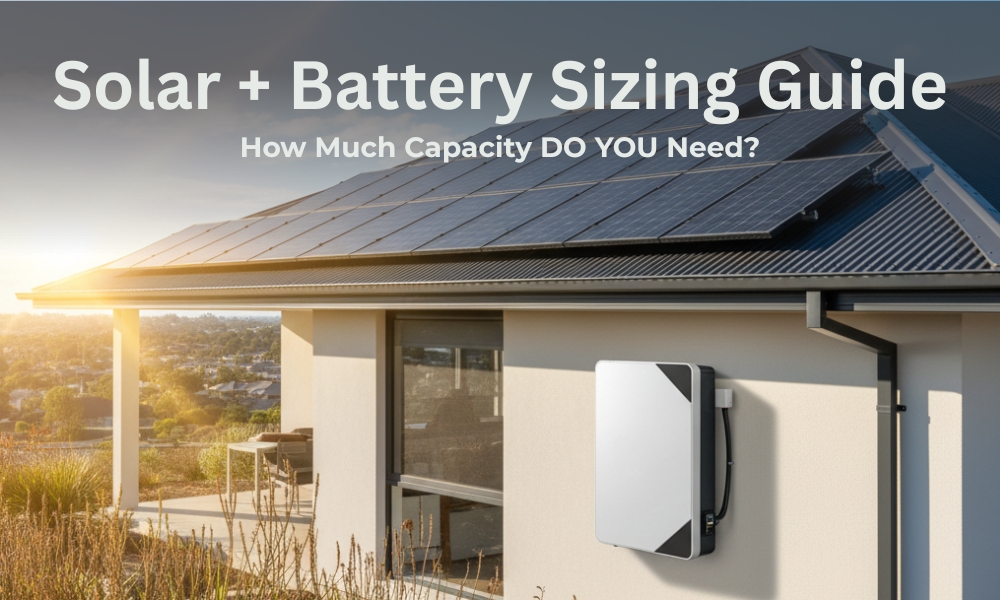
The sun-drenched landscape of Australia offers homeowners an incredible opportunity to embrace solar energy. But with an abundance of options, a common question arises: How much solar and battery capacity does a typical Australian home need?
Understanding your energy consumption and future goals is paramount to making an informed decision that optimises your investment and minimises your carbon footprint. This guide will delve into the factors influencing solar and battery sizing, helping you navigate the path to energy independence. Use Energy Matters’ carbon footprint calculator to calculate your household and business’s direct emissions.
Understanding solar and battery capacity
To determine the ideal system size, it’s essential to understand a few basics:
- Solar capacity (kW): Refers to how much power your solar panels can produce.
- Battery capacity (kWh): The amount of energy your solar battery can store for later use.
The perfect combination depends on your household’s daily consumption patterns, roof space, and budget.
Use Energy Matters’ easy-to-use solar power and battery storage calculator to determine the size of your solar system with storage! Our solar calculator will generate performance information and potential savings.
We can send this information to 3 of our pre-vetted and trusted local installers in your area to receive obligation-free solar quotes and take the first step towards true energy independence!


Step 1: Know your household energy consumption
Before you can determine the ideal solar and battery setup, you need to understand your current energy usage. This can be found on your electricity bills, typically measured in kilowatt-hours (kWh). A “typical” Australian home’s daily consumption can vary significantly, ranging from 15-25 kWh for a smaller household to 25-40+ kWh for larger families with extensive appliance use. Factors like the number of occupants, insulation quality, and the age and efficiency of your appliances all play a role.
| Home Type | Daily Energy Use (kWh) | Recommended Solar System Size (kW) | Recommended Battery Size (kWh) |
| Small home (1–2 people) | 10–15 | 3–5 | 5–10 |
| Medium home (3–4 people) | 15–25 | 5–7 | 10–13 |
| Large home (5+ people) | 25–40+ | 8–10+ | 13–20+ |
Step 2: Calculate your solar power requirements
The size of your solar panel system, measured in kilowatts (kW), directly correlates with its electricity generation potential. To estimate your required solar capacity, you’ll need to consider your average daily energy consumption. A good rule of thumb is to aim for a system that can generate slightly more than your daily usage to account for cloudy days and potential future increases in consumption.
For example, if your average daily consumption is 20 kWh, consider a 5 kW solar system. A 5 kW system in a sunny location like Queensland could generate approximately 20-25 kWh per day.
Step 3: Determine your solar battery storage needs
Solar battery sizing in Australia depends on how much energy you want to store and use overnight or during blackouts. A good rule of thumb:
- Small users (10–15 kWh/day): 5–8 kWh battery
- Medium users (15–25 kWh/day): 10–13 kWh battery.
- Large users (25–40 kWh/day): 13–20+ kWh battery or dual-unit setup.
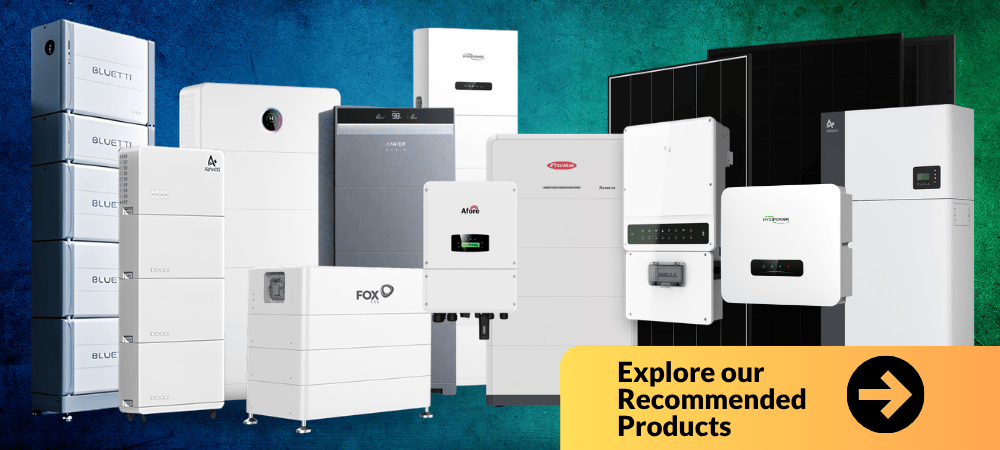
Check our page for our recommended solar products.
Step 4: Consider regional differences in solar output
Australia’s climate varies, affecting how much energy solar systems can produce. Homes in sunnier states like Queensland or Western Australia can install slightly smaller systems than those in Victoria or Tasmania.
| City | Average Sun Hours/Day | Optimal Solar System Size (kW) |
| Sydney | 4.5 | 5–6 |
| Melbourne | 4.0 | 6–7 |
| Brisbane | 5.0 | 5 |
| Perth | 5.5 | 4–5 |
| Adelaide | 4.8 | 5–6 |



Step 5: Factor in your lifestyle and energy goals
Your household habits greatly influence your solar and battery requirements. Consider the following:
- Daytime energy use: If you’re home during the day, you’ll rely less on battery storage.
- Nighttime consumption: More nighttime energy use (e.g., air conditioning, EV charging) increases battery size needs.
- Future-proofing: Planning to buy an electric vehicle or add appliances? Opt for a larger solar system to accommodate future demand.
- Backup needs: If you want backup during outages, ensure your system supports full or partial home backup functionality.
Step 6: Understand solar battery sizing in Australia
Proper solar battery sizing in Australia ensures your system meets both your power demands and budget. Oversizing can lead to unnecessary costs, while undersizing limits your savings.
Key tips for correct sizing:
- Match your battery to your energy profile. Avoid buying a battery too small to meet overnight needs.
- Check discharge depth (DoD). Choose batteries with higher DoD (e.g., 90–100%) for better efficiency.
- Consider hybrid systems. Combine solar and battery storage for greater flexibility and reduced reliance on the grid.
Step 7: Explore government rebates and incentives
Government support makes solar and battery installation more affordable. Homeowners may be eligible for:
- Small-scale Technology Certificates (STCs) – A national rebate reducing upfront solar costs.
- State battery rebates – Programs like Solar Victoria’s Battery Loan and the Northern Territory’s Home and Business Battery Scheme.
- Feed-in tariffs – Earn credits for exporting surplus energy to the grid.
Check current incentives through Energy Matters’ rebate guide.

Optimising your investment
Investing in solar and battery storage is a smart financial move. Government rebates and incentives, such as the Small-scale Renewable Energy Scheme (SRES), can significantly reduce the upfront cost. Furthermore, by reducing your reliance on grid electricity, you’ll save money on your power bills for years to come.
To further optimise your investment:
- Monitor your energy usage: Regularly reviewing your consumption patterns can help you identify areas for efficiency improvements.
- Maximise self-consumption: Use major appliances like washing machines and dishwashers during the day when your solar panels are generating electricity.
- Consider a smart energy management system: These systems can intelligently control your energy flow, optimising battery charging and discharging.
Sizing your solar and battery system correctly is the key to maximising savings and sustainability. By understanding your energy use, sun exposure, and long-term goals, you can create the perfect setup for your home.
Ready to find your ideal system? Don’t wait to power your home with the sun; get quotes today and take control of your energy future with Energy Matters! Discover how much solar and battery capacity your Australian home really needs — the smart way to power your future.