
The European Space Agency’s Jupiter Icy Moons Explorer (JUICE) is a step closer to spending three-and-a-half years examining the environment surrounding the gas giant, assisted by solar power.
The ESA recently announced that earlier this month the project had reached a stage where a prototype craft can now be constructed, which will be subjected to rigorous testing.
“Demanding electric, magnetic and power requirements, harsh radiation, and strict planetary protection rules are some of the critical issues that had to be tackled in order to move ESA’s Jupiter Icy Moons Explorer – JUICE – from the drawing board and into construction,” says ESA.
JUICE’s science payload will be hefty. It includes:
- An optical camera
- A hyper-spectral imaging spectrometer
- UV spectrometer
- A sub-millimeter wave instrument
- A laser altimeter
- An ice penetrating radar
- A magnetometer
- A plasma package with sensors
- A radio plasma wave instrument
- A radio science package
- Standard telecommunication system
All this will consume a significant amount of energy and as JUICE will be operating so far from the sun, a huge solar array will be required.
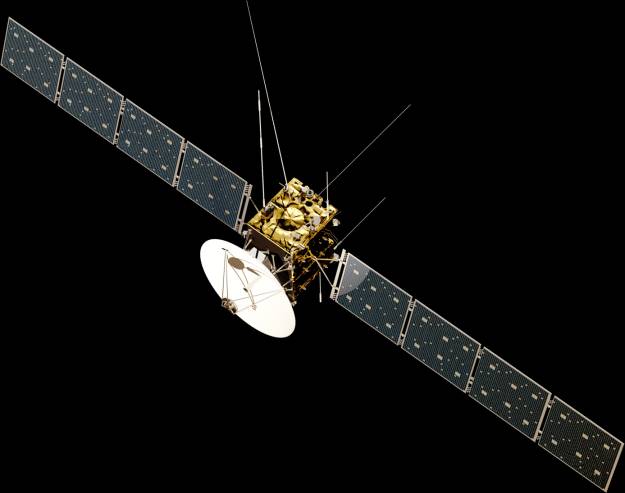
While nearly 100 square metres of solar PV will be hosted on two wings, at that distance the arrays will only be able be able to crank out a maximum 820 watts of power. The solar modules will be comprised of GaAs (Gallium arsenide) solar cells optimized for low-intensity/low-temperature conditions.
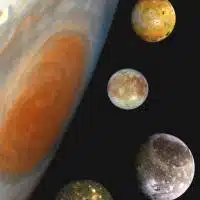
JUICE is scheduled for launch in 2022, with arrival in the Jovian system in 2029. A focus of the mission will be to study Jupiter’s large icy moons: Ganymede, Europa and Callisto. Europa has water ocean beneath its icy surface, with plenty of oxygen available; leading to speculation it could support life. It’s a tad chilly on Europa though – around minus 160 degrees Celsius near the equator.
More on the Jupiter Icy Moons Explorer mission can be viewed here.
Another traveller to Jupiter last year broke the record for humanity’s most distant solar powered spacecraft after NASA’s Juno had reached approximately 793 million kilometers from the sun. Juno successfully entered Jupiter’s orbit in July 2016. At this distance, Juno’s substantial solar array only has an output of 500 watts. Regardless, the craft has been capturing some amazing imagery and providing scientists with reams of valuable data.
You can read more at the Mission Juno web site.
Now is the right time to switch to Brisbane solar energy. We recommend seeking at least 3 solar quotes to ensure that you are getting the best deal and selecting the right solar installer in Brisbane whom you can trust. With this, you can guarantee a solar system in Brisbane that meets your energy needs.