

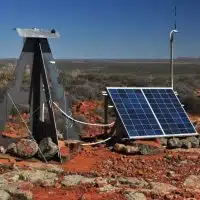
Solar power played an important role in the discovery of a meteorite in South Australia’s outback that made headlines around the world.
At around 9:15 pm on November 27th, 2015, a lump of rock estimated to be 80kg entered Earth’s atmosphere, travelling at about 50,000km/hr. The visitor was around 4.5 billion years old, older than the Earth itself.
While most of these objects tend to vaporize or break up into very small fragments, a 1.6kg remnant survived the searing journey and embedded itself in the middle of Kati Thanda-Lake Eyre South in the state of South Australia.
Finding that small lump of rock would have been like trying to find a needle in a haystack – but it was located thanks to the determination of researchers and technology.
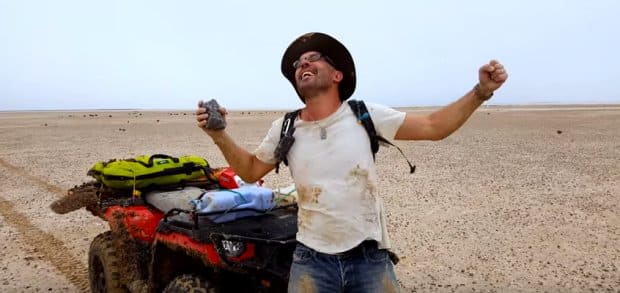
To say the scientist who dug up the meteorite was exuberant over the discovery is probably somewhat of an understatement.
Crucial to the discovery were the Desert Fireball Network camera stations across South Australia’s outback; 4 of which captured the meteorite’s trajectory.
The camera stations consist of a Nikon D800, Samyang 8mm fisheye still camera and a Watec 902H, Fujinon fisheye video camera. The cameras are housed within a waterproof container that incorporates a fan cooling system to protect the camera during the day. Internet connectivity is provided by 3G mobile coverage, or LAN/Wifi, depending on the site.
The still cameras snap pics every 30 seconds during the night , which are processed during the day in the hunt for fireballs. Video is also recorded and deleted in the morning, unless a corresponding fireball is observed.
Solar power systems are used for remote sites, incorporating a couple of small solar panels and a deep cycle battery.
Solar energy has become the power source of choice for the project – even where mains is available.
“At remote sites, solar power has been more reliable than mains, as brief power cuts are not uncommon in the outback, and these result in system re-boots,” according to findings presented at the 46th Lunar and Planetary Science Conference last year.
The Desert Fireball Network is a part of Fireballs in the Sky; a Curtin University project and an Inspiring Australia initiative, supported by the Australian Government through the Department of Industry.
Image credit: Curtain University, Desert Fireball Network