
Researchers at Eindhoven University of Technology (TU/e) and FOM Foundation have unveiled a prototype solar cell that directly produces hydrogen fuel from water.
While using solar power to split water into hydrogen and oxygen isn’t new, it’s often performed with a battery between – adding to the cost.
The researchers have been looking for a semiconductor material able to both convert sunlight into an electrical charge and split the water, all in one. A possible candidate is gallium phosphide (GaP), a compound of gallium and phosphide that is also used for certain colored LEDs.
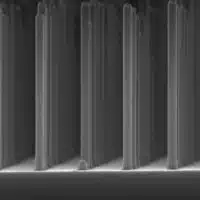
The researchers overcame a challenge of GaP being unable to easily absorb light when in the form of large flat surface by creating a grid of very small GaP nanowires, measuring five hundred nanometers long and ninety nanometers thick.
The nanowire based device boosted the yield of hydrogen tenfold to 2.9 percent. This, the researchers say, is a record for GaP cells. While acknowledging it’s a long way off the fifteen percent achieved by silicon cells connected to a battery, research leader and TU/e professor Erik Bakkers says there is plenty of room for improvement.
“For the nanowires we needed ten thousand less precious GaP material than in cells with a flat surface,” stated Professor Blakkers. “That makes these kinds of cells potentially a great deal cheaper.”
Details of the prototype have been published in the journal Nature Communications.
Another interesting development to come out of Eindhoven University of Technology recently are solar noise barriers.
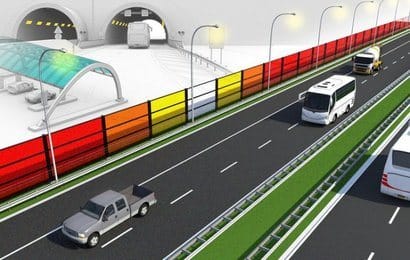
Alongside the A2 highway near Den Bosch two small noise barriers are being tested that have the additional function of generating solar electricity. The luminescent solar concentrators ( LSC) panels used, developed by researcher Michael Debije at TU/e, guide concentrated light side of the panels where solar cells are present.
In addition to offering pleasing aesthetics, the LSC panels are low cost, robust and will work in cloudy conditions.
While not particularly efficient in comparison to standard solar panels, a one kilometre stretch of the solar electricity generating noise barrier could power up to 50 homes.
More information on the LSC noise barrier can be viewed here.