

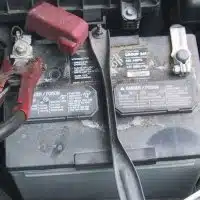
MIT researchers have created perovskite solar cells using the lead recovered from old car batteries.
Car batteries have a high degree of recyclability; for example the lead in a battery can be used to make more batteries. But with lead-free car batteries on the horizon; a major market for this lead could disappear.
An emerging solar material is perovskite – and the most efficient perovskite solar cells all contain lead.
Seeing an opportunity, Paula Hammond, head of the Department of Chemical Engineering, and Angela Belcher, a professor in biological engineering and materials science and engineering at MIT, set to work to determine if recovered lead from car batteries could create high quality solar cells.
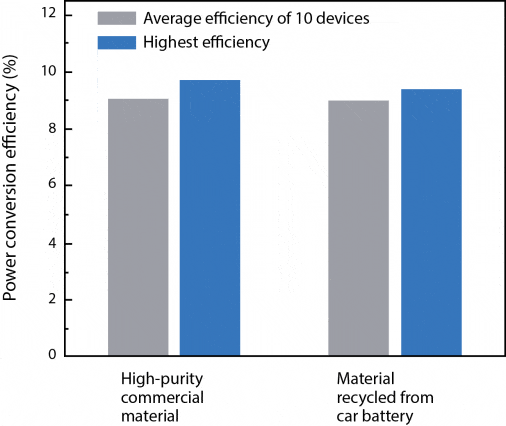
They were successful – using a simple procedure, the pair and their team have constructed perovskite solar cells with similar efficiencies to those made with high-purity commercial lead iodide.
Here’s how the process works.
- The batteries are drained and rinsed with water, then disassembled.
- Lead is extracted from the anode and lead dioxide from the cathode; the latter then processed to make lead oxide.
- Both are then dissolved in acids and mixed with aqueous potassium iodide.
- The lead iodide precipitate is dried to a powder, dissolved in solvent and spin coated onto a substrate.
- The lead iodide film then goes through a reaction with organic halide to form perovskite.
A little lead can go a long way in perovskite solar cell production. The researchers estimate one lead-acid car battery could provide enough lead for the fabrication of more than 700 square meters of perovskite solar cells; based on a perovskite thin film layer half a micrometer thick.
Powering the entire USA would take about 12.2 million recycled car batteries, fabricated into 8,634 square kilometers of perovskite solar panels operating under conditions similar to those in Nevada. This number of car batteries is just a fraction of the amount currently in service in the USA (around 250 million).
While lead is toxic, it can be encapsulated in other materials to prevent leaching and environmental contamination and still remain recoverable. Even so, Professors Belcher and Hammond are also investigating alternatives to the use of lead in high efficiency perovskite solar cells.