





Scientists at Karlsruhe Institute of Technology (KIT) have come up with an interesting approach to boosting the conversion efficiency of solar panels.
Even the most efficient solar panels only convert a fraction of the sun’s energy into electricity. A number of issues impact on panel efficiency, include heat, shading and general quality of the solar cells used.
Another factor are the cell contact fingers – these are the small lines on cells that carry the current generated. Up to ten percent of a solar module’s surface may be covered by these contacts, which are “optically dead” areas.
If the contacts could be made “invisible” using a cheap method easily integrated into existing solar cell manufacturing, it could provide a significant boost in efficiency; enabling valuable rooftop real estate to be better utilised and further reducing costs of solar power projects.
The researchers at KIT believe they have found a way to do this – perhaps a couple of ways.
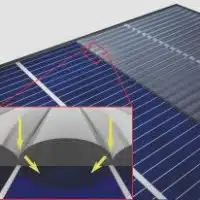
The first involves coating the fingers in a polymer shaped in a way to refract sunlight onto an active part of the cell. The other also uses a polymer coating, but this method involves the surface of the cloak layer being grooved along the contact fingers, refracting light away from them and onto the active surface area of the solar cell.
“The second concept is particularly promising, as it can potentially be integrated into mass production of solar cells at low costs,” according to the team.
Computer models indicate both methods would be successful.
“When applying such a coating onto a real solar cell, optical losses via the contact fingers are supposed to be reduced and efficiency is assumed to be increased by up to 10%,” said doctoral student Martin Schumann, who carried out the experiments and simulations.
The technology could also be used with other optoelectronic devices where efficient coupling to light with minimal losses is highly desirable, such as in light-emitting diodes or optical detectors
For a more uber-geeky explanation of the concepts, read the team’s paper, “Cloaked contact grids on solar cells by coordinate transformations: designs and prototypes”, which can be accessed here.
The Karlsruhe Institute of Technology was established by the merger of the Forschungszentrum Karlsruhe GmbH and the Universität Karlsruhe (TH) in 2009