




If you’re mid-way through getting battery quotes right now, you’ve probably noticed something odd: solar is having a record year, but the battery your installer is recommending looks smaller than what a neighbour installed six months ago. That’s not a coincidence, and it’s not really about demand cooling off. It’s about a rebate formula that changed on May 1, and most buyers still haven’t clocked what it means for their own sizing decision.
The two numbers that don’t match
Rooftop solar installs in Australia are tracking about 41% ahead of the same point last year, according to SunWiz. Batteries, by contrast, had a rough June, with registered capacity down close to 30% on May, and the average system size shrinking from an oversized ~50 kWh norm toward a 20-30 kWh range.
It’s tempting to read that as households losing interest in storage while solar keeps humming along. But that reading misses the actual mechanism. Solar wasn’t touched by any policy change. Batteries were, and it happened on a specific date: May 1, 2026.
What changed, in plain numbers
Before May 1, the Cheaper Home Batteries Program applied roughly the same rebate rate across a battery’s entire capacity. If bigger batteries earned proportionally the same support as smaller ones, then installing as much capacity as the program allowed was close to a free lunch, and average system sizes had reportedly doubled in the months before the change, according to Solar Choice.
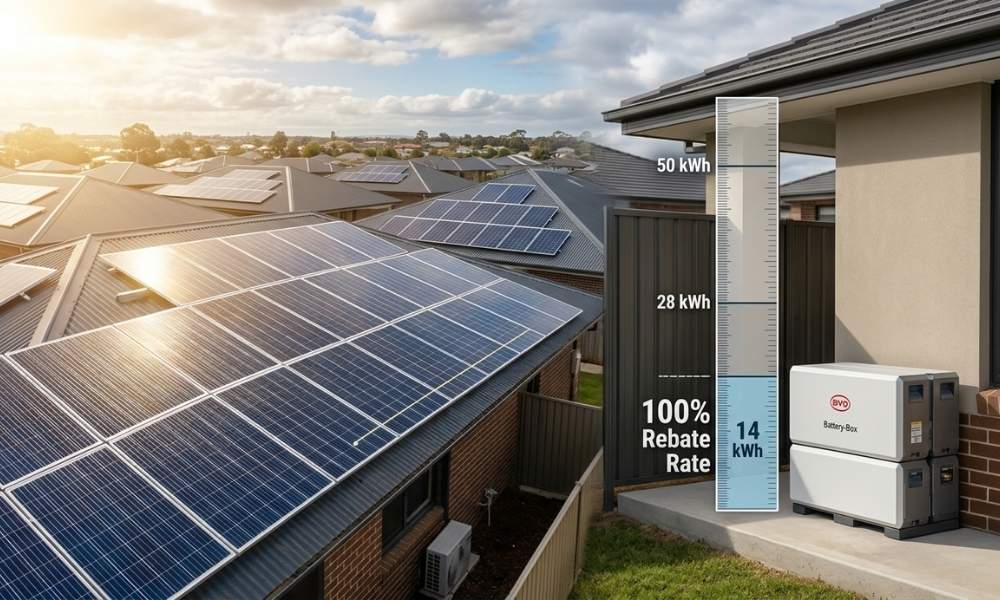
The Clean Energy Regulator confirmed the new structure taps the brakes on that math. From May 1, the STC factor (the mechanism that determines rebate value) now tapers in three bands:
- 0 to 14 kWh: full rebate rate (100%)
- 14 to 28 kWh: 60% of the rebate rate
- 28 to 50 kWh: just 15% of the rebate rate
In practice, this means the last few kWh of a 45 kWh system are earning a fraction of the support the first 14 kWh get. The Department of Climate Change, Energy, the Environment and Water has framed the change as an attempt to hold the discount around 30% across typical system sizes, rather than letting it concentrate on oversized installs.





Running the actual math
Say you’re comparing a 20 kWh system to a 40 kWh system, both quoted after May 1.
The 20 kWh system gets the full rate on its first 14 kWh, then the 60% rate on the remaining 6 kWh. Almost all of its capacity is earning strong support.
The 40 kWh system gets the same full rate on its first 14 kWh and 60% on the next 14 kWh (up to 28 kWh), but the remaining 12 kWh, nearly a third of the whole system, only earns 15% of the rebate rate. You’re paying close to full price for that last chunk of capacity, even though the sticker price per kWh looks similar to the smaller system on paper.
That’s the actual reason the market’s “centre of gravity” moved to the 20-30 kWh band. It’s not that households decided they wanted less storage. It’s that the 20-30 kWh range is now where the rebate dollars stretch furthest per kWh installed.
Why this didn’t touch solar at all
Solar panels sit under a completely separate part of the incentive scheme and weren’t part of the May 1 restructure. That’s the entire explanation for the divergence: one technology had its subsidy formula rebuilt around capacity tiers, the other didn’t. There’s no deeper story about consumer sentiment splitting between the two. It’s a policy lever pulled on one side of the meter and left alone on the other.
So is the “battery slowdown” something to worry about?
Industry analysts don’t seem to think so, and the underlying volumes back that up. SunWiz’s Warwick Johnston has described the June dip as a “controlled reset,” pointing out battery volumes are still running at roughly triple where they sat a year earlier. Multiple installer-facing sources note the government’s own goal here was to stop oversized systems draining the program budget before more households got a chance to use it, not to discourage battery uptake generally.
What this actually means for your quote
If you’re sizing a system right now, three things are worth checking with your installer:
- Ask where your quoted capacity sits relative to the 14 kWh and 28 kWh thresholds. A system that lands just over 28 kWh may be paying full price for a meaningful chunk of its capacity, so it’s worth asking whether trimming back to just under that line, or building in the 14-28 kWh band, gets you a better rebate-to-capacity ratio.
- Match capacity to what you’ll actually use, not what the rebate used to reward. A typical Australian household uses somewhere in the order of 15-20 kWh a day. The old incentive to “go as big as the program allows” no longer holds up financially the way it did before May 1.
- Check the brand’s stacking increments. Several of the major brands (BYD, Sungrow, GoodWe, Alpha ESS) build in stackable modules that land neatly inside the 20-30 kWh sweet spot, which makes it easier to size a system that maximises rebate value without over-committing capacity you won’t use.
The record solar numbers and the softer battery numbers aren’t opposing signals about where the market is heading. They’re two technologies responding to two different sets of rules, and only one of those rulebooks changed. For battery buyers, the practical upshot is straightforward: the biggest system on the quote sheet isn’t automatically the best value anymore, and checking where your capacity sits against the new tiers matters more than chasing kWh for its own sake.
Rebate figures above reflect the Cheaper Home Batteries Program structure confirmed by the Clean Energy Regulator and DCCEEW, in effect from May 1, 2026. Market volume figures are drawn from SunWiz data as reported in mid-2026. Rebate settings are scheduled to adjust further over time, so confirm current STC factors with your installer before signing a quote.