





It’s been a long time coming and the moment has finally (nearly) arrived. The Planetary Society has announced the first of two LightSail spacecraft will be launched into space in May, carried by an Atlas V rocket.
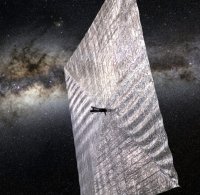
Solar sails work on the principle of reflected light pressure propulsion through the push of photons against a mirror-bright surface.
We first wrote about the LightSail project back in 2009. At that point in time, the Society had planned a test by the end of 2010 after two failed attempts in 2001 and 2005 due to rocket trouble. The 2010 test also didn’t eventuate.
But it seems it’s all systems go for the May test, when a 3-unit CubeSat will spend around a month in orbit; communicating with mission control, deploying its solar sails and sending images back to Earth.
Deploying the sails is no mean feat. Solar sails with combined area of 32 square meters are packed into the tiny CubeSat, which has dimensions of approximately 10cm x 30cm.
LightSail’s four solar panels will swing open; then a small motor will engage and extend four, tape measure-like metallic booms from the spacecraft’s lower compartment. These booms will pull the four, triangular Mylar sails out of storage.
The mission will be short, just 2 – 10 days. During that time, LightSail’s two inward-facing cameras will capture timelapse images of the deployment sequence and record how the large sail performs in a microgravity environment.
The May mission will be closely watched by NASA, which is preparing for two of its own two small-scale solar sail missions; NEA Scout and Lunar Flashlight. NEA Scout will visit a near-Earth asteroid and Lunar Flashlight will remain at the moon, using its solar sail to reflect sunlight into permanently shadowed lunar craters. Both craft will have sail areas double that of LightSail.
The LightSail project has been funded with private donations.
“There’s an old saying in aerospace, ‘One test is worth a thousand expert opinions.’ After six years of development, we’re ready at last to see how LightSail flies,” said Bill Nye (The Science Guy), CEO of The Planetary Society.
The LightSail project’s progress can be viewed at sail.planetary.org.
Solar sail trivia: In 2010, Japan Aerospace Exploration Agency’s (JAXA’s) “IKAROS ” solar sail craft unfurled its solar sail and generated the largest amount of acceleration through photon power in the history of interplanetary flight.