






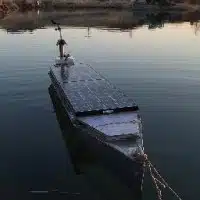
The Solar Voyager is (slowly) making its way across the Atlantic. If it succeeds, it will be the first autonomous craft to do so.
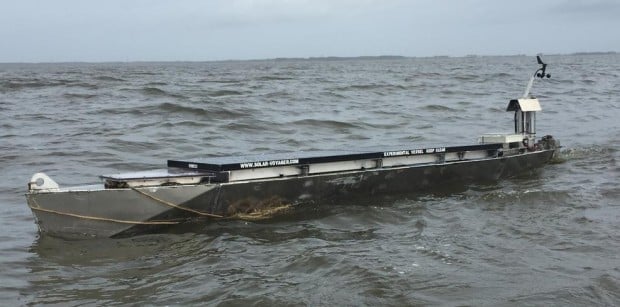
According to the Solar Voyager web site, the kayak is more than four metres in length and one metre in width. Solar Voyager is powered by two solar panels providing 240 watts capacity.
The site states the panels can generate up to 7 kWh per a day during summer or up to 3 kWh per day in winter. However, this would appear to be a mistake. The capacity of the panels couldn’t possibly generate this amount and their flat installation would further impede their output. It may be there are 2 x 240 watt panels given the size of the craft and the space the panels occupy; but even then the stated output is a little optimistic.
The craft doesn’t appear to have any sort of energy storage of significance for propulsion (it’s not mentioned) – so this would mean daylight only travel; and even then there would need to be suitable solar conditions.
Almost all the power is consumed by the propulsion actuator, with what’s left used by various electronics; including satellite communications. The boat links in with the Iridium network, which consists of 66 satellites – so Voyager can communicate its position from any point on the planet at any time.
For a kayak, this is no lightweight. It weighs around 250kg, with much of this due to having an aluminium hull. While it’s a lot to push through the water, the added weight offers increased inertia, improving stability. It also offers the craft additional robustness in the event of knocks.
“Focusing on reliability rather on performance, we concluded that this was a reasonable compromise,” say the team.
Launched at the beginning of this month, Solar Voyager had traveled nearly 439 kilometres at the time of writing – you can track its progress here. Even at this early stage, there’s been some drama. On June 7, the kayak reported a rudder fault condition causing the rudder to not move. This was fixed by the team with that well known fix for all computer stuff – a shutdown and reboot.
The lonely journey from Gloucester, Massachusetts to Lisbon, Portugal, is expected to take four months. This is the second attempt at a crossing, with the first attempt in 2015 abandoned due to a “fatal failure”.
The project is the brainchild of Isaac Penny and Christopher Sam Soon, who started on it in 2013.
Unmanned marine vessels are increasingly appearing on our oceans; including Liquid Robotics’ Wave Glider. In March, we reported its fleets of solar assisted vessels had clocked up 1 million nautical miles. They’ve endured all sorts of challenges, including 17 hurricanes. Controlled via a satellite watch room, the craft are cutting costs and reducing risks involved with offshore surveillance activities.