



Here’s a number worth sitting with: the average Australian drives about 33 kilometres a day.
That’s the school drop-off, the supermarket run, the commute to work and back. It’s a lot of life packed into a relatively short distance, and it’s well within the range of almost every electric vehicle on the market today.
So why aren’t more Australians making the switch? Because Australia isn’t just school runs and supermarkets. It’s also a country of vast distances, long weekends on the highway, and regional towns where the nearest fast charger might be a very long detour. For families who love a road trip to the coast, or who have relatives a few hours out past the suburbs, the anxiety of running flat in the middle of nowhere is a completely rational fear. Range anxiety is real, and dismissing it doesn’t make it go away.
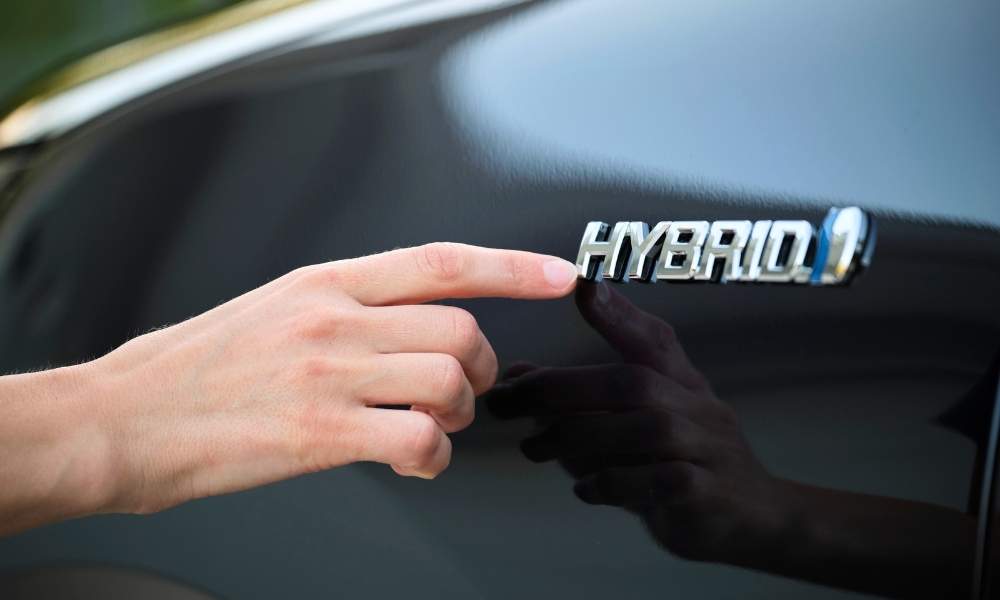
This is exactly where the modern Plug-in Hybrid Electric Vehicle (the PHEV) makes its case. Think of it as the “90% EV”: a car that handles your everyday driving entirely on electricity, while quietly keeping a petrol engine in reserve for the moments when you actually need it. It’s not a compromise. It’s a genuinely clever solution for the way most Australians actually live.
The daily routine
Let’s start with the numbers that matter most for day-to-day life.
Today’s PHEVs typically offer between 60km and 80km of pure electric range. Set that against that 33km daily average, and the maths is almost embarrassingly simple: most Australians could complete their entire week of driving without burning a single drop of petrol.
What makes this even more achievable is how PHEVs are charged. Unlike a full-battery EV, which benefits from a faster wallbox charger installed in the garage, a PHEV’s battery is considerably smaller, typically 10-20 kWh. That’s small enough to top up overnight using nothing more exotic than a standard 10-amp household power point. The same socket you plug your kettle into. No expensive charger installation required, no electrician needed, no upfront infrastructure cost.
For those who aren’t quite ready to commit to a full charging setup, this is a meaningful advantage. You park the car, plug it into the wall like you’d charge a phone, and wake up to a full electric tank.
The solar connection
Here’s where things get genuinely exciting for the growing number of homes with rooftop solar.
Australia has one of the highest rates of household solar adoption in the world, and for good reason. The sun is reliable, the panels are affordable, and the savings on power bills are real. But for most households, a chunk of that solar energy is generated during the day when nobody’s home to use it, and it ends up exported to the grid for a modest feed-in tariff. A PHEV changes that equation.
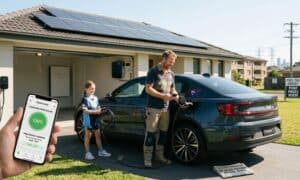
Since the battery is small, it charges quickly. Plug the car in on a sunny morning before you leave, or set it on a timer for peak generation hours, and you can fill a significant portion of that electric range using energy your roof produced for free. Depending on your solar system’s output and your driving patterns, you could realistically cover most of your weekday driving at close to zero fuel cost.
Think about what that means over a year. Petrol prices in Australia have been volatile, and the weekly fuel bill for a typical family car adds up fast. A PHEV paired with solar doesn’t just reduce that bill. It effectively turns your roof into a fuel station. The energy flows from the sun, into your panels, into your car, and onto the road. It’s a closed loop that makes financial sense from day one.
The safety net that changes everything
Now for the part that separates the PHEV from a full EV for a lot of buyers.
Let’s say it’s the long weekend in October. You’re loading up the car for a drive down to the family farm, or heading up to the mountains, or making the run to the coast for a few days away. In a full EV, that trip requires planning: checking charging station locations, building in stops, hoping the fast charger at the servo isn’t occupied or out of order.
In a PHEV, you just… drive.
When the electric range runs out on the highway, the petrol engine takes over. Seamlessly. Quietly, no alerts, no anxiety, no pulling off the highway hoping there’s a charger at the next town. You stop for fuel when you want to stop, at a servo you choose, and you’re back on the road in five minutes.
This isn’t a step backwards. For many families, it’s the thing that makes electrification actually feel achievable rather than aspirational. The road trip stays enjoyable. The holiday stays relaxed. And when you get home, you plug back in, wake up to a full electric charge, and go back to driving on sunshine for the rest of the week.



Is a PHEV right for you?
Not everyone is the ideal PHEV buyer, and knowing which category you fall into saves a lot of deliberation.
A PHEV probably makes a lot of sense if:
- You’re a single-car household and need one vehicle to cover both daily driving and the occasional long trip
- You live in or frequently travel to regional areas where fast-charging infrastructure is still patchy
- You already have rooftop solar and want to cut your fuel bill immediately without changing how you travel
- You want the psychological safety net of a petrol engine while you build confidence with electric driving
A full EV might be the better call if:
- Your household runs two cars, making one pure EV is an extremely efficient setup, with the second car covering longer trips
- You live close to a solid network of fast chargers and rarely venture beyond it
- You want to eliminate petrol costs and servicing entirely and are ready to plan longer drives around charging stops
The right choice is the one that fits how your household actually operates, not how you think you should operate.
The bigger picture
There’s a tendency in the EV conversation to treat is as binary: you’re either all-in on electric, or you’re not serious about the transition. That framing isn’t helpful.
The real goal, for household budgets, for emissions, for energy independence, is to move as much of your daily transport as possible onto clean electricity. A PHEV does that extremely well for the vast majority of days. It just happens to carry a backup plan in the boot for the days when it needs to.
Whether you eventually graduate to a full EV or stick with a PHEV for the long term, the principle is the same: the less petrol you burn, the more your driving runs on energy you generate yourself. And in Australia, with the rooftop solar infrastructure that already exists across millions of homes, that is not a distant ambition. It’s available right now.
The modern PHEV isn’t a halfway measure. For the right household, it’s a practical, intelligent step toward making your daily transport as clean and affordable as possible, without asking you to change anything about the trips that matter most.
Energy Matters has been in the solar industry since 2005 and has helped over 40,000 Australian households in their journey to energy independence.
Complete our quick Solar Quote Quiz to receive up to 3 FREE solar quotes from trusted local installers – it’ll only take you a few minutes and is completely obligation-free.