







Researchers at Case Western Reserve University are utilising iron to create a flow battery; a scalable energy storage system that can service a single home or an entire community.
We’ve reported on flow battery technology in the past – it refers to a form of battery in which all electroactive components are dissolved in the electrolyte, rather than using solid electrodes that are consumed over time as part of the fuel, such as in the case of a normal deep cycle battery.
In a flow battery, the chemical solutions are stored in two tanks and the electrodes in a separate chamber. The solutions are pumped one direction through the chamber to charge the battery and the other direction to discharge it.
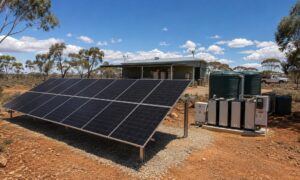
The researchers’ goal is to create an economic and efficient battery system that could be used to store surplus energy created by wind turbines and solar panels, for use in conditions when electricity is not being produced.
Robert Savinell, professor of chemical engineering at Case Western Reserve, refers to their project as the “rustbelt battery”.
Our previous story was on a vanadium based flow battery – but iron is as little as 1% of the cost of vanadium. The researchers estimate because of the low cost of components, the iron-based battery would cost USD$30 per kilowatt-hour; well below a $100 per kilowatt goal set by Sandia National Laboratories.
Highly corrosive sulfuric acid is also used in vanadium flow batteries, so the researchers are focusing their efforts on developing a safer chemistry for the rustbelt battery. “I wouldn’t want to put anything in the battery that you couldn’t swim in.” says Jesse Wainright, a fellow chemical engineering professor at Case School of Engineering.
A large-scale iron based flow battery that could store up to 20 megawatt-hours of electricity would require two storage tanks for the iron solutions of about 250,000 gallons. A system of that size would provide enough electricity storage to supply the power needs of 650 homes for a day.
The US Department of Energy’s Office of Electricity Delivery and Energy Reliability is funding the iron flow battery research with a grant of USD $600,000.