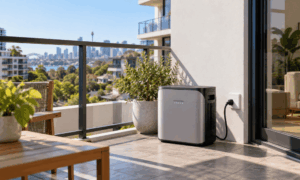






Missing the boat is never an easy pill to swallow. Hundreds of thousands of Australian homes took advantage of the very generous Cheaper Home Batteries Program from mid-2025, which will soon taper down from 1 May 2026. Whether you waited due to financial constraints or were not convinced of the ROI at the time, you might now wish you could turn back the clock. Your next-door neighbour who jumped on board and installed a battery might be gloating about their electricity savings while cost-of-living pressures continue to mount.
Is it too late? Not even close. Home battery storage still delivers strong financial benefits, and in many cases, those benefits will only grow as energy prices rise and feed-in tariffs continue to fall. The key difference now is timing. Acting sooner means securing a higher rebate, reducing upfront costs, and accelerating your path to savings.
Why timing matters more than ever
From 1 May 2026, the federal battery rebate begins its gradual decline, tapering every six months until it eventually phases out. While the reduction may not feel dramatic at first glance, it compounds quickly. A system installed today will attract a higher rebate than the same system installed later this year, and significantly more than one installed in 2027 or beyond.
This means that delaying your decision does not just postpone savings; it actively increases the cost of entry. For households already considering a battery, the financial logic is simple. Lock in the highest available incentive now, rather than paying more for the same technology later.
What will a battery cost from May?
Using real-world pricing already seen across the Australian market, a typical installed battery system from May 2026 is expected to sit within the following ranges:
- 10 to 13 kWh systems: $12,000 to $16,000 installed
- 15 to 20 kWh systems: $16,000 to $22,000 installed
- 20 kWh+ systems: $22,000 to $30,000+ depending on configuration
A 20 kWh system is increasingly the sweet spot for Australian households. It maximises the remaining rebate, provides strong overnight coverage, and significantly reduces reliance on the grid. For those with higher energy usage or a desire for full home backup, larger systems can deliver even greater long-term value.
Real-world savings: what can you expect?
The financial case for batteries has shifted. It is no longer about exporting excess solar for a small credit. It is about using your own energy when electricity prices are at their highest.
For a typical household:
- Daily usage often sits between 15 and 25 kWh
- Feed-in tariffs are commonly 5 to 10 cents per kWh (much lower in states like Victoria)
- Grid electricity costs around 30 to 50 cents per kWh
Without a battery, you sell low and buy high. With a battery, you store that solar and use it later, which changes everything.
Typical annual savings can include:
- $800 to $1,500 per year from avoided grid usage
- Additional savings through time-of-use optimisation
- Further upside from virtual power plant participation
Many households are now seeing payback periods of around six to eight years, even as the rebate begins to taper.
Protection against rising energy costs
Electricity prices in Australia have been trending upwards for years, and there is no sign of that slowing. A battery acts as a buffer against these increases by reducing how much power you need to buy from the grid.
Key benefits include:
- Reduced exposure to peak pricing periods
- Greater control over when you use electricity
- Less reliance on retailer pricing structures
In simple terms, a battery shifts control back into your hands. You generate it, you store it, and you decide when to use it.
The value you cannot measure on a spreadsheet
While the financial returns are compelling, they do not tell the full story. Some of the most important benefits of battery storage sit outside a traditional ROI calculation.
A properly configured system with whole-home backup can provide:
- Blackout protection for lighting, refrigeration, and essential appliances
- Continued operation during grid outages or extreme weather events
- Peace of mind during bushfire season or network instability
There is also a broader, more forward-looking benefit. Energy systems are changing rapidly, and global or local disruptions can impact supply chains, fuel availability, and electricity pricing. While this is purely hypothetical, having your own generation and storage gives you a level of independence that doesn’t have a price tag.
In a world where uncertainty is becoming more common, energy security is not just a luxury; it is a safeguard.
Why a 20 kWh battery makes sense
Choosing the right system size is critical, and for many Australian homes, a battery around 20 kWh offers the best balance between cost and performance.
This size typically allows you to:
- Store excess solar during the day for full evening and overnight use
- Reduce grid reliance to minimal levels
- Support whole-home backup, depending on system design
- Maximise the remaining rebate without overspending
If your budget allows, going larger can further improve resilience and future-proof your home. However, even a well-sized 15 to 20 kWh system can deliver excellent outcomes for most households.
Freedom has no price tag
At its core, this is not just a financial decision. Yes, the numbers stack up, and yes, batteries can pay for themselves over time. However, the real value lies in what they enable.
A home battery gives you:
- Energy independence from rising electricity prices
- Control over how and when you use your power
- Security during outages and uncertain conditions
- A pathway toward a fully electrified, self-reliant home
From 1 May, the rebate begins to fade, but the opportunity does not disappear. If anything, the case for acting now becomes stronger. Every six months you wait, the incentive shrinks, the cost increases, and the payback stretches.
The reality is simple. Batteries are still worth it, and for many households, they are becoming essential. The sooner you install, the sooner you take control, and that is something no rebate can truly replace.