



Apartment dwellers and renters have been watching the wide adoption of home battery installations without a viable equivalent, and a small number have started improvising.
A small handful of Aussies are already plugging portable home batteries into their household circuits without official approval. Aside from it being illegal under current rules, it’s also a sign of how much demand exists for storage in a housing type that has been effectively excluded from the battery boom.
Three things have changed this month that make this conversation more urgent. Here is what each one means:
What people are doing and why it’s not legal yet
The appeal is there: a portable battery charged during the Solar Sharer free electricity window, which launches on 1 July in NSW, South East Queensland, and South Australia, could cover several hours of evening household use. For a renter paying 30-35 cents per kWh for grid electricity after 4pm, the value proposition is straightforward.
The problem is a specific piece of electrical infrastructure.
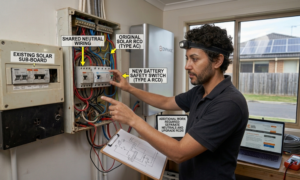
Most older homes and apartment buildings have Type AC residual current devices, the safety switches that cut power when a fault is detected. These were banned in new Australian installations from May 2023 because they cannot detect certain faults involving direct-current components. Portable home batteries produce direct current, and plugging one into a circuit protected by an older AC RCD creates a fault detection problem that the safety switch was not designed for.
Glen Morris, a prominent battery and solar tester, has pointed this out as the core concern. The issue is not that regulators are moving slowly for its own sake. The rules exist because the safety infrastructure in most rental properties was not built for this use.
It is also straightforward to buy batteries approved for use in Germany and plug them into an Australian power point. That does not make it compliant with Australian electrical standards. Australian Standards for electrical wiring and battery installation would need to change before plug-in batteries could be used legally in a residential home here.
Germany registered 430,000 plug-in balcony solar systems in 2025, accounting for 3.2% of the country’s new solar capacity that year. The difference is not the technology. It is that Germany has clearly approved device standards and installation limits, while Australia doesn’t have that framework yet.



What type of portable batteries are illegal for use in Australia?
It is important to note that the restrictions do not apply to standard portable power stations used as standalone appliances. Products such as portable batteries from Anker SOLIX, BLUETTI, EcoFlow, and similar brands can be legally used to power appliances directly from their built-in outlets.
The concern relates to a different class of product known as a “plug-in battery” or “balcony battery”, which is designed to export electricity back into a home’s electrical wiring through a standard power point. Under current Australian electrical standards, these plug-and-play systems are generally not approved for grid-connected operation. As a result, apartment owners and renters should not confuse portable power stations with the plug-in battery systems being discussed. Portable batteries remain a legal and practical solution for backup power, camping, outdoor activities, and powering appliances directly.
The campaign to change the rules
Rewiring Australia has submitted to the NSW Government’s consultation on minimum energy efficiency standards for rental homes, calling for a right to plug in. Under the proposal, renters would be allowed to use approved plug-in devices, including balcony solar systems, portable batteries, and EV chargers, without requiring permanent changes to the property.
Anker SOLIX’s Australian sales manager Phil Krok recently shared that the Solar Sharer Offer is the policy that will unlock the value of plug-in products for renters. “Younger Australians are the majority who rent and don’t have access to renewable resources,” he said. “I sit in that category and am pretty happy to have this fight.”
A motivated government could bypass the Australian Standards process by making new regulations directly. Whether the federal or state governments move on this in the 12-18 months is an open question. For now, plugging an overseas-approved device into an Australian household circuit remains illegal.

The legitimate option that just launched: SolShare 2
On June 15, 2026, Melbourne-based Allume Energy launched SolShare 2. The original SolShare, released in 2019, allowed a single rooftop solar system to be shared across multiple apartments in the same building. SolShare 2 adds battery storage to that shared system.
This is a building-level solution. It requires body corporate or owners corporation approval and a rooftop that can accommodate shared solar panels. For apartment buildings that clear those conditions, it is the first legitimate pathway to battery storage in a multi-residential setting in Australia.
For any apartment dweller reading this: Does your building have rooftop solar, or has the body corporate discussed it? If yes, SolShare 2 is worth raising at the new owners’ meeting. If the building has no solar at all, that conversation starts first.
The no-installation option: Solar Sharer
This is ideal for apartment dwellers whose building is not going to approve anything soon.
The Solar Sharer Offer gives households within the Default Market Offer (DMO) areas with a smart meter at least 3 hours of free electricity daily from 1 July, during the middle of the day when rooftop solar floods the grid. This means you don’t need solar panels, a battery, and strata approval.
The condition worth checking before assuming eligibility: the property must already have a smart meter, which is a landlord’s decision. Check your electricity bill or call your retailer.
Without a battery, the free window only helps if you are home and actively running appliances during those hours, or have appliance timers set in advance. A renter who is out all day captures very little of it. This is precisely why the campaign for legal plug-in batteries has gained momentum alongside Solar Sharer: the two are more useful in combination than either is alone.
Victoria is not part of the initial rollout. The state’s Midday Power Saver launches October 1, 2026, with a free window from 11am to 2pm daily.
Where this leaves apartment dwellers right now
The legal options in mid-2026 are SolShare 2 at the building level, and Solar Sharer at the individual level for those with smart meters. Neither requires buying a portable battery.
Plug-in batteries are spreading through apartments because people want storage, and the legal options are limited. Rewiring Australia, Anker Solix, and energy consultants are actively pushing for the rules to change. The argument is not whether they should, but how fast regulators move.
In the meantime, a portable battery bought online and approved for use in Germany is not approved for use in Australia, regardless of where it was purchased or what the product listing says.