




Deep cycle batteries provide those living off grid to store power for use during times when their renewable energy system can’t keep up with demand or if inclement weather conditions prevail. Aside from the cost of a deep cycle battery, their size and weight can also be an issue – for example, a 230 AH battery can weigh up to 75 kilograms.
Thanks to the surge of interest in electric cars, improved energy storage solutions are getting much needed attention and a variety of innovations with good potential are being developed, such as the Beltway battery and even a virus battery.
Research work funded by the Engineering and Physical Sciences Research Council (EPSRC) and led by researchers at the University of St Andrews with partners at Strathclyde and Newcastle is focusing on a new type of air-fuelled battery could provide up to ten times the energy storage of designs currently available.
The batteries will also enable a constant flow of electricity from sources such as wind or solar power, even during overcast or calm conditions and during the night.
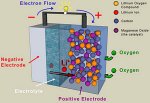
The addition of a component that uses oxygen drawn from the air during discharge replaces one chemical constituent used in current rechargeable batteries today. The oxygen, which will be drawn in through a surface of the battery exposed to air, reacts within the pores of the carbon to discharge the battery. This offers more energy for the same size battery.
The STAIR (St Andrews Air) battery should be cheaper than today’s rechargeables as the new component is made from porous carbon, which is far less expensive than the lithium cobalt oxide it replaces.
The four-year research project, which is nearly at its halfway point, builds on the discovery at the university that the carbon component’s interaction with air can be repeated, creating a cycle of charge and discharge.
It will likely be at least five years before the STAIR cell is commercially available and initially it will only be available for small applications, such as mobile phones or MP3 players.