




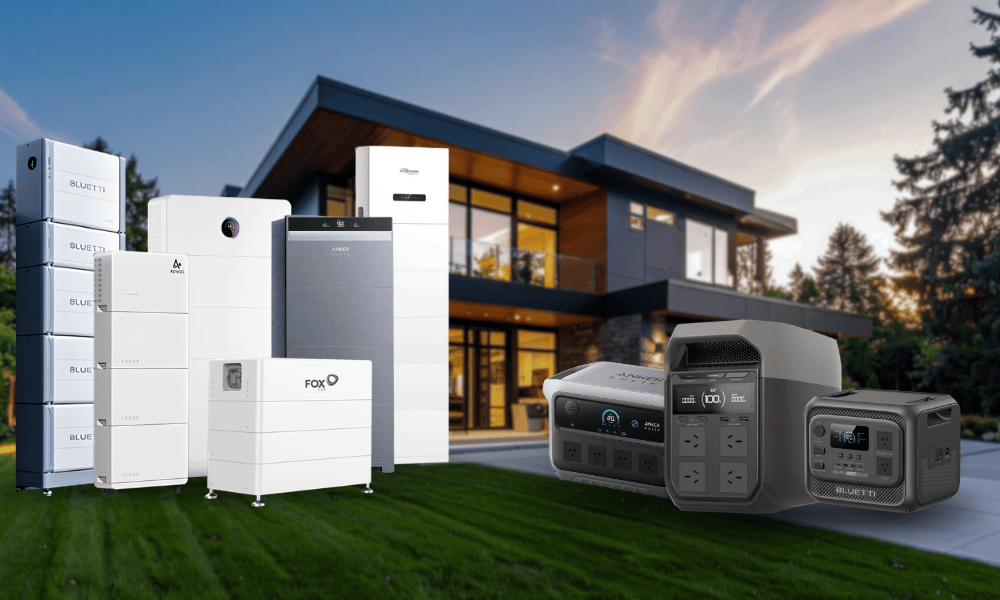
If the last 8 months have taught us anything, it’s that Australians are hungry for batteries. The Cheaper Home Batteries Program could not have come at a better time, with world conflicts highlighting our need for energy independence. And while the song and dance have been about home batteries, a quiet achiever has also seen record sales. Portable batteries are now seen by many as a necessity. Where home battery storage requires a large investment, portable power stations can chime in at a tenth of the cost, or much less.
If you’re looking for energy security and are not sure what will suit your home best, we’ll take you through the different features of the two battery options available to help make the decision a little easier.
What is the difference between home energy storage and portable batteries?
You’d think that the answer would be in the name, and you’d be mostly correct, but portability isn’t the only difference. They might both store energy, but they serve very different jobs. One powers your home. The other is your backup.
Home energy storage
Home energy storage is a fixed battery system installed in your home, usually paired with solar.
Key traits
- High capacity: Typically 10 to 50+ kWh
- Whole-home support: Can run lights, appliances, and even air conditioning
- Grid-connected: Charges from solar or the grid
- Automatic backup: Kicks in during outages
- Long lifespan: Designed for daily use over 10 to 15 years
Best for
- Reducing power bills
- Maximising solar self-consumption
- Blackout protection
- Electrified homes
Portable batteries
Portable batteries are compact, plug-and-play units you can move around.
Key traits
- Lower capacity: Usually 0.5 to 3 kWh
- Plug-and-play: No installation required
- Portable: Take it camping, in the car, or from room to room
- Limited backup: Runs small devices, not the whole house
- Shorter duty cycles: Not built for heavy daily cycling
Best for
- Camping and travel
- Emergency device charging
- Short outages
- Renters or temporary setups
Side-by-side comparison
| Feature | Home battery | Portable power station |
|---|---|---|
| Capacity | High (10–50+ kWh) | Low (0.5–3 kWh) |
| Installation | Professional | None |
| Mobility | Fixed | Portable |
| Powers whole home | Yes | No |
| Solar integration | Direct and optimised | Limited, slower |
| Cost | Higher upfront | Lower upfront |
-
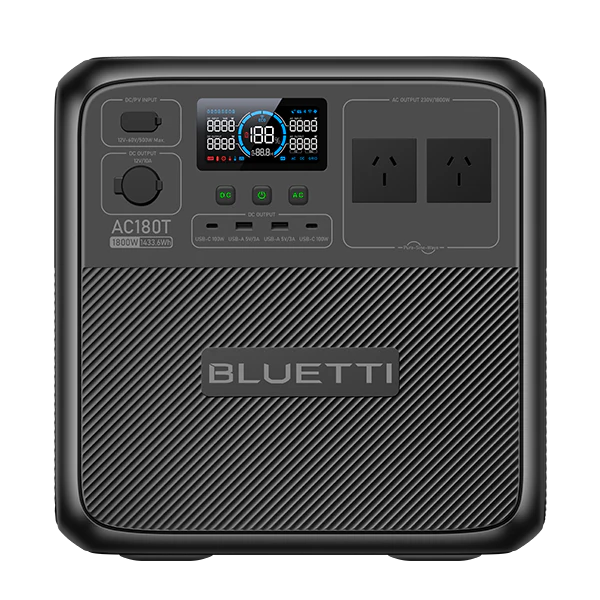
BLUETTI AC180T Portable Power Station | 1,800W 1,433.6Wh
Original price was: $2,499.00.$2,199.00Current price is: $2,199.00. -
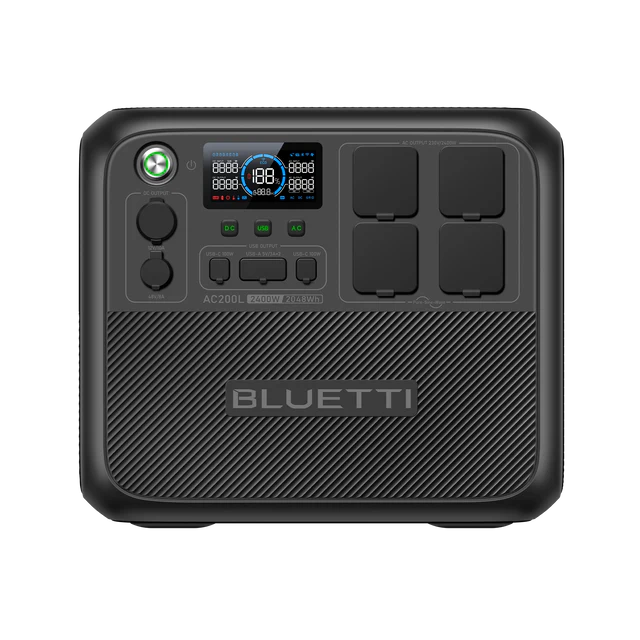
BLUETTI AC200L Portable Power Station | 2,400W 2,048Wh
Original price was: $2,799.00.$1,799.00Current price is: $1,799.00. -
BLUETTI AC240 Portable Power Station | 2,400W 1,536Wh
Original price was: $2,799.00.$2,099.00Current price is: $2,099.00.
What does your home really need?
Different strokes for different folks: the saying rings true for battery storage.
Have a large family with growing energy needs? Live alone in a one-bedroom apartment? Or are you a fly-by-night traveller? No two homes have the same needs, and the battery you choose should suit.
The answer really hides within your electricity bills. You’re looking for your average daily usage. To give you an example, I live with my husband and three power-hungry kids. I work from home, my husband mostly works away, and my kids seem to absorb electricity through their skin. Our average daily usage, before we installed batteries and solar, was 26 kWh.
Knowing how much you use is one thing; knowing what it means is another.
The average Australian family consumes 16 – 20 kWh of electricity per day. If you’re in Victoria like me, that bumps up to 18 – 25 kWh. This covers two adults and two children.
When we installed solar, our draw from the grid dropped to 9 kWh per day. This meant that the core of our usage was during daylight hours. As our habits shifted, the usage weighed in more at 50/50; 50% covered by solar and 50% drawn from the grid.
This told us that we were looking at covering around 13 kWh of electricity per day.
If your usage looks like mine did, then home energy storage would be an absolute winner. Portable battery storage, while fantastic for on-the-go power, would be unnecessary in the home – even if the grid goes down.
Now, if your bills are less than 10 kWh per day, portable batteries are worth considering in certain circumstances.


What do YOU need?
Now that we know what your home consumes, the question directs to your personal needs and situation.
Situations where home energy storage is the winning solution:
- You own your home
- Daily usage exceeds 10 kWh
- Already have or can have solar installed on your home
- You regularly run higher-capacity loads, such as your dishwasher and washing machine, at night
- You own an electric vehicle
- The budget allows for a larger investment
When a portable power station may be a better investment:
- You rent
- You’re an individual, a couple, or live in a share house
- Daily usage is less than 10 kWh
- No ability to install solar panels
- Your evening loads are low
- The budget is restricted to a smaller investment
Portable batteries offer the added benefits of use while camping, on worksites, during emergencies, and other out-of-the-home activities.
What usage would look like
A home with an energy storage system might use its battery like this:
Solar covers most of your daylight energy usage, with excess charging the battery. You might top up the battery utilising free windows of electricity from your retailer during the day or very low import rates. At night, your home would use the stored energy. If your battery participates in a Virtual Power Plant, you would receive credit according to how much you discharge at night. Home battery setups like this generally see the electricity bill in credit each month. Without a VPP, you would only need to pay for the daily supply charge and minimal electricity imports.
A home that utilises portable batteries may look like this:
Before leaving for work, the power station is plugged in for charging. If your retailer has a free window of electricity during the day, you can use a smart adaptor to only charge during this window, or to charge only during off-peak times. At night, depending on the capacity of the battery, you could power low-load devices such as your TV, laptop or computer, chargers, lamps, and an internet modem.
Portable power stations are limited by their storage capacity and their power output.
For example, your washing machine will likely experience surges of 2,000 Watts or more. A dishwasher operates between 1,200 and 2,400 Watts. For a 1 kWh portable battery, this would mean you may not be able to run these appliances at all if the unit cannot meet the required power output, and even if it can, a single cycle could drain the battery in under an hour. Your clothes or cutlery may not even be cleaned!


Which should I choose: home or portable batteries?
This is where the old pen and paper come in handy. Write down:
- What appliances and devices you use
- Their average electricity requirements (you may need to do an internet search), and
- How often you use them
Your list may look something like this:
| Appliance | Avg daily usage (kWh) | Notes |
|---|---|---|
| Fridge | 1.0 to 2.0 | Runs 24/7, varies by size and age |
| TV | 0.2 to 0.6 | Per fan, several hours of use |
| Microwave | 0.1 to 0.3 | Short bursts only |
| Dishwasher | 1.0 to 2.0 | One cycle per day |
| Washing machine | 0.5 to 1.5 | Depends on hot or cold wash |
| Pedestal fans | 0.1 to 0.3 | Per fan, several hours use |
| Devices (phones, laptops) | 0.2 to 0.5 | Combined daily charging |
| Total: | 3.1 – 7.2 |
This does not take into account home heating and cooling, electric hot water systems, oven use, or cooktops. These are the bigger ticket items that simply cannot be covered by portable batteries.
If you are looking to cover very minor usage, such as running your TV and charging your devices, a portable power station is a realistic option for you. It is important to note that a portable battery has no way of eliminating your electricity bills, unlike home storage.
For most other scenarios, home energy storage is the only solution that will see your household energy usage covered.
Return on investment
At the end of the day, it all comes down to money. Let’s take a look at how much you can realistically save with home energy storage or a portable power station, and how rising electricity prices improve the picture over time.
A 20kWh home battery can deliver strong savings by shifting solar, or even free grid energy, into the evening. Most households will realistically shift 10 to 14kWh per day, resulting in around $800 to $1,500 per year in today’s dollars. With a VPP or a plan offering free daytime charging and peak incentives, this typically lifts to $1,000 to $1,800 per year total. As electricity prices rise by around 3% per year, these savings grow over time, often shortening payback by several years and pushing long-term value well beyond static estimates.
A 2kWh portable battery is far more limited. It can cover light overnight loads such as a TV, device charging, and a pedestal fan, typically using 0.6 to 1.2kWh per night. That equates to roughly $60 to $130 per year, with only minor upside from rising electricity prices. While useful for outages or renters, it is not designed to materially reduce household electricity costs.
| Option | Scenario | Daily energy used | Annual savings (today) | Annual savings (with 3% increases) | Typical cost | ROI (approx) |
|---|---|---|---|---|---|---|
| 20kWh home battery | No VPP | 10 to 14kWh | $800 to $1,500 | $1,000 to $1,900 over time | Avg. $16,000 | 9 – 14 years |
| 20kWh home battery | With VPP / free charging | 10 to 14kWh | $1,000 to $1,800 | $1,300 to $2,200+ over time | Avg. $16,000 | 7 – 12 years |
| 2kWh portable power station | No VPP, possible free charging | 0.6 to 1.2kWh | $60 to $130 | $80 to $170 over time | ~$2,000 to $3,000 | 20+ years |

The verdict
The fact remains that home energy storage and portable batteries serve different purposes. The true value of either of the systems comes down to the benefits that cannot be financially calculated. Being able to power your home during a blackout adds energy security. Whether that’s part or all of your home with a home battery, or a few devices with a portable power station, the security it provides can be priceless when it’s needed. Portable power stations grant freedom when on the go. There’s no price tag for that.
If you have to put a finer point on it, home energy storage is the ultimate winner if you’re looking to save on your electricity bills and see a strong return on investment. Portable power stations have their uses, and this rings especially true for renters or apartment living, where home battery storage simply isn’t feasible.
It comes down to energy security, and both options offer this in their own ways. For my family and me, we have both! Home energy storage to cover all of our home’s needs, and a portable power station for when we travel.
If you’re in the market for a portable power station, check out the Energy Matters Marketplace for a range of options to suit your needs. If you’re ready to add home energy storage, request FREE quotes from trusted, local installers.