





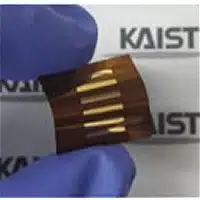
A new all-polymer organic solar cell developed by a Korean research team is tougher and more flexible than its other organic counterparts.
Organic solar cells have been attracting interest for quite a while given their low-cost, flexible properties and their potential for applications such as wearable devices; but their major drawback has been efficiency and durability.
The somewhat fragile nature of organic solar cells (OSC’s) is due to the presence of fullerenes, molecules of carbon in the form of hollow shapes. The other drawbacks of fullerenes are weak light absorption and un-optimized energy levels.
Researchers at the Korea Advanced Institute of Science and Technology (KAIST) found all-polymer solar cells (PSC’s) based on a BDTTTPD polymer donor and the P(NDI2HD-T) polymer acceptor overcame these issues.
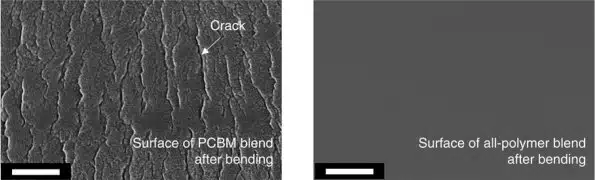
Their efforts have resulted in an organic solar cell that demonstrates a 60-fold increase in flexibility and 470-fold improvements in strength compared to with polymer/PCBM cells.
“The superior mechanical properties of all-polymer solar cells afford greater tolerance to severe deformations than conventional polymer-fullerene solar cells, making them much better candidates for applications in flexible and portable devices,” says a paper on the team’s work; recently published in the journal Nature Communications.
As for efficiency, the team’s development achieves up to 6.64% currently, with ‘great potential’ for further enhancement.
That conversion efficiency is some way off conventional solar cells that offer triple or even more sunlight conversion rates; but it’s a certainly a step in the right direction.
“Our results provide guidelines for the design of new material systems for high-performance all-PSCs and demonstrate their potential for future applications in portable and wearable devices that require both high performances and mechanical stability,” says the team.
Meanwhile the hunt for the OSC holy grail goes on; with researchers around the world looking to evolve the technology.
In June, the University of Adelaide’s Chemistry Department announced it would be studying the molecular nature of conductive plastics to better understand how they absorb and convert light into energy; with view to ‘tuning’ these materials to dramatically improve conversion efficiency.