




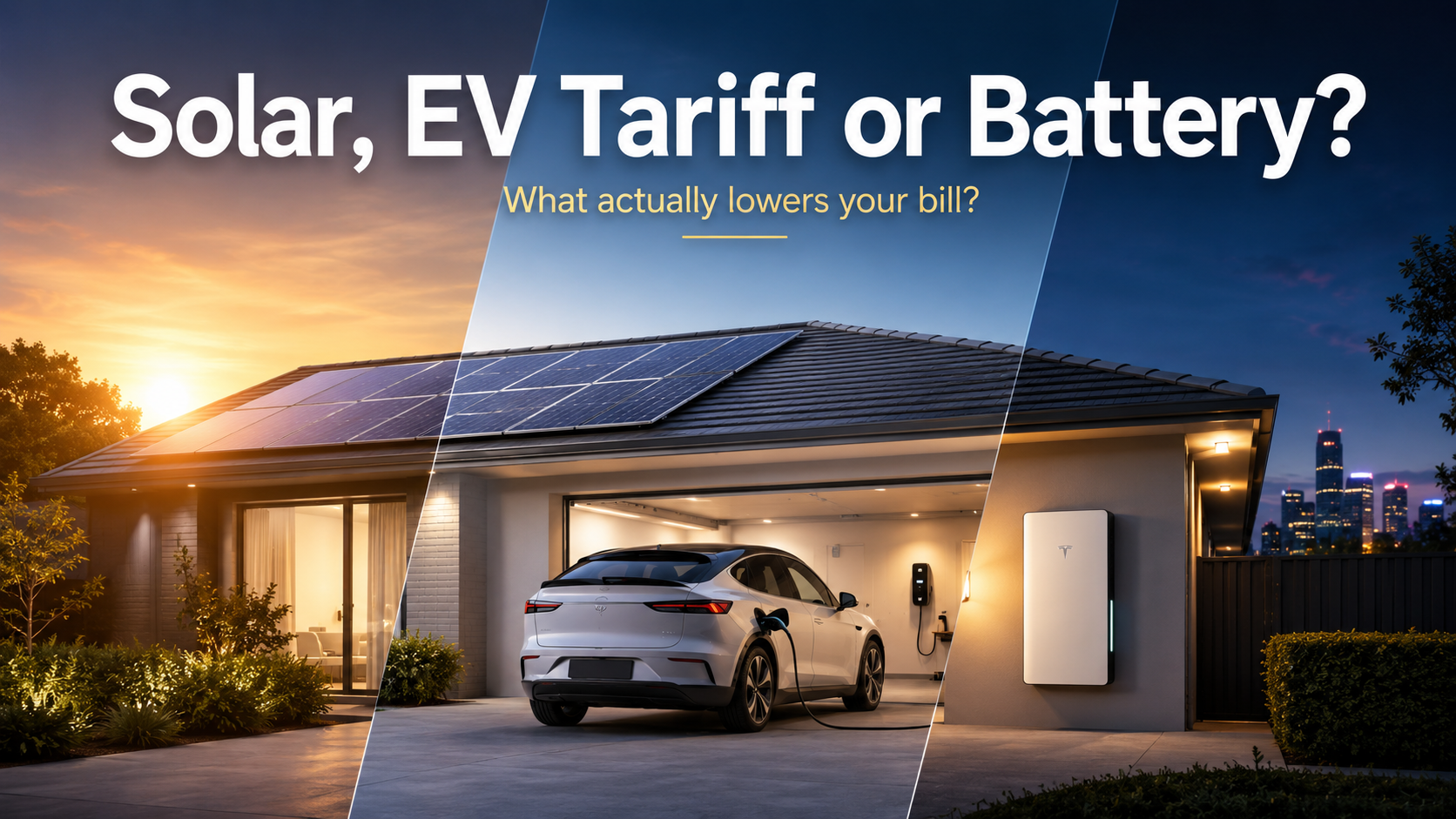
Most advice around EV charging starts with one question: Should you switch to an EV electricity plan? It sounds simple, but it misses the bigger decision sitting underneath.
Charging your car isn’t just a bout finding a cheaper rate. It’s about choosing where your energy comes from and when you use it. For many, that choice sits between 3 options: using your own solar as it’s generated, storing it in a battery for later, or buying electricity from the grid when prices drop.
Each can lower your bill, but they don’t work together in a neat, additive way. Lean into one, and you often give up value in another. That’s why two homes with the same EV and solar system can end up with very different results. The difference comes down to timing, not just technology.
Start with how your home actually uses energy
Before comparing solar, EV tariffs, or batteries, you need a clear picture of how your home runs across the day. This is where most decisions go off track.
The first thing to look at is when your EV is actually at home and able to charge. If it’s parked during the day, that opens up the option to use solar directly. If it only comes home in the evening, you’re immediately leaning toward grid charging or stored energy.
Next is what happens to your solar during the day. Many homes export a large portion of it because no one is home to use it. That exported energy is typically paid at a much lower rate than what you pay to buy electricity later. That gap is where a lot of potential savings sit.
Then there’s your evening usage, which is often the most expensive part of the day. Cooking, heating or cooling, lighting, and EV charging can all stack into peak pricing windows. This is the period that tends to drive bills up, regardless of how cheap your EV charging might be at other times.
What matters is how these pieces line up. A home that uses most of its power during the day will get a very different value from solar compared to one that peaks at night. The same goes for EV tariffs and batteries.
If you don’t know when you’re using electricity, it’s almost impossible to choose the option that actually lowers your bill.
Using your own solar
Before comparing plans or adding hardware, it helps to treat your existing solar as the starting point.
Charging your EV from solar isn’t technically “free.” It usually means giving up a feed-in tariff for exported energy. But in most parts of Australia, that export rate is far lower than what you pay to buy electricity later. So using your own solar often delivers better value than it looks on paper.
This works best when your EV is home during the day and there’s enough excess generation to cover charging. In those cases, you’re effectively redirecting low-value exports into something useful. It’s simple, doesn’t rely on specific tariffs, and doesn’t require behaviour to change dramatically.
Where it falls short is consistency. Solar output varies across seasons and weather conditions, and daytime charging isn’t always practical for every household. If the car isn’t home, or if your system doesn’t regularly produce surplus energy, the benefit drops quickly.
Even with those limits, this is still the baseline to compare everything else against. If another option can’t clearly beat the value of using your own solar, it’s worth questioning whether it’s actually improving your overall setup.
EV tariffs
EV electricity plans can look like the obvious upgrade. Lower overnight rates or “free” charging windows promise cheaper energy, especially if most charging happens outside peak hours.
When it works, it works well. If your EV is charged consistently during those low-cost periods, you can bring down the cost per kilometre significantly compared to standard tariffs. For those without solar or where daytime charging isn’t possible, this can be the most straightforward way to reduce costs.
The trade-off is what happens outside those windows. Many EV plans come with higher peak rates, which means your evening usage can quietly become more expensive. If the rest of your household demand isn’t shifted or managed, those higher rates can offset the savings from cheap charging.
There’s also a behavioural layer. To get the most out of these plans, charging needs to be scheduled or automated. That might be easy with a smart charger, but less so if charging is more ad hoc.
The key point is that the savings don’t come from owning an EV. They come from aligning your usage with the tariff. If that alignment isn’t there, the plan can end up solving one part of the bill while increasing another.




Solar batteries
A battery changes the equation in a different way. Instead of choosing when to buy electricity, you’re deciding when to use what you’ve already generated.
By storing excess solar during the day, a battery lets you use that energy later, usually in the evening when grid prices are highest. That can reduce both your imports and your exposure to peak rates, which is where a lot of household costs sit.
It can also support EV charging indirectly. If your daytime solar is being stored instead of exported, you have more flexibility in how and when that energy is used. In some setups, that means freeing up solar for EV charging during the day, or reducing the need to charge from the grid at night.
The trade-off is upfront cost. Batteries are still one of the more expensive additions to a home energy system, and the value you get depends heavily on how your household uses electricity. Homes with high evening demand tend to see more benefit than those that already use most of their solar during the day.
What a battery really offers is control. You’re less dependent on tariff structures and timing windows, and more able to shape your own usage. But that control comes at a price, and it only pays off when it’s matched to how your home actually runs.
The real trade-offs most people miss
Most advice treats solar, EV tariffs, and batteries as upgrades you can layer together. In reality, each one moves where the value comes from and often reduces the benefit of the others.
If you want to avoid low-value solar exports:
- Prioritise daytime EV charging where possible
- Check whether your EV is home often enough to make this reliable
- Compare the value against your feed-in tariff, not against “free” power
If you want to avoid expensive evening imports:
- A battery may do more for the whole household than an EV tariff
- This matters most if your peak usage is high after sunset
- Look at evening grid imports before assuming the EV is the main problem
If you want to avoid high charging costs:
- An EV tariff can work well if charging is predictable
- The cheapest window needs to match your real routine
- Higher peak rates elsewhere can still affect the total bill
If you want the most flexibility:
- Solar charging is simple when the car is home
- EV tariffs reward discipline and automation
- Batteries give more control, but only if the extra cost is justified
The mistake is treating these as separate upgrades. They all compete for the same thing: the best use of each kilowatt-hour your home produces or buys.
What tends to work best in real homes
There’s no single setup that wins every time, but patterns do show up once you look at how households actually use energy.
Homes with solar and daytime access to the EV tend to get the most value from simply charging during the day. It avoids exporting at low rates and doesn’t rely on specific tariffs. In these cases, adding an EV plan often complicates things more than it helps unless there’s still a lot of unused solar.
Homes where the EV is only charged at night lean more naturally toward EV tariffs. If charging is consistent and can be scheduled, the lower overnight rates can make a noticeable difference. The key is making sure the rest of the household isn’t exposed to higher peak pricing as a result.
Homes already considering a battery are usually trying to solve a different problem. It’s less about the EV and more about reducing expensive evening usage. In these setups, the EV becomes part of a wider energy system rather than the main driver of savings.
Homes with high evening demand often underestimate how much that period drives their bill. Even with cheap EV charging, heavy usage during peak hours can cancel out the benefit. That’s where shining usage or storing energy tends to have more impact than focusing on the car alone.
What this shows is that the EV rarely sits at the centre of the decision. It’s one part of a broader pattern, and the best outcomes come from matching your setup to how your home actually runs day to day.
Make the decision based on outcomes
It’s easy to get pulled into plan features, discounts, or new tech. What actually matters is what changes on your bill.
Start by looking at where your costs are coming from now:
- How much electricity you’re buying during peak hours
- How much solar you’re exporting instead of using
- When your EV is typically being charged
From there, test each option against a simple question: what does this reduce?
- Does it cut down your evening grid usage?
- Does it reduce how much solar you export at low rates?
- Does it shift your EV charging into genuinely cheaper periods?
If the answer isn’t clear, the benefit probably isn’t either.
It also helps to ignore headline offers and look at the full picture. A plan with “free” charging might still raise your overall costs if peak rates are higher. A battery might reduce imports but take years to justify financially. Charging from solar might be simple, but only if your routine allows it.
The strongest setups are the ones that consistently reduce reliance on expensive electricity, not just the ones that look good on paper.

Target the part of your bill that matters most
There isn’t a single setup that wins for every home. What matters is how well your system lines up with when you use electricity.
Using your own solar, moving to an EV tariff, or adding a battery can all reduce costs. But each one solves a different part of the problem. The biggest gains come from choosing the option that targets your most expensive usage, not the one that sounds the cheapest.
Once you understand where your energy is going and when you’re using it, the right decision tends to become much clearer.
Energy Matters has been in the solar industry since 2005 and has helped over 40,000 Australian households in their journey to energy independence.
Complete our quick Solar Quote Quiz to receive up to 3 FREE solar quotes from trusted local installers – it’ll only take you a few minutes and is completely obligation-free.