





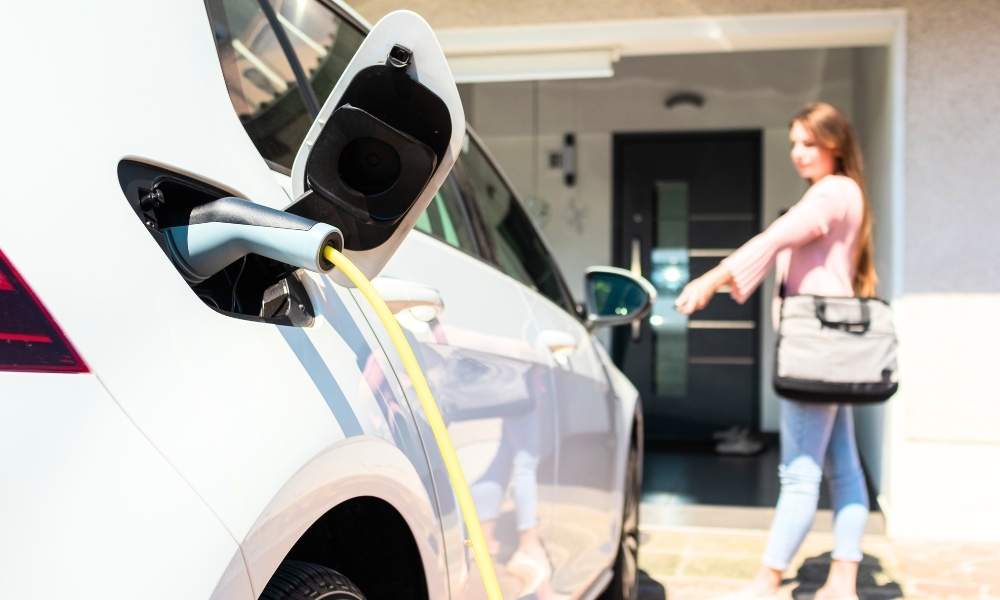
Most people approach EV charging with the wrong mental model. They assume it works like a phone; something you plug in every day, something you need to stay on top of constantly. That assumption shapes how people think about range, convenience, and whether they even need home charging in the first place.
But it doesn’t reflect how EVs are actually used. In practice, most drivers don’t need to charge nearly as often as they think. Daily driving distances are lower than people estimate, and modern EV ranges are higher than expected. The result is a gap between perception and reality, and it’s that gap that tends to drive hesitation.
Understanding that difference is where the conversation around EV ownership becomes a lot clearer.
Most drivers don’t use as much range as they think
The easiest way to reset expectations is to look at how people actually drive. Most households aren’t coming close to using an EV’s full battery in a single day. Daily travel tends to sit around 30 to 40 kilometres. Even with some variation, that’s still a long way off the 300 to 500 kilometres of range that many modern EVs now offer. That changes the equation.
A full charge isn’t something you run down overnight. For many, it stretches across several days of normal use. Commutes, school runs, and errands all add up, but not as quickly as people expect when they first think about EV ownership.
Where things start to skew is in how people estimate their own driving. It’s common to think about the busiest day of the week, or the occasional longer trip, rather than the average. That’s what creates the sense that charging needs to be constant, when in reality it’s often something you do every few days.
Once expectations are grounded in actual usage, the idea of needing to charge all the time starts to fall away.
Why daily charging feels necessary
If most drivers don’t need to charge every day, why does it feel like they do?
A big part of it comes down to habit. People are used to devices that need constant topping up. Phones, laptops, and even wireless earbuds all reinforce the idea that batteries should be kept full. It’s an easy mental shortcut to apply the same thinking to an EV.
There’s also a tendency to plan around extremes. Instead of thinking about a typical week, people picture the longest drive they might do, or a day where everything stacks up at once. That becomes the reference point, even if it only happens occasionally.
Those two things create a kind of quiet pressure to charge more often than necessary. Not because the car needs it, but because it feels safer to stay topped up.
In practice, EV ownership works differently. Charging becomes something you fit around your routine rather than something you do by default every night. And once that happens, the experience starts to feel far less demanding than many expect.
Where charging still becomes a constraint
Even if you don’t need to charge often, where and when you charge still matter. This is where the experience starts to diverge. With home charging, it’s passive. You plug in when it suits you, usually overnight, and the car is ready the next day. Without it, charging becomes something you have to plan around.
That doesn’t mean it’s unworkable. Many drivers build it into things they already do, but it does introduce a layer of dependency. You’re relying on chargers being available, working, and not already in use.
Timing also starts to matter more. A quick top-up isn’t always quick if there’s a queue, or if the charger is slower than expected. What would have been a simple overnight charge at home turns into a decision about when and where to stop.
So while frequency isn’t the issue most people think it is, control becomes the real constraint. Without a reliable place to charge on your own terms, the experience depends more on infrastructure than your actual driving needs.





What it actually costs without home charging
Charging at home is where EVs deliver their biggest savings, especially when paired with solar. Electricity is cheaper, more predictable, and often used at off-peak times. Public charging works differently. Pricing varies by network, location, and speed, and fast chargers tend to carry a premium.
In some cases, the cost per kilometre can start to approach (or even match) what you’d pay for petrol in an efficient hybrid. Not always, but often enough that it changes the equation people expect going in.
There’s also less consistency. One charger might be reasonably priced, while another nearby costs significantly more for the same amount of energy. Without a fixed place to charge, you’re exposed to that variation every time you plug in.
That doesn’t mean EV ownership stops making sense. It just means the savings depend on how and where you charge. Without home charging, you’re not fully in control of that part of the equation, and that’s where expectations and reality can start to drift apart.
Plan around your week, not the battery
Once you move past the idea of daily charging, your focus shifts to something more practical: how charging fits into your routine.
The difference between a smooth experience and a frustrating one usually comes down to this. Not how big the battery is, but whether your week naturally gives you opportunities to charge.
Think about where the car already sits for 30-60 minutes at a time. Supermarkets, shopping centres, workplaces, gyms, and even regular weekend stops. These become your charging windows. If those places have reliable chargers, ownership feels
straightforward. If they don’t, it quickly becomes inconvenient.
It’s also worth looking beyond the closest charger. Availability matters more than distance. A charger five minutes away isn’t helpful if it’s consistently occupied or out of service. What matters is whether you can rely on it when you actually need it.
This is the layer most people skip. They think about range and battery size, but not how charging fits into their existing routine. Once you map that out, it becomes much clearer whether owning an EV without home charging will work for you.
Where home charging changes the equation
Up to this point, the issue hasn’t been how often you charge. It’s been how much control you have over it. This is where home charging makes a clear difference.
Instead of planning around availability, you decide when the car charges. It happens in the background, usually overnight, without needing to think about it. There’s no need to factor in stops, check apps, or adjust your routine around charger access.
Cost becomes more predictable as well. Charging at home is typically cheaper than relying on public fast chargers, and pairing it with solar brings that cost down even further. You’re not exposed to fluctuating pricing or limited by what’s available nearby.
It doesn’t mean you can’t own an EV without it. Many people do. But home charging removes most of the friction points that come up in the real-world experience. It shifts EV ownership from something you manage to something that simply fits into your day.
Keep the focus on how you actually use the car
Owning an EV without home charging is more manageable than most people expect. For many drivers, the battery lasts longer between charges than they initially assume, and daily charging simply isn’t necessary.
But that doesn’t mean it’s effortless.
Without a reliable place to charge on your own terms, the experience depends on access, timing, and cost in a way that home charging avoids. The difference isn’t how often you charge. It’s how much control you have over when and where it happens.
That’s the part worth thinking through before making the switch.
If your weekly routine already gives you consistent, reliable opportunities to charge, going without home charging can work. If it doesn’t, it’s worth considering how you’ll fill that gap.
Energy Matters has been in the solar industry since 2005 and has helped over 40,000 Australian households in their journey to energy independence.
Complete our quick Solar Quote Quiz to receive up to 3 FREE solar quotes from trusted local installers – it’ll only take you a few minutes and is completely obligation-free.