




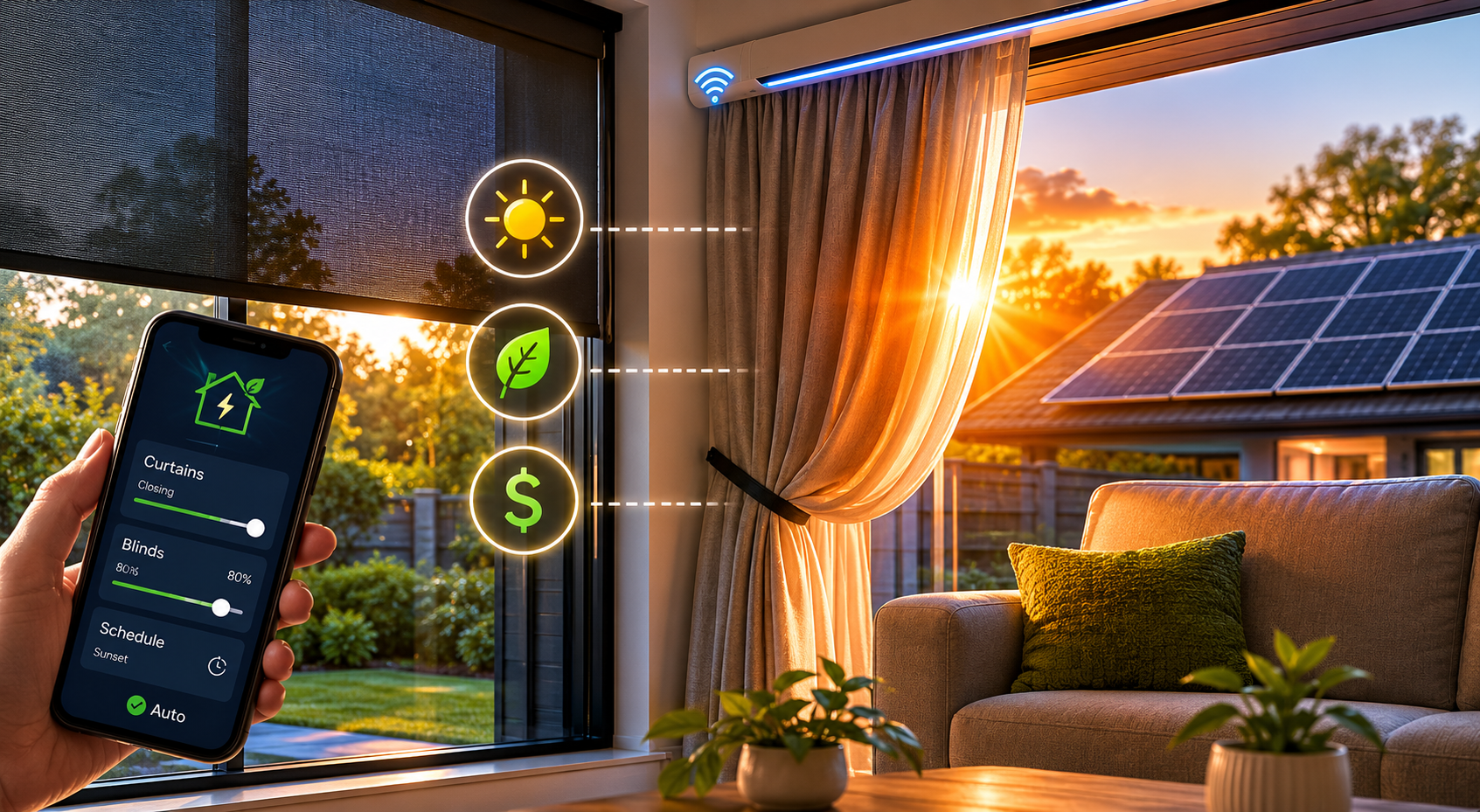
A lot of smart home upgrades promise convenience, then end up adding one more app, one more subscription, or one more thing that can stop working when you need it. In a wider story about smart-home tech that can be fussy, expensive, or unreliable, smart curtains and blinds were singled out as one of the few upgrades industry people still back, largely because they do a simple job and tend to do it consistently.
That matters more than it might seem, especially for homeowners thinking about comfort, cooling bills, and solar. Windows are one of the biggest weak points in a home’s thermal performance. According to energy.gov.au, windows can account for almost 90% of a home’s heat gain and up to 40% of heating energy loss, which is why well-fitted curtains and blinds are not just decorative. They are part of how a home holds onto comfort and limits unwanted heat in the first place.
This is where smart curtains and blinds start to make real sense. They can help a solar home run better by reducing how hard the air conditioner or heater has to work.
Why windows matter more than many homeowners realise
Windows have a bigger effect on home comfort than many people think. In Australia, they can account for almost 90% of a home’s heat gain and up to 40% of heating energy loss, which makes them one of the biggest weak points in the building envelope.
That is why curtains and blinds are more than just a finishing touch. When they are well fitted, they help trap a layer of still air next to the window, which can reduce heat transfer and make rooms easier to keep comfortable.
This is also what makes smart curtains and blinds worth paying attention to. They can help homeowners manage sun and heat at the window before the air conditioner or heater has to work harder, especially in rooms with lots of glass or strong afternoon sun.



Smart curtains vs. smart blinds
| If your priority is… | Smart curtains | Smart blinds |
| Covering large windows or sliding doors | Usually the better fit. They suit wide openings and feel more natural across big expanses of glass. | Can work, but may be less practical or more segmented across large areas. |
| Better blackout for bedrooms | Strong option, especially with heavier or blockout fabrics. | Also a good option, particularly if you want a neater look and tighter light control. |
| Precise glare control | Less precise once closed. | Usually the better choice, especially in rooms where glare shifts through the day. |
| A softer, more decorative look | Usually stronger. They add warmth and can feel less utilitarian. | Better if you want a cleaner, more minimal finish. |
| Tight spaces or smaller windows | Can feel bulky in some rooms. | Usually the better fit. |
| Insulation and thermal comfort | Strong when well fitted and paired with suitable fabric. | Also strong, especially well-fitted insulating styles. |
| Retrofit flexibility | Depends on the track and space available. | Often easier, especially for existing roller blind setups. |
| Simple zoning across different windows | Less flexible if windows vary in size or sun exposure. | Usually easier to tailor room by room. |
The best choice depends less on which product is “smarter” and more on what the room needs. Smart curtains often make more sense for large glass areas, bedrooms and spaces where softness and coverage matter most. Smart blinds are often the better fit for smaller windows, tighter glare control and more targeted day-to-day shading.
What to look for before you buy
- Start with the room: A bedroom, a west-facing living area and a sliding door opening all need different things, so it makes more sense to begin with the window and the problem you are trying to solve.
- Put thermal performance ahead of smart features: A motor does not improve comfort on its own. Fit, coverage and fabric matter more because they are what help limit heat gain and heat loss through the window.
- Think about installation early: Some systems are easier to retrofit, while others make more sense in a renovation or new build.
- Check the power source: Battery-powered options can be easier in existing homes, while hardwired systems may suit larger or more permanent setups.
- Keep the controls as simple as you need them to be: Some homeowners will be happy with a remote and a timer. Others may want app control, scheduling or smart-home compatibility.
- Do not ignore local support: If your windows are custom or the system is more complex, local supply and installation support can make a big difference.
- Buy for ease of use: The best system is usually the one that fits the room properly and is simple enough to use consistently.
The smart curtains and blinds worth watching in Australia 2026
- Luxaflex PowerView suits homeowners looking for premium, custom-made window coverings with built-in automation. Its Australian range covers blinds, shades and curtains, with features such as scheduling, app control and rechargeable battery options.
- Somfy is one of the stronger names if you want both smart curtains and smart blinds in the same system. Its Australian offering includes motorised curtains and interior blinds, with control through remotes, smartphones and connected-home platforms.
- Rollease Acmeda Automate may appeal more to homeowners planning a broader shading setup rather than a single-room upgrade. Its Australian range includes indoor and outdoor motorised shades, controllers, sensors, and both wired and wire-free options.
- Motionblinds stands out for homeowners who care about newer smart-home compatibility. Its platform highlights Matter and Thread support, along with compatibility with Apple Home, Google Home, Amazon Alexa and Samsung SmartThings
The right brand depends less on hype and more on what your home needs. Some are better suited to premium custom window furnishings, others to broader smart-home integration, and others to more retrofit-friendly setups.

The smartest part is the timing
Smart curtains and blinds will not transform a poor-performing home on their own, but they can make a practical difference where it counts most: at the window. In a solar home, that matters because better control over heat and light can support comfort first and reduce how hard cooling and heating systems need to work.
That is what makes this category more useful than a lot of other smart-home upgrades. It is not about adding more tech for the sake of it. It is about making a familiar energy-saving habit easier to do consistently.
Energy Matters has been in the solar industry since 2005 and has helped over 40,000 Australian households in their journey to energy independence.
Complete our quick Solar Quote Quiz to receive up to 3 FREE solar quotes from trusted local installers – it’ll only take you a few minutes and is completely obligation-free.