
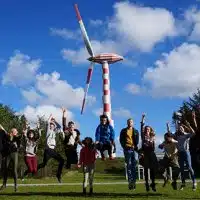
Last week marked the anniversary of the ground-breaking for Tvindkraft, a wind turbine that became somewhat of a poster child for the wind industry – and for the power of community collaboration.
The idea of Tvindkraft was hatched in the schools of Tvind, an international school centre in the small town of Ulfborg in Denmark, during the 1970’s oil crisis. The teachers wanted to supply the schools with cheap, clean and renewable energy. They also wanted to show Denmark’s government that there was an alternative to nuclear power; which was being planned for the country at the time.
Teachers, students and others made up the construction team and on 29th May 1975, 400 people gathered at Tvind with shovels in hand to break ground. While construction may have commenced in 1975, it wasn’t until the 26th of March in 1978 that Tvindkraft started producing power.
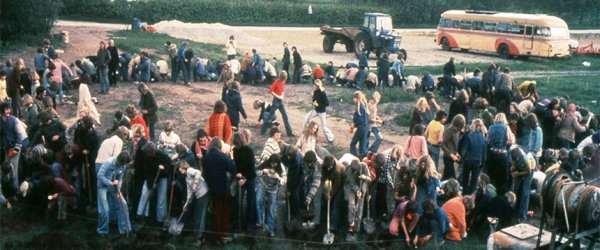
Unlike the streamlined processes in place today for erecting wind turbines rapidly, the construction of Tvindkraft was slow and saw its share of challenges. For example, twice as much concrete was needed than what had been originally calculated – and the funds weren’t available to buy the extra concrete from the local mixing plant. The group then decided to buy a very large concrete mixer and do it themselves.
Every challenge was overcome and their efforts produced a wind turbine with an incredibly long lifespan. It has required very little in the way of repairs during its long tenure. A few blade bearings have been replaced, the blades replaced once, yawing and control systems modernised and another frequency converter added to increase capacity.
By the end of last year, Tvindkraft had clocked up 150,540 operational hours and had generated 20,000, 000 kilowatt-hours of electricity.
Tvindcraft has a maximum output capacity of 900kW. Each blade is 54m long and weighs 3.2 tonnes.
The impact Tvindkraft had is evident in Denmark’s current wind capacity. In 2014, Danish wind turbines supplied 39.1% of the country’s electricity needs.
As for the number of nuclear electricity generation facilities in the country – it’s still zero. In 1985, a law passed by the Danish parliament prohibited power production from nuclear energy in Denmark.
Denmark has set a target of 50 per cent wind power in its energy mix by 2020. The country has also set its sights to be completely free of dependence on fossil fuels by 2050.
The story of Tvindkraft is a fascinating one – you can read more about the history of the wind turbine here.