If you’ve been keeping an eye on the Australian energy market this month, you know that May 2026 is a massive milestone. It’s the month that “Vehicle-to-Home” (V2H) officially moved from a “trial phase” into a mainstream reality for thousands of homeowners.
But as Australians rush to buy their first bidirectional chargers, a silent technical divide is forming in the garage. While the glossy brochures promise that your car can power your house during the evening peak, they often gloss over the two wildly different ways to achieve it.
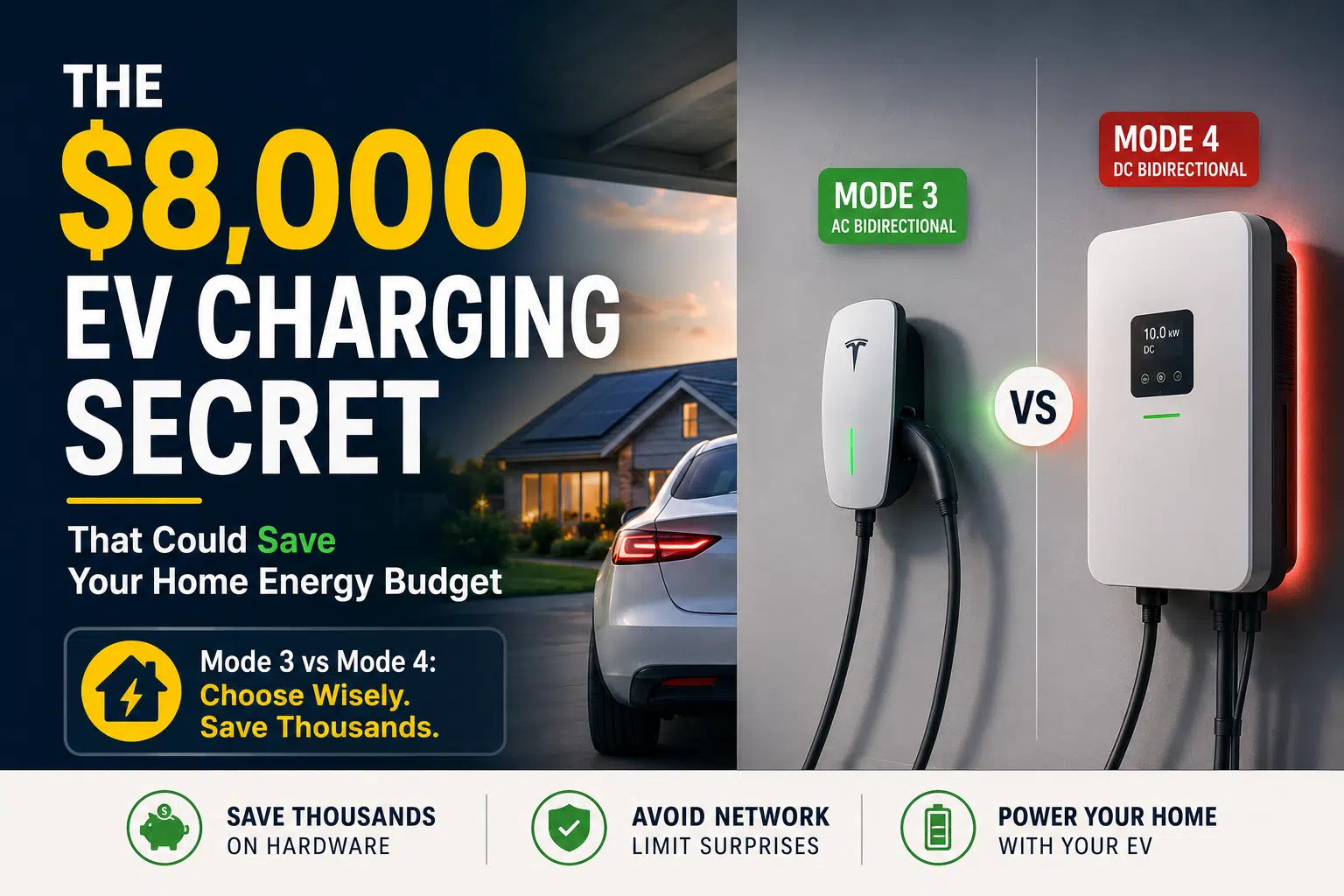
Depending on which EV you choose, the cost of turning your car into a home battery could range from a couple of thousand dollars to well over ten grand. The secret lies in understanding the difference between Mode 3 (AC) and Mode 4 (DC) bidirectional charging.
If you don’t know which one your future car uses, you might be accidentally signing up for an $8,000 hardware bill you never saw coming.
The V2H landscape in 2026: Why the hype?
For years, the holy grail of the Australian energy transition has been the ability to use the massive battery sitting in your driveway to power your house at night. An average EV battery (60–80 kWh) is five to six times larger than a standard home battery like a Tesla Powerwall.
As of mid-2026, the regulatory hurdles have largely cleared. With the updated AS/NZS 4777.2:2020 (Amd 2:2024) standards now fully in effect, bidirectional inverters are hitting the approved lists, and retailers are rolling out V2H-ready plans across the country.
But here is the catch: To get power out of that car and into your lights, the DC electricity in the battery must be converted into AC electricity for your home. Where that conversion happens changes the price of your installation by thousands of dollars.
Mode 4: The “external brain” (DC Bidirectional)
Most of the “pioneer” V2H vehicles in Australia (think the Nissan Leaf, the Mitsubishi Outlander PHEV, and several newer Chinese-made SUVs) rely on Mode 4.
In a Mode 4 setup, the car itself remains relatively passive. It simply sends raw DC power out through its charging port. To make that power usable for your home, you have to buy a specialised DC Bidirectional Charger.
The hidden costs of Mode 4
- The Hardware: Because this wallbox is actually a high-powered inverter, it is massive and expensive. Units like the Wallbox Quasar 2 or the SigenStor systems are retailing in 2026 for anywhere between $6,500 and $9,500.
- The Installation: This isn’t a plug-and-play job. It requires heavy-duty DC wiring, specialised shielding, and often a significant amount of labour. By the time you’ve paid a certified electrician, your total bill is likely hitting $11,000 to $12,000.
- The Benefit: The upside? Mode 4 is currently the most grid-proven way to participate in Virtual Power Plants (VPPs) in Australia, and it works with the established CHAdeMO and CCS2 standards.
Mode 3: The budget disruptor (AC Bidirectional)
On the other side of the garage is Mode 3 (AC). This is the technology that is currently sending shockwaves through the industry, led primarily by Tesla and a few European and American brands like Ford and Volvo.
In a Mode 3 setup, the car is the hero. The inverter is built into the vehicle itself. The car does the hard work of converting DC to AC internally, then sends “house-ready” power out through the cable.
Why Mode 3 is a financial game-changer
- The Hardware: Because the car is doing the heavy lifting, you don’t need a $10,000 box on your wall. You just need a smart gateway or a compatible AC wallbox that can communicate with the car.
- The Price Tag: Tesla’s Powershare hardware and similar AC-based systems are landing in Australia for between $1,500 and $2,500.
- The “Garage Audit” Factor: Millions of Australians already have a standard Level 2 AC charger on their wall. If you buy a Mode 3-compatible car, your current charger might only need a software update or a small gateway addition to become a V2H powerhouse.
Why Mode 4 can be a “no” from the network
In Western Australia, a new 30 kVA limit was introduced on May 1st to simplify this. But if you live in NSW, VIC, or QLD, you are often dealing with much stricter local network limits.
If you choose a Mode 4 (DC) system, that $10,000 charger is its own separate 7 kW to 10 kW inverter. In many suburbs, your network provider (like Ausgrid or SAPN) might tell you that your property is already at capacity if you have a large solar system. Adding a Mode 4 charger can push you over the limit, requiring you to pay for expensive network studies or even a three-phase power upgrade that could cost another $5,000.
Mode 3 (AC) systems are much lighter on your grid connection. Because the car uses its internal inverter, it can often be integrated into your existing home energy management system more easily, avoiding the “Inverter Crunch” that stops many projects in their tracks.
[metaslider id=”138351″]
What are Australians actually buying?
It’s easy to assume that because Mode 4 has been around longer, it’s the default choice. But the market data for 2026 tells a different story.
- The Tesla factor: Tesla remains the dominant EV brand in Australia. Their pivot toward AC Bidirectional (Mode 3) via their Powershare tech means that the vast majority of future V2H users in Australia are technically in the Mode 3 camp.
- The retrofit wave: A 2026 survey of early-majority EV owners showed that 72% would refuse to spend more than $5,000 on a home charger. For this group, Mode 4 is simply too expensive. They are waiting for Mode 3-compatible cars so they can utilise their existing $1,500 chargers.
- The “Sun Tax” avoidance: In NSW and Queensland, the “Sun Tax” (export charges) has made self-consumption critical. Homeowners are realising that a $2,000 Mode 3 setup pays for itself in avoided export fees much faster than an $11,000 Mode 4 system.
How to choose your side: A buyer’s guide
Before you sign a contract for a new EV or a charger this year, you need to run your own garage audit:
| Choose Mode 4 (DC) If… | Choose Mode 3 (AC) If… |
| You already own a Nissan Leaf or Mitsubishi Outlander. | You are buying a Tesla, Ford, or a newer European EV. |
| You want to join a VPP and earn maximum grid-support credits today. | You already have a standard AC charger installed in your garage. |
| You have a high budget and want a “standalone” garage powerhouse. | You want V2H but only have a $3,000 budget for the upgrade. |
| Your local network has “headroom” for an extra 10 kW inverter. | You are tight on your grid connection limit and need to save space. |
Don’t buy the box before the car
The most expensive mistake you can make in 2026 is buying a charger before you’ve picked your car. In the old days, a charger was just a charger. Today, your charger is a financial and technical commitment to a specific way of powering your home.
If you value flexibility and your bank balance, the evidence points toward Mode 3 (AC) as the likely winner for the average Aussie home. It’s cheaper, it’s easier on your grid connection, and it plays nice with the equipment you probably already own.
The hidden pro tip: When you’re at the dealership, don’t just ask if the car is “V2H Ready.” Ask: “Is it Mode 3 AC or Mode 4 DC?” That one question could be worth $8,000.
Ready to make the switch?
The tech is here, and the savings are real, but the best way to choose is to experience it for yourself.
- Feel the power: Before you commit to a charging standard, see how these vehicles handle the road. Book an EV Test Drive and find the car that fits your lifestyle.
- Get the numbers: Already found your perfect match? Don’t guess on the installation. Get a FREE EV charger quote today to see exactly how much your V2H setup will cost and ensure it fits your home’s grid capacity.