






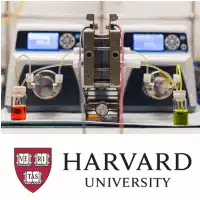
In January 2014 we reported on Harvard University’s development of a metal-free, rechargeable flow battery with applications in large-scale renewable energy storage.
Building on that earlier work, members of the same team have demonstrated an improved flow battery system that is 50 per cent more efficient than its predecessor and is composed entirely of Earth-abundant, non-toxic, non-corrosive and non-flammable materials.
They say their new design could make storage of electricity from intermittent energy sources such as solar power systems and wind safe and cost-effective for businesses; but also for home owners too.
Flow batteries store energy in liquid solutions contained in two separate tanks which form the positive and negative side of the battery. Pumping solutions in one direction charges the battery and the other direction discharges it.
In some flow battery designs, the negative side uses metal electrolyte solutions containing vanadium dissolved in acid – a rare, expensive and highly corrosive substance. Last year, the Harvard team demonstrated a successful ‘organic’ flow battery that replaced these toxic metals with organic molecules called quinones; abundant, naturally occurring chemicals used in organic processes such as photosynthesis.
While the aqueous quinone-bearing solution worked well for the negative side of the battery, the positive tank still required a conventional electrolyte liquid containing bromine, another toxic material which can only be handled in controlled conditions.
In findings published in the journal Science, the researchers report their new flow battery replaces bromine with a safe and eco-friendly metal ion called ferrocyanide.
“It sounds bad because it has the word ‘cyanide’ in it,” explains co-lead author Michael Marshak, who is now assistant professor of chemistry at the University of Colorado Boulder. “Cyanide kills you because it binds very tightly to iron in your body. In ferrocyanide, it’s already bound to iron, so it’s safe. In fact, ferrocyanide is commonly used as a food additive, and also as a fertilizer.”
Ferrocynanide dissolves more readily in alkaline solutions that acidic ones, and when paired with a quinone compound, produced better voltages than Harvard’s previous flow battery design – and without the toxicity.
“This is chemistry I’d be happy to put in my basement,” says Michael J. Aziz, Gene and Tracy Sykes Professor of Materials and Energy Technologies at Harvard Paulson School of Engineering and Applied Sciences (SEAS), and project Principal Investigator.
“The non-toxicity and cheap, abundant materials placed in water solution mean that it’s safe — it can’t catch on fire — and that’s huge when you’re storing large amounts of electrical energy anywhere near people.”
Related: