





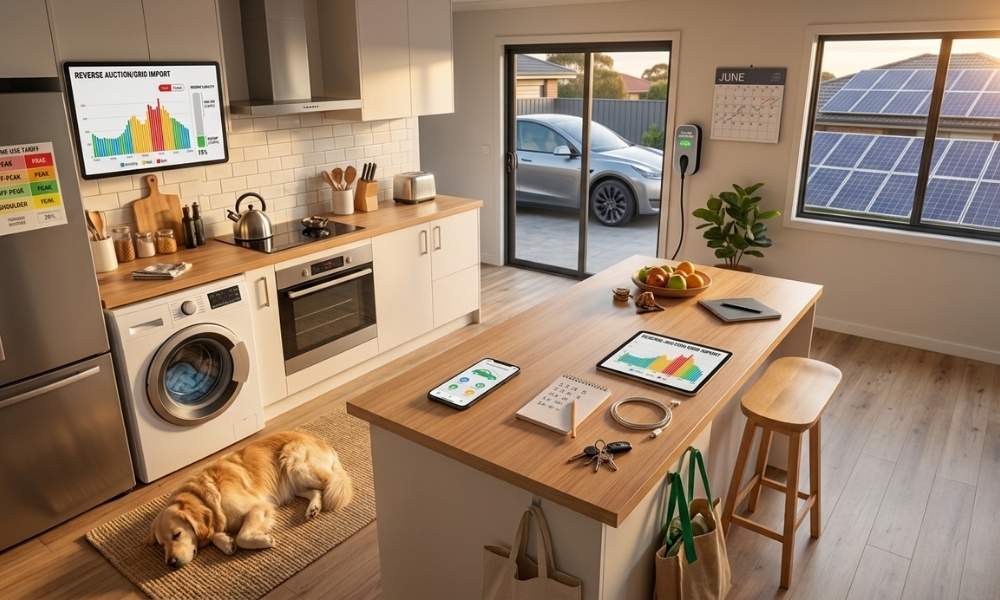
There was a time when owning solar panels required almost no thought. The system went on the roof, the bills went down, and life continued as normal. You didn’t manage it. You didn’t monitor it. On a good day, you might glance at the app, feel briefly satisfied, and move on.
That era ended the day an EV arrived in the driveway.
Adding an EV to a solar household sounds like a natural fit. In practice, a standard home wallbox charger draws around 7kW of continuous power, which is roughly the entire peak output of a mid-sized solar system. Plug the car in at the wrong moment and the household that was quietly exporting surplus solar is suddenly importing expensive grid power, with the family’s appliances and the car all competing for the same limited sunshine.
Welcome to the new Australian household dynamic nobody saw coming.
The solar pecking order
On a clear Saturday morning in a solar-and-EV household, the negotiations begin early.
The washing machine is already running a hot cycle on the towels. Someone has turned the dishwasher on. The kettle has been boiled twice. And then the car gets plugged in.
“Can you unplug the car for a bit? I need to run the oven.”
“The car’s only at 40%.”
“I’ll plug it back in after lunch.”
“What time is lunch?”
This conversation, or some version of it, is now happening in households every weekend. The solar system is generating a fixed amount of power. The household’s appetite for that power now significantly exceeds what the roof can supply all at once. Something has to give, and in the absence of any system to manage the competing demands, the system that gives is usually patience.
The pecking order that emerges tends to follow a rough hierarchy: hot water, cooking, the washing machine, and then the car. The car is last because it’s the most flexible, not needing to be finished by dinner time the way a roast does, and because plugging it in feels optional in a way that turning on the oven doesn’t.
In reality, the car needs to be charged by the time someone leaves for work on Monday morning, which makes it a lot less optional than it seems on Saturday afternoon.
The cloud panic
Even households that have managed to negotiate a working solar pecking order face a more unpredictable adversary: the Australian sky.
A clear winter morning in Sydney or Melbourne can turn overcast within 20 minutes. When it does, the solar system’s output drops sharply, sometimes 5-6 kW down to 1 or less. Any appliances running on assumed solar surplus are now drawing from the grid at rates of 30-40 cents per kWh. The EV charger, quietly pulling 7kW in the background, is suddenly an expensive background process nobody remembered to pause.
The result is what might be called cloud panic. Someone checks the app. Someone else looks out the window. There’s a rapid mental calculation of what’s currently running versus what the panels are producing. There’s a sprint to the garage, or a frantic tap through the charger app, to reduce the charge rate before the grid import bill climbs any further.
This is not a rare edge case. Winter in southern and coastal Australia involves enough variable cloud cover that this scenario plays out regularly. And for households managing it manually, it requires a level of attention to the weather that starts to feel less like energy management and more like a part-time job.
The work-from-home solar privilege
The most quietly contentious dynamic in the solar-and-EV household is one that rarely gets named directly.
The partner who works from home, or who works hybrid days at home during the week, has access to the solar in down from approximately 10am to 2pm on every day they’re not in an office. They can plug the car in at 10:30am, charge it during peak solar generation, unplug it at 1pm, and arrive at pickup with a fully charged vehicle that cost them almost nothing to run.
The partner who commutes to an office 5 days a week arrives home at 6:30pm. The panels finished generating hours ago. Peak electricity pricing is in full effect. Plugging the car in now means charging at 35-40 cents per kWh from the grid, which is the opposite of the free solar charging the other person has been quietly enjoying all week.
Both people live in the same house, pay the same electricity bill, and own the same EV. Their actual charging cost per kilometre can differ by a factor of 5 or more depending on when each of them happens to be home.
Nobody sets out to create this inequity. It’s simply what happens when solar generation is fixed to daylight hours and household members have different schedules. The work-from-home partner isn’t doing anything wrong. The office commuter is not being penalised for anything. The system was just not designed with this in mind.





The maths behind the friction
The frustration these households feel isn’t just about domestic negotiation. There’s a specific financial logic driving it.
Solar FiTs, the rate paid for surplus electricity exported to the grid, now sit between 3 and 7 cents per kWh for most households. The rate at which those same households buy electricity back from the grid, particularly during peak evening hours, runs from 30-40 cents per kWh or higher in some states.
That gap, selling at 5 cents and buying back at 35, is why every kWh of solar used directly in the home is worth 7 times more than one exported. The financial motivation to consume your own solar generation rather than send it to the grid has never been stronger.
Which means the EV, sitting in the driveway, capable of absorbing all of the day’s solar surplus if charged at the right time, is either a significant financial asset or a significant missed opportunity, depending entirely on when it gets plugged in.
The overlap trap makes this concrete. A solar system producing 6kW at noon sounds comfortable. Add a 7kW EV charger and the household is already importing 1kW from the grid before anything else is running. Add the washing machine at 2kW and the kettle at 2 kW and the house is suddenly importing 5kW from the grid, quietly, invisibly, while everyone assumes the solar is handling it.
The panels are doing their job. The household’s consumption has simply outpaced them without anyone noticing.
How smart chargers brokered the peace
The households that have stopped having this argument aren’t the ones that negotiated better. They’re the ones that removed the need to negotiate at all.
A smart EV charger with solar tracking uses a sensor in the switchboard to monitor the household’s electricity generation and consumption in real time. Rather than drawing a fixed 7kW regardless of what the solar system is producing, it adjusts the charge rate continuously to match only the surplus available after the home’s other loads are accounted for.
When the washing machine turns on, the charger automatically reduces its draw so the total remains within what the panels can supply. When the washing machine finishes, the charger ramps back up. When a cloud reduces solar output, the charger throttles down to match. When the sun returns, it increases again. The car still charges, the household appliances still run, and nothing draws from the grid unless generation genuinely can’t keep up.
For the office commuter to arrive home at 6:30pm, a smart charger can also be set to schedule overnight charging during off-peak hours, when grid electricity is significantly cheaper than peak rates. It’s not the solar-charged scenario that their partner enjoys during the day, but it’s the cheapest available alternative.
The cloud panic stops. The Saturday morning negotiation about the over and the car and the towels largely disappears. The charger handles it.
It doesn’t fix the work-from-home solar privilege. That’s a structural advantage of schedule. But it doesn’t man that the office commuter’s evening charging is at least optimised for the cheapest available rate, rather than drawing peak-rate power because nobody remembered to set a timer.
The actual state of the modern solar household
Solar and an EV is one of the best financial combinations available to a household in 2026. The fuel cost per kilometre drops dramatically. The solar self-consumption rate increases. The payback period on both investments shortens.
It’s also, without any management at all, one of the easiest ways to accidentally spend more on grid electricity than you did before either technology was installed.
The difference between those 2 outcomes is not the equipment, but whether the equipment is managed. A smart charger is the lowest-friction version of that management, the one that requires the least ongoing attention and delivers the most consistent result.
The sunshine is still fixed. The roof still produces what it produces. The only question is whether the household captures it deliberately or argues about it on Saturday mornings.