





Global tensions around the Strait of Hormuz tend to feel distant; something for governments and oil markets to worry about. But when a key shipping route tightens, the effects don’t stay offshore for long. They show up in fuel prices, transport costs, and eventually, everyday household expenses.
For most Australians, that link isn’t always obvious. Energy bills might look local, and rooftop solar can give a sense of independence. But behind the scenes, much of daily life still depends on oil moving smoothly through global supply chains.
That’s what moments like this reveal. Not just where energy comes from, but how exposed a typical home still is when fuel becomes harder to access or more expensive.
Trace where oil shows up in your daily life
Most homes don’t think of themselves as “running on oil,” but it shows up in more places than expected — and not always directly.
- Petrol (daily travel): Commuting, school runs, errands. This is the most immediate exposure when prices rise.
- Freight and deliveries: Groceries, online orders, building materials. Transport runs on diesel, and those costs flow straight into what you pay.
- Gas in the home: Cooking, heating, hot water. While not oil, gas prices often move with global energy markets.
- Electricity pricing: Not directly oil-based, but still influenced by broader energy costs during periods of volatility.
Put together, it’s a system that still relies on fuel moving globally. When that flow is disrupted, the impact reaches into everyday household spending faster than most people expect.
Watch what changes first when oil prices spike
When fuel supply tightens, the impact doesn’t hit everything at once. It moves in stages, and most households feel it sooner than they expect.
- Fuel prices jump first: This is immediate. Petrol and diesel respond quickly to global disruptions, often within days.
- Transport costs follow: As fuel becomes more expensive, moving goods costs more. This affects logistics, freight, and services that rely on transport.
- Every day prices start to rise: Groceries, deliveries, and materials begin to reflect higher transport and production costs.
- Energy bills begin to shift: Not always instantly, but broader energy market pressure can push electricity and gas prices higher over time.
The key point is timing. You don’t need a full supply crisis to feel the effects—just enough disruption to push prices up. And once that happens, the impact spreads quickly across everyday spending.
Why having solar doesn’t mean you’re protected
Rooftop solar changes how you generate electricity, but it doesn’t remove your exposure to fuel. Most households still rely on petrol for daily travel and gas for cooking, heating, or hot water, all of which remain tied to global energy markets.
There’s also a timing gap. Solar generation peaks in the middle of the day, while most energy use happens in the morning and evening. That means households often export excess solar when it’s least valuable, then buy energy back later when prices are higher.
This is where the mismatch happens. You can be generating clean energy and still be exposed to rising fuel costs across the rest of your home.




What keeps working when a home is electrified
Electrification isn’t something you just turn on with one switch. Instead, it’s a series of changes across how your home uses energy. The table below shows where fuel exposure typically sits, and what actually changes when those areas are electrified.
| Area of the home | Typical setup (fuel exposure) | Electrified alternative | What changes in a fuel shock |
| Transport (daily driving) | Petrol or diesel car | Electric vehicle (EV) | Running costs shift from fuel to electricity, which can be partly self-generated with solar |
| Second car / short trips | Petrol car used for short distances | EV or e-bike | Short, frequent trips become near-zero cost when powered by solar |
| Hot water | Gas storage or instant system | Heat pump hot water | Can run during midday solar peaks instead of relying on gas pricing |
| Cooking | Gas cooktop | Induction cooktop | Removes exposure to gas supply and improves efficiency indoors |
| Space heating | Gas heater or portable heaters | Reverse-cycle air conditioning | Lower running costs and no dependence on gas price fluctuations |
| Pool heating / pumps | Gas pool heater, fixed-time pumps | Electric heat pump + timer/smart control | Can shift energy use to daytime solar instead of peak electricity periods |
| Laundry (washing/drying) | Hot water wash + conventional dryer | Cold wash + heat pump dryer | Reduces total energy demand and avoids peak-time electricity use |
| Outdoor equipment | Petrol mower, blower, tools | Electric garden equipment | Removes small but frequent fuel purchases |
| Backup cooking (during outages) | Gas reliance | Battery + electric appliances | Maintains functionality without needing gas supply |
| Electricity usage timing | Fixed morning/evening usage | Smart scheduling (timers, apps) | Aligns consumption with solar generation, reducing grid reliance |
| Energy storage (optional) | No storage | Battery system | Stores excess solar for night use, reducing exposure to price spikes |
| EV charging behaviour | Charging at night (grid-dependent) | Daytime solar charging | Maximises use of self-generated energy instead of buying from the grid |
What this shows
Most homes aren’t fully dependent on fuel, but they’re not fully insulated either. The biggest gap isn’t solar generation, but how energy is used across the home.
Some of these changes are obvious. Others, like shifting when appliances run or replacing small petrol tools, are easy to overlook but still reduce exposure over time.
Taken together, electrification becomes less about a single upgrade and more about removing fuel from as many everyday touchpoints as possible.
Where electrification starts to make a real difference
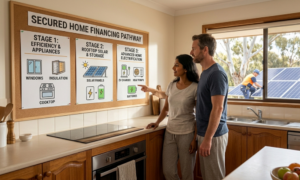
Electrification doesn’t need to happen all at once to change your exposure. The biggest gains come from targeting the parts of the home that rely most heavily on fuel and switching those first.
Transport is usually the tipping point. Petrol is often the largest and most immediate expense in a household budget, so reducing or replacing it has the fastest impact. Even partial shifts—like using an EV for short trips or daily commuting—start to break that link to oil prices.
Hot water is another high-impact change. It runs every day, often unnoticed, and switching from gas to a heat pump system moves that energy use into something that can align with solar generation.
From there, it becomes about tightening the gaps. Adjusting when appliances run, using more electricity during solar hours, and gradually replacing gas appliances reduce reliance step by step. A battery can add another layer of control, but it’s not where most households need to start.
The shift is gradual, but the effect compounds. Each change removes one more dependency on fuel, and over time, that’s what turns a home from exposed to more resilient.
How exposed is your home to the next fuel shock?
You don’t need a full crisis to test this. A simple way to understand your exposure is to look at what would change if fuel prices rose sharply—and how quickly you’d feel it.
- If petrol doubled tomorrow, what would change first?
Daily travel is usually the most immediate pressure point. - If deliveries and transport costs rise, where do you notice it?
Groceries, online orders, and services all start to creep up in price. - If gas prices increase, what in your home is affected?
Cooking, hot water, heating—often without obvious alternatives in place. - If electricity prices shift, when do you rely on the grid most?
Morning and evening usage can still be fully exposed without load shifting or storage.
Most households won’t tick every box, but if several of these hit at once, the impact adds up quickly. That’s the difference between having solar and being insulated from broader energy shocks.
Electrification doesn’t remove every cost, but it changes how many of these pressures apply and how much control you have when they do.
The real takeaway isn’t about what happens in the Strait of Hormuz; it’s what it reveals at home. The more your household depends on fuel, the more exposed you are when global markets shift. Electrification doesn’t remove every cost, but it reduces how much of your day-to-day life is tied to them.
Energy Matters has been in the solar industry since 2005 and has helped over 40,000 Australian households in their journey to energy independence.
Complete our quick Solar Quote Quiz to receive up to 3 FREE solar quotes from trusted local installers – it’ll only take you a few minutes and is completely obligation-free.