












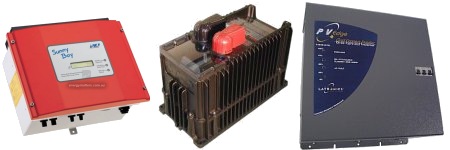
In the context of renewable energy, solar inverters or power inverters are devices that will convert DC battery/solar panel voltage into mains type AC power; suitable for use in your home or business.
Check out our huge range of true sine wave inverters
Without this conversion from DC to AC, special appliances or adapters often need to be purchased – and DC appliances are often more expensive than their AC counterparts. A solar inverter is an integral part of a system, but attention to this aspect is often overlooked. You can have the best solar panels available, but if your solar inverter is of poor quality, overall system performance can be greatly impacted.
- Solar inverters ratings
- Modified sine wave and true sine wave inverters compared
- Modified sine wave inverters
- True sine wave (digital) inverters
- Converting a modified sine wave inverter into a true sine wave inverter?
- Grid connect inverters – true or modified sine wave?
- Non-grid connect inverter tips
Solar Inverters ratings
The ratings that you should look at when buying solar inverters (depending on the type) are:
- Continuous Rating: This is the amount of power you could expect to use continuously without the inverter overheating and shutting down.
- Half Hour Rating: This is handy as the continuous rating may be too low to run a high energy consumption power tool or appliance, however if the appliance was only for occasional use then the half hour rating may well suffice.
- Surge Rating: A high surge is required to start some appliances and once running they may need considerably less power to keep functioning. The inverter must be able to hold its surge rating for at least 5 seconds. TVs and refrigerators are examples of items that require only relatively low power once running, but require a high surge to start.
- IP rating – defines the ability of the inverter seals to prevent water and dust ingress. Although some inverter manufacturers claim high IP ratings suitable for outdoor installation, the quality and location of the seals and ventilation will greatly affect the ability of the inverter to outlast the many years solar installations are expected to work.
- Peak efficiency – represents the highest efficiency that the inverter can achieve
Modified sine wave and true sine wave inverters compared
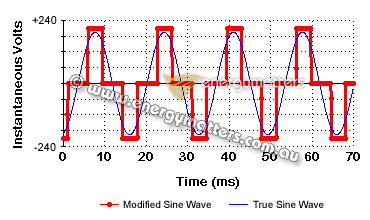
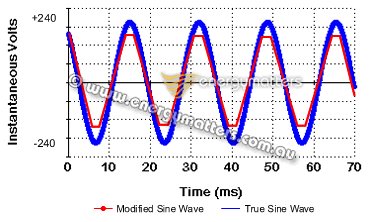
There are basically two types of inverters: modified sine wave (aka modified square wave) and true sine wave. The differences between these two types of inverters are subtle but significant in the way they operate.
Examples of modified “sine” wave vs true sine wave:
Modified sine wave inverters
A modified sine wave inverter can adequately power some household appliances and power tools. It is cheaper, but may present certain compromises with some loads such as computers, microwave ovens, laser printers, clocks and cordless tool chargers. Virtually all low cost power inverters are “modified sine wave”. A modified sine wave is easier and cheaper to produce than a sine wave inverter.
It is also a fact that cheaper modified sine wave inverters have given this type of inverter a bad name. These low cost inverters are generally available from electrical stores, hardware stores, automotive store and electronic suppliers. They usually lack many features such as auto-start or any type of tweaking ability. The devices are usually about 70% efficient, so expect some significant power losses if you are using a modified sine wave inverter in your system. We do not sell such devices.
True sine wave inverters
A true sine wave inverter, also known as a digital inverter, has a design to replicate and even improve the quality of electricity supplied by utility companies. To operate higher-end electronic equipment, experts recommend a sine wave inverter. Efficiency has reached up to about 98% and the electricity from these devices is of a higher quality than grid power almost anywhere in the world.
We only sell this kind of solar inverter for grid connect and off-grid applications.
A high quality solar inverter for off grid applications will include:
- An auto-start system. An auto start allows an inverter to switch to a low power consumption standby state when nothing is connected and turned on. This will save you a lot of manual switching and/or wasted power
- Tweaking ability. An ability to adjust parameters such as auto-start and battery depth of discharge (for off grid systems) is also helpful.
- High quality heavy-duty power transformer. A heavy inverter usually means a high quality heavy-duty power transformer.
Even among sine wave inverters, there’s a great deal of difference in quality. Cheap imports are flooding our shores and in many cases, these devices will be inefficient and may pose safety issues. A long warranty is no guarantee of quality as companies can shut up shop overnight, rendering the warranty useless. Ensure you purchase a solar inverter that has undergone independently testing and has a demonstrated history of reliable operation for Australia’s often harsh conditions.
Converting a modified sine wave inverter into a true sine wave
inverter
If you have an modified sine wave inverter and suspect you need a true sine wave inverter, please note there is no ‘filter’ or ‘retrofit’ you can apply to the output of an modified sine wave inverter to clean up the output or turn it into true sine wave.
Grid connect inverters – true or modified sine wave?
All grid connect solar inverters, such as those used in systems connected to mains electricity, are true sine wave units. While all grid connect power inverters sold in Australia must meet minimum standards and be approved for use in conjunction with mains electricity. Not all solar inverters are created equal as this video clearly shows.
Grid connect solar inverters endure high and varying voltage levels, extreme temperature ranges, moisture and dust. Quality power inverters are the key to the safety, efficiency, reliability, and usability of solar power systems.
Non-grid connect inverter tips:
In general, any device that senses either voltage peaks or zero crossings could have problems when running from modified sine wave. Devices such as these should run from true sine wave inverters.
Ham radio and CB radio operators may notice RF noise from modified sine wave inverters; in that case do not run the radio and the inverter at the same time. Electronics that modulate RF (radio frequency) signals on the AC line will not work and may suffer damage. You may notice hum or buzz in the audio of TV’s, radios and satellite systems used with modified sine wave inverters. Audiophiles or professionals using sophisticated audio, remote measurement, surveillance or telemetry equipment should use true sine wave.
Examples of problem devices are motor speed controllers employing triacs, and some small battery rechargers that do not incorporate a transformer between the utility power and the load. To help you visualize this, if there isn’t a ‘wall wart’ between the battery charger (or the battery in the device) and the AC plug, don’t use modified sine wave.
What are problem load appliances for inverters?
Please note two other common problem loads: electric shavers and emergency flashlights. Both of these items have batteries in them but connect directly into the wall to charge, without an external transformer. Don’t use items like these with an modified sine wave inverter. If you do use an modified sine wave inverter with a transformer-less charger, your product will likely suffer damage.
Garage door openers, laser printers and large strobes for photography are reportedly trouble loads for modified sine wave inverters. They either don’t work at all or stop working entirely, so don’t take a chance – use true sine wave.
As a general rule, products operating through an AC adapter will work fine from an modified sine wave inverter. These include laptops and cell phone chargers, video games, camcorder and digital camera chargers. Televisions generally work well; some VCR’s with inexpensive power supplies run poorly. Consider switching to another brand of VCR in that case.
A potential solution for RV’ers or off-grid cottagers is to purchase our smallest true sine wave inverter to run TV, VCR and audio equipment, and a larger modified sine wave inverter (such as the XPower 1750 Plus) for the coffee maker, hair dryer and microwave.
Related:
Micro Vs. String Vs. Central Power Inverters
Buy off grid / grid connect power inverters
Whether it’s a grid connect solar inverter you need or small 12 volt power inverters for off-grid use; we have the range, brands and prices that are sure to impress! If you’re not sure which is the best solar inverter in Melbourne for your requirements, our friendly team will gladly help you with expert advice.